
U.S. Initial Jobless Claims Rise to 219,000 Amid Stable Labor Market
Here's what it means for you.
If you're navigating the global job market, understanding U.S. employment trends can influence your strategic decisions.
Why it matters
The increase in jobless claims signals potential shifts in hiring practices, impacting global economic stability and job security.
What happened (in 30 seconds)
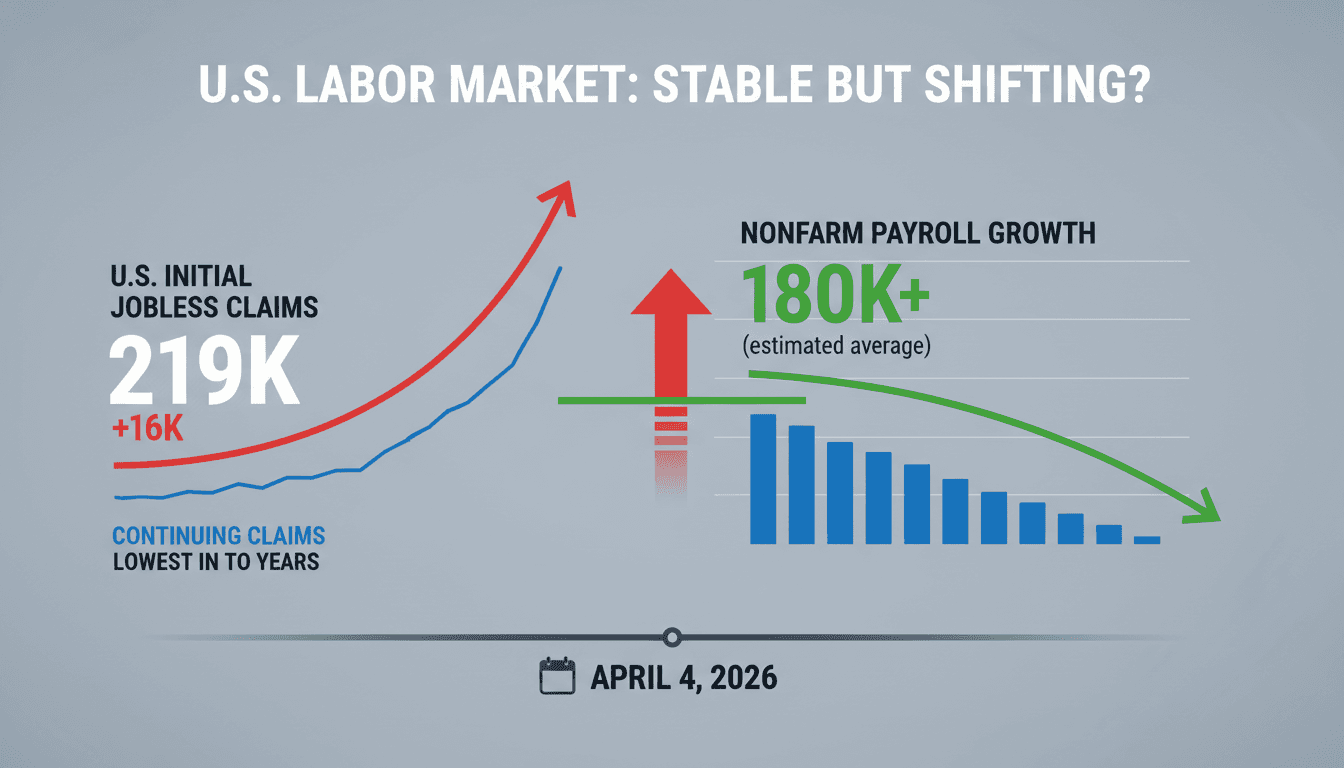
- Initial jobless claims rose to 219,000 for the week ending April 4, 2026, an increase of 16,000 from the previous week.
- Continuing claims fell to 1.794 million, the lowest level in nearly two years, indicating fewer layoffs.
- The labor market remains stable, with claims within the historical range of 200,000 to 250,000, despite moderating job growth.
The context you actually need
- Post-pandemic recovery has stabilized U.S. jobless claims between 200,000 and 250,000, reflecting a resilient labor market.
- Monthly job gains averaged fewer than 200,000 in 2025, a significant drop from 1.5 million in 2024, indicating a cooling hiring environment.
- Unemployment rate stands at 4.3 percent, with revisions to prior months' figures suggesting a more cautious labor market outlook.
What's really happening
The latest data from the U.S. Department of Labor shows an uptick in initial jobless claims, which rose to 219,000 for the week ending April 4, 2026. This increase of 16,000 from the previous week’s revised figure of 203,000 was above economists' expectations of 210,000. However, the continuing claims for the week ending March 28 fell to 1.794 million, marking the lowest level in nearly two years. This juxtaposition of rising initial claims alongside declining continuing claims highlights a complex labor market dynamic.
The four-week moving average of initial claims also rose to 209,500, indicating a slight upward trend. Yet, the insured unemployment rate remained steady at 1.2 percent, suggesting that while new claims are increasing, the overall number of people relying on unemployment benefits is decreasing. This reflects a labor market that, while showing signs of strain, remains fundamentally stable.
The labor market has shown resilience despite a slowdown in hiring. In 2025, monthly job gains averaged fewer than 200,000, a stark contrast to the robust recovery seen in 2024. The March 2026 nonfarm payrolls added 178,000 jobs, indicating that while the economy is still creating jobs, the pace has moderated. This moderation can be attributed to various factors, including economic uncertainty and shifts in consumer demand, which have led employers to adopt a more cautious approach to hiring.
Economists view the rise in jobless claims as modest and not indicative of an impending recession. Instead, it reflects a labor market adjusting to new economic realities, where layoffs are still relatively low, as evidenced by the decline in continuing claims. The mixed reactions in the markets, with spot gold prices advancing amid the data, suggest that investors are closely monitoring these trends for broader economic implications.
Who feels it first (and how)
- Job seekers: Those entering or transitioning within the job market may face increased competition as hiring slows.
- Employers: Companies may adjust hiring strategies and budgets in response to fluctuating jobless claims.
- Investors: Market participants will closely watch labor market indicators to gauge economic health and investment opportunities.
What to watch next
- Future jobless claims: Continued monitoring of initial and continuing claims will provide insights into labor market trends and potential economic shifts.
- Nonfarm payroll reports: Upcoming monthly payroll data will reveal whether job growth continues to slow or stabilizes, impacting economic forecasts.
- Consumer spending trends: Changes in consumer behavior can influence hiring patterns, making it essential to track retail sales and spending reports.
Initial jobless claims have risen to 219,000, indicating a slight increase in unemployment filings.
The labor market will continue to show resilience, but hiring may remain subdued as employers adjust to economic conditions.
The long-term impact of these trends on the overall economy and potential recession risks remains uncertain.
Frequently Asked Questions
- Why it matters?
- The increase in jobless claims signals potential shifts in hiring practices, impacting global economic stability and job security.
- What happened (in 30 seconds)?
- Initial jobless claims rose to 219,000 for the week ending April 4, 2026, an increase of 16,000 from the previous week. Continuing claims fell to 1.794 million, the lowest level in nearly two years, indicating fewer layoffs. The labor market remains stable, with claims within the historical range of 200,000 to 250,000, despite moderating job growth.
- What's really happening?
- The latest data from the U.S. Department of Labor shows an uptick in initial jobless claims, which rose to 219,000 for the week ending April 4, 2026. This increase of 16,000 from the previous week’s revised figure of 203,000 was above economists' expectations of 210,000. However, the continuing claims for the week ending March 28 fell to 1.794 million, marking the lowest level in nearly two years. This juxtaposition of rising initial claims alongside declining continuing claims highlights a comp
- Who feels it first (and how)?
- Job seekers: Those entering or transitioning within the job market may face increased competition as hiring slows. Employers: Companies may adjust hiring strategies and budgets in response to fluctuating jobless claims. Investors: Market participants will closely watch labor market indicators to gauge economic health and investment opportunities.
- What to watch next?
- Future jobless claims: Continued monitoring of initial and continuing claims will provide insights into labor market trends and potential economic shifts. Nonfarm payroll reports: Upcoming monthly payroll data will reveal whether job growth continues to slow or stabilizes, impacting economic forecasts. Consumer spending trends: Changes in consumer behavior can influence hiring patterns, making it essential to track retail sales and spending reports.
Conservative-leaning political and national coverage.
"The Washington Times is a conservative-leaning newspaper known for its political coverage and advocacy of right-of-center viewpoints."
— A47 Editor
U.S. filings for jobless aid jump to 219K last week but remain within stable range of past few years
U.S. applications for unemployment benefits increased to 219,000 last week, indicating a rise in jobless claims while remaining within a stable range observed over the past few years. This uptick comes amid a backdrop of geopolitical developments, in...
Social/economic commentary and analysis relevant to business and markets.
"WSJ blends data-driven economic insight with commentary on policy and society."
— A47 Editor
U.S. Jobless Claims Rose More Than Expected Last Week
U.S. jobless claims rose unexpectedly last week, reaching their highest level since February, with initial claims reported at 210,000 for the week ending April 4. This increase follows a strong jobs report in March, where 178,000 jobs were added, sug...