
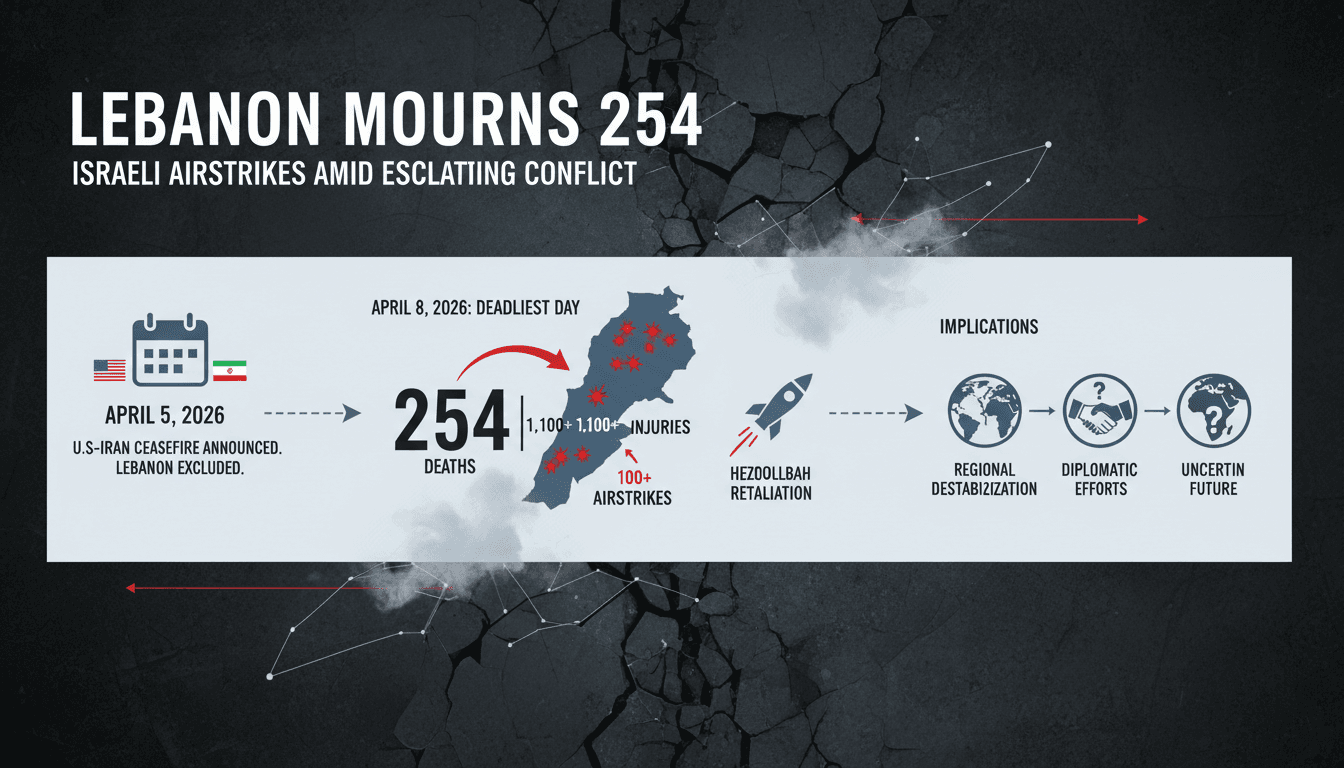
Lebanon mourns 254 casualties from Israeli airstrikes amid escalating conflict
Here's what it means for you.
The escalating conflict in Lebanon could impact global markets and regional stability, affecting your investments and travel plans.
Why it matters
The airstrikes have heightened geopolitical tensions, threatening stability in the Middle East, which can ripple through global oil prices and security dynamics.
What happened (in 30 seconds)
- On April 8, 2026, Israel executed over 100 airstrikes across Lebanon, killing 254 and injuring over 1,100.
- Prime Minister Nawaf Salam declared April 9 a national day of mourning as hospitals struggled to cope with the casualties.
- Hezbollah responded with retaliatory rocket fire, further escalating the conflict amid ongoing ceasefire discussions.
The context you actually need
- The 2026 Lebanon war intensified after Hezbollah resumed rocket attacks on Israel in March, aligning with Iran amid U.S.-Iran tensions.
- A U.S.-Iran ceasefire was announced on April 7, but Israel claimed it did not apply to Lebanon, leading to confusion and conflict.
- Lebanon's infrastructure is already fragile, and the airstrikes have overwhelmed hospitals and emergency services, exacerbating humanitarian crises.
What's really happening
The recent airstrikes represent a significant escalation in the ongoing conflict between Israel and Hezbollah, rooted in a complex web of regional politics and military strategies. On April 8, the Israel Defense Forces (IDF) launched Operation Eternal Darkness, targeting over 100 Hezbollah sites with precision airstrikes. This operation was executed with a rapid deployment of 50 jets releasing 160 munitions within a mere 10 minutes, indicating a high level of military coordination and intent to inflict substantial damage on Hezbollah's capabilities.
The strikes were not just a military tactic but also a strategic message. Israel aimed to dismantle Hezbollah's operational infrastructure, including command centers and missile sites, to establish a buffer zone in southern Lebanon. However, the strikes resulted in significant civilian casualties, with 254 reported deaths, including many in Beirut and surrounding areas. This has drawn widespread condemnation from Lebanese officials, who labeled the attacks as "barbaric aggression," while Israel defended its actions as necessary to target militant threats.
The geopolitical implications are profound. The airstrikes occurred against the backdrop of a tenuous U.S.-Iran ceasefire, which was perceived differently by the involved parties. While the U.S. and Israel maintained that the ceasefire did not apply to Lebanon, Iran and Hezbollah claimed it did, leading to a breakdown in communication and trust. This situation has the potential to destabilize the region further, as both sides prepare for possible escalations.
As the conflict intensifies, Lebanon's already strained healthcare system faces catastrophic overload. Hospitals are overflowing with casualties, and the Lebanese Civil Defense has been stretched thin, struggling to manage the influx of injured civilians. The humanitarian crisis is likely to worsen, with the potential for increased displacement and suffering among the Lebanese population.
In the broader context, the airstrikes have implications for global markets, particularly oil prices, which are sensitive to Middle Eastern conflicts. The threat of instability in the Strait of Hormuz, a critical oil shipping route, has already led to fluctuations in oil prices, affecting economies worldwide. Investors and businesses must remain vigilant as the situation evolves, as further escalations could lead to more significant disruptions in global supply chains.
Who feels it first (and how)
- Lebanese civilians: Directly impacted by casualties and infrastructure damage, facing a humanitarian crisis.
- Healthcare workers: Overwhelmed by the influx of injured individuals, struggling to provide care.
- Expatriates in Dubai: More than 100,000 Lebanese expatriates are anxious about family safety and communication challenges.
- Investors: Those with stakes in Middle Eastern markets may see volatility in oil prices and regional investments.
What to watch next
- Ceasefire negotiations: Monitor any developments in talks between Israel, Hezbollah, and international mediators, as these could influence regional stability.
- Oil price fluctuations: Watch for changes in oil prices, particularly if tensions escalate further, impacting global markets.
- Humanitarian response: Observe international responses to the humanitarian crisis in Lebanon, including aid efforts and potential sanctions.
The airstrikes resulted in significant civilian casualties and a national day of mourning in Lebanon.
Continued military engagement from both Israel and Hezbollah, with potential for further escalation.
The long-term implications for U.S.-Iran relations and their impact on regional stability.
Frequently Asked Questions
- Why it matters?
- The airstrikes have heightened geopolitical tensions, threatening stability in the Middle East, which can ripple through global oil prices and security dynamics.
- What happened (in 30 seconds)?
- On April 8, 2026, Israel executed over 100 airstrikes across Lebanon, killing 254 and injuring over 1,100. Prime Minister Nawaf Salam declared April 9 a national day of mourning as hospitals struggled to cope with the casualties. Hezbollah responded with retaliatory rocket fire, further escalating the conflict amid ongoing ceasefire discussions.
- What's really happening?
- The recent airstrikes represent a significant escalation in the ongoing conflict between Israel and Hezbollah, rooted in a complex web of regional politics and military strategies. On April 8, the Israel Defense Forces (IDF) launched Operation Eternal Darkness, targeting over 100 Hezbollah sites with precision airstrikes. This operation was executed with a rapid deployment of 50 jets releasing 160 munitions within a mere 10 minutes, indicating a high level of military coordination and intent to
- Who feels it first (and how)?
- Lebanese civilians: Directly impacted by casualties and infrastructure damage, facing a humanitarian crisis. Healthcare workers: Overwhelmed by the influx of injured individuals, struggling to provide care. Expatriates in Dubai: More than 100,000 Lebanese expatriates are anxious about family safety and communication challenges. Investors: Those with stakes in Middle Eastern markets may see volatility in oil prices and regional investments.
- What to watch next?
- Ceasefire negotiations: Monitor any developments in talks between Israel, Hezbollah, and international mediators, as these could influence regional stability. Oil price fluctuations: Watch for changes in oil prices, particularly if tensions escalate further, impacting global markets. Humanitarian response: Observe international responses to the humanitarian crisis in Lebanon, including aid efforts and potential sanctions.
24/7 international news from a French perspective in multiple languages.
"France 24 is viewed as a globally focused outlet with balanced coverage and a European perspective."
— A47 Editor
Lebanon declares day of mourning after over 250 killed in Israeli attacks
Lebanon has declared a national day of mourning following a series of Israeli airstrikes that resulted in over 250 fatalities and more than 1,000 injuries, marking one of the deadliest days in the ongoing conflict. The attacks occurred despite a ceas...
Comprehensive coverage of Middle Eastern and global issues.
"Al Jazeera is a prominent voice from the Global South, especially the Middle East, with an emphasis on underreported stories."
— A47 Editor
Lebanon Latest: Israel kills hundreds in one day
Israel has launched a series of airstrikes across Lebanon, resulting in hundreds of fatalities, despite a ceasefire agreement between the United States and Iran. The attacks have particularly targeted neighborhoods in Beirut, leading to widespread pa...
Global news coverage with extensive reporting on Middle Eastern conflicts and geopolitics.
"Al Jazeera is a Qatar-based broadcaster known for wide regional coverage and alternative perspectives."
— A47 Editor
Iran war day 41: What’s happening in Lebanon, Middle East and beyond?
Lebanon has declared a national day of mourning following a devastating series of Israeli airstrikes that resulted in at least 254 fatalities in a single day, marking one of the deadliest moments in the ongoing conflict. The strikes have particularly...
Comprehensive coverage of Middle Eastern and global issues.
"Al Jazeera is a prominent voice from the Global South, especially the Middle East, with an emphasis on underreported stories."
— A47 Editor
Iran war day 41: What’s happening in Lebanon, Middle East and beyond?
Lebanon has declared a national day of mourning following a devastating series of Israeli airstrikes that resulted in at least 254 fatalities in a single day, marking one of the deadliest moments in the ongoing conflict. The strikes have particularly...