
External actors prolong Sudan's civil war into fourth year with arms supplies and resource exploitation
Here's what it means for you.
The ongoing conflict in Sudan could disrupt global supply chains and impact commodity markets, particularly in gold and agricultural products.
Why it matters
The civil war in Sudan is a critical flashpoint in a region where geopolitical interests intersect with humanitarian crises.
What happened (in 30 seconds)
- Conflict erupted on April 15, 2023, between the Sudanese Armed Forces (SAF) and Rapid Support Forces (RSF) over power-sharing disputes.
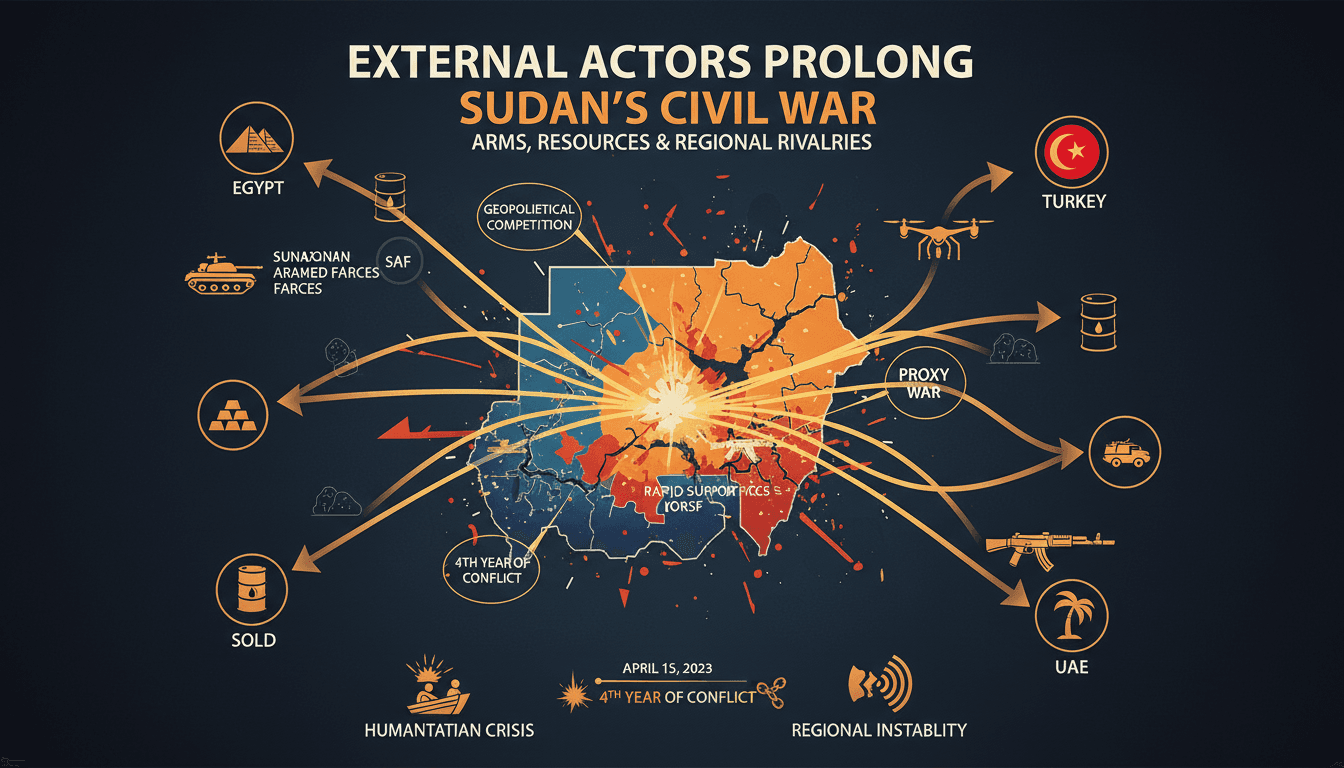
- External actors like Egypt, Russia, Iran, and Turkey are supplying arms to SAF, while the UAE allegedly supports RSF through smuggling networks.
- As of April 2026, the war has led to a military stalemate, with 14 million people displaced and ongoing drone warfare escalating the violence.
The context you actually need
- The war stems from a 2021 military coup that ousted a transitional government, igniting tensions between SAF and RSF.
- Geopolitical rivalries are intensifying as regional powers vie for control over Sudan's rich resources, including gold and access to the Nile.
- The conflict has transformed into a proxy war, with arms flowing through neighboring countries like Eritrea, Chad, and Libya, complicating peace efforts.
What's really happening
The civil war in Sudan is not merely a local conflict; it is a complex interplay of internal power struggles and external geopolitical interests. The SAF and RSF, once allies in a coup against the transitional government, have devolved into bitter rivals, each backed by different foreign powers. This division has created a military stalemate, with SAF controlling key urban centers like Khartoum and RSF holding sway in the western regions, particularly Darfur.
External actors are deeply entrenched in this conflict. Egypt supports SAF, viewing a stable Sudan as crucial for its national security, particularly regarding the Nile waters. Meanwhile, the UAE's alleged support for RSF is driven by economic interests, particularly in gold mining, which has become a lucrative trade. The UAE's involvement is not just about arms; it is about securing access to resources that can bolster its own economy.
The war has led to a staggering humanitarian crisis, with 14 million people displaced since the conflict began. The international community has responded with pledges of aid, but these efforts are hampered by the ongoing violence and the complexities of negotiating with factions that have established parallel administrations. The UN has warned of famine and potential genocide in Darfur, highlighting the urgent need for intervention.
Drone warfare has escalated dramatically, with over 1,000 strikes reported since the conflict began. Both SAF and RSF have adopted advanced drone technology, sourced from their respective allies, which has changed the dynamics of ground combat. This reliance on aerial strikes has not only increased the lethality of the conflict but has also made it more challenging for humanitarian organizations to operate in affected areas.
As the war drags on, the prospect of a negotiated settlement appears increasingly remote. The Quad nations (US, Saudi Arabia, Egypt, UAE) have attempted mediation, but progress has stalled amid ongoing hostilities. The situation is further complicated by regional spillovers, with tensions rising along the borders of Chad and Ethiopia as they grapple with the influx of refugees and the destabilizing effects of the conflict.
Who feels it first (and how)
- Local civilians: Facing displacement, violence, and humanitarian crises, with millions in need of aid.
- Regional governments: Strained by refugee influx and border tensions, particularly in Chad and Ethiopia.
- International businesses: Companies involved in gold and agricultural exports may face supply chain disruptions and increased costs.
What to watch next
- International mediation efforts: Watch for any breakthroughs or setbacks in negotiations involving the Quad nations, as these will influence the conflict's trajectory.
- Humanitarian aid responses: Monitor the effectiveness of international aid pledges and their impact on the humanitarian situation in Sudan.
- Resource exploitation trends: Keep an eye on the gold market and how illicit trade routes may evolve as the conflict continues, affecting global supply chains.
The conflict has displaced 14 million people and created a humanitarian crisis.
Continued external support for both SAF and RSF will prolong the conflict and complicate peace efforts.
The potential for a negotiated settlement remains uncertain, as both sides have entrenched positions and external interests at play.
Frequently Asked Questions
- Why it matters?
- The civil war in Sudan is a critical flashpoint in a region where geopolitical interests intersect with humanitarian crises.
- What happened (in 30 seconds)?
- Conflict erupted on April 15, 2023, between the Sudanese Armed Forces (SAF) and Rapid Support Forces (RSF) over power-sharing disputes. External actors like Egypt, Russia, Iran, and Turkey are supplying arms to SAF, while the UAE allegedly supports RSF through smuggling networks. As of April 2026, the war has led to a military stalemate, with 14 million people displaced and ongoing drone warfare escalating the violence.
- What's really happening?
- The civil war in Sudan is not merely a local conflict; it is a complex interplay of internal power struggles and external geopolitical interests. The SAF and RSF, once allies in a coup against the transitional government, have devolved into bitter rivals, each backed by different foreign powers. This division has created a military stalemate, with SAF controlling key urban centers like Khartoum and RSF holding sway in the western regions, particularly Darfur. External actors are deeply entrench
- Who feels it first (and how)?
- Local civilians: Facing displacement, violence, and humanitarian crises, with millions in need of aid. Regional governments: Strained by refugee influx and border tensions, particularly in Chad and Ethiopia. International businesses: Companies involved in gold and agricultural exports may face supply chain disruptions and increased costs.
- What to watch next?
- International mediation efforts: Watch for any breakthroughs or setbacks in negotiations involving the Quad nations, as these will influence the conflict's trajectory. Humanitarian aid responses: Monitor the effectiveness of international aid pledges and their impact on the humanitarian situation in Sudan. Resource exploitation trends: Keep an eye on the gold market and how illicit trade routes may evolve as the conflict continues, affecting global supply chains.
Comprehensive coverage of Middle Eastern and global issues.
"Al Jazeera is a prominent voice from the Global South, especially the Middle East, with an emphasis on underreported stories."
— A47 Editor
Who is keeping the fight alive in Sudan’s war?
As Sudan approaches the third anniversary of its civil war, the ongoing conflict has resulted in widespread violence and humanitarian crises, displacing millions and causing thousands of deaths. The war, which began in April 2023, has devastated the ...
Global news coverage with extensive reporting on Middle Eastern conflicts and geopolitics.
"Al Jazeera is a Qatar-based broadcaster known for wide regional coverage and alternative perspectives."
— A47 Editor
Who is keeping the fight alive in Sudan’s war?
As Sudan approaches the third anniversary of its civil war, the ongoing conflict has resulted in widespread violence and humanitarian crises, displacing millions and causing thousands of deaths. The war, which began in April 2023, has devastated the ...
24/7 international news from a French perspective in multiple languages.
"France 24 is viewed as a globally focused outlet with balanced coverage and a European perspective."
— A47 Editor
Sudan's forgotten war: three years on, humanitarian catastrophe has no end in sight
Three years into the conflict in Sudan, the humanitarian situation remains dire, with over 11 million people displaced and tens of thousands dead. The war, which erupted in April 2023, has led to a persistent cycle of violence and deprivation, leavin...
Regional coverage and analysis focused on politics, diplomacy, and business across the Middle East.
"Al-Monitor is known for analytical reporting on Middle East politics and policy developments."
— A47 Editor
Explainer-Why is Sudan at war, and what is the impact?
The war in Sudan, which began in April 2023, has now entered its fourth year, marked by intense fighting between the Sudanese army, led by General Abdel Fattah al-Burhan, and the Rapid Support Forces, commanded by General Mohamed Hamdan Dagalo. The c...
24/7 international news from a French perspective in multiple languages.
"France 24 is viewed as a globally focused outlet with balanced coverage and a European perspective."
— A47 Editor
Sudan enters fourth year of war as officials lament 'abandoned crisis'
Sudan has entered its fourth year of war, which has been described as an 'abandoned crisis' by officials. The ongoing conflict has led to famine and widespread violence, forcing 13 million people to flee their homes. The humanitarian situation is dir...
International stories from NPR’s global desk.
"NPR is an American public media organization known for thoughtful reporting and a slightly left-leaning editorial tone."
— A47 Editor
'Humiliated, broken, powerless': Sudan enters fourth year of war
As Sudan enters its fourth year of conflict, the ongoing war between the army and a rival paramilitary group continues to inflict severe humanitarian crises across the nation, leading to mass displacement and widespread hunger. Reports indicate that ...
International coverage of politics, culture, and current affairs.
"BBC News is widely regarded as a reputable international news organization, known for its impartial tone and public service mandate."
— A47 Editor
The human cost of the war in Sudan, three years on
The conflict in Sudan, which began in April 2023, has resulted in a staggering human toll, with widespread violence and humanitarian crises displacing millions and causing thousands of deaths. As of April 2026, the war continues to devastate the nati...