
UK Prime Minister condemns Israeli airstrikes on Lebanon amid US-Iran ceasefire tensions
Here's what it means for you.
Rising tensions in the Middle East could lead to increased energy prices and economic uncertainty globally.
Why it matters
The ongoing conflict threatens to disrupt global energy markets and geopolitical stability.
What happened (in 30 seconds)
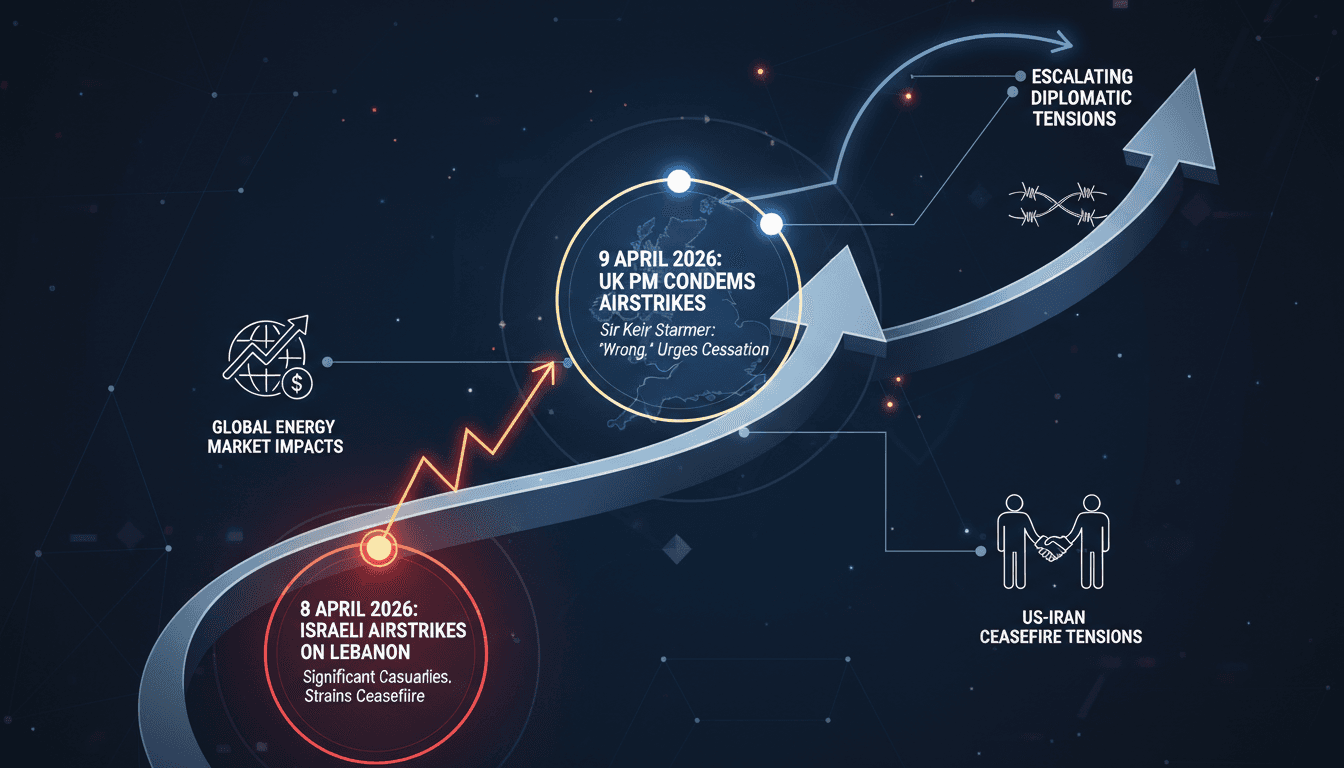
- On April 9, 2026, UK Prime Minister Sir Keir Starmer condemned Israeli airstrikes on Lebanon as "wrong" during an ITV interview.
- Israeli airstrikes on April 8 targeted over 100 Hezbollah sites, resulting in at least 303 deaths and over 1,150 injuries according to Lebanese health authorities.
- The US-Iran ceasefire, announced on April 7, is now strained, with Israel asserting its right to continue operations against Hezbollah, complicating diplomatic efforts.
The context you actually need
- The strikes follow a significant escalation in the US-Israel conflict with Iran, triggered by the assassination of Iranian Supreme Leader Ayatollah Ali Khamenei on February 28, 2026.
- Hezbollah's involvement in the conflict since March 2 has intensified regional hostilities, with the group claiming compliance with the ceasefire while also reporting retaliatory actions.
- International reactions have included condemnation from multiple countries, with calls for de-escalation and concerns over the broader implications for regional stability and energy markets.
What's really happening
The Israeli airstrikes on Lebanon mark a critical escalation in the ongoing conflict involving Iran and its allies, particularly Hezbollah. Following the assassination of Khamenei, the geopolitical landscape has shifted dramatically, with the US and Israel intensifying their military operations against Iranian interests in the region. The strikes on April 8 targeted Hezbollah positions across Lebanon, which Israel claims are legitimate military targets due to Hezbollah's role as an Iranian proxy.
The two-week ceasefire brokered by the US on April 7 was intended to stabilize the situation following disruptions in the Strait of Hormuz, a vital passage for global oil shipments. However, Israel's actions have effectively undermined this truce, as they assert that operations against Hezbollah are exempt from the ceasefire terms. This has led to a backlash from Iran and its allies, who view the strikes as a significant violation of the agreement, further complicating the diplomatic landscape.
The humanitarian toll of the airstrikes is severe, with reports of over 300 fatalities and more than 1,150 injuries. This raises urgent concerns about the humanitarian crisis in Lebanon, which is already grappling with economic instability and infrastructure challenges. The UK government, through Starmer and Foreign Secretary Yvette Cooper, has expressed deep concern over the strikes, labeling them as "deeply damaging" and risking further destabilization in the region.
The broader implications of these developments extend beyond immediate military concerns. The conflict has already begun to affect global energy markets, with Brent crude oil prices rising by 3% to $98 per barrel in response to the escalating tensions. This increase in energy costs will likely impact consumers and businesses worldwide, particularly in regions heavily reliant on oil imports.
Moreover, the situation is a litmus test for international diplomatic efforts to manage the conflict. With Israel rejecting calls for a ceasefire that includes Lebanon, the likelihood of further military engagements increases, potentially drawing in more regional players and exacerbating the crisis. The ongoing instability poses risks not only to the immediate parties involved but also to global economic stability, as energy prices and supply chains are affected.
Who feels it first (and how)
- Energy consumers: Higher oil prices will directly impact fuel costs for households and businesses.
- Middle Eastern nations: Countries in the region may face increased instability and security threats, affecting tourism and trade.
- Global investors: Fluctuations in energy prices could lead to market volatility, impacting investment portfolios and economic forecasts.
What to watch next
- Further military actions: Monitor for additional Israeli strikes or Hezbollah retaliations, as these could escalate tensions and affect regional stability.
- US diplomatic efforts: Watch for any shifts in US policy or statements regarding the ceasefire and its applicability to Lebanon, which could influence international responses.
- Energy market reactions: Keep an eye on oil prices and supply chain disruptions, as continued conflict may lead to further increases in energy costs.
The Israeli strikes resulted in significant casualties and have drawn international condemnation.
Continued military operations will further strain the US-Iran ceasefire and escalate regional tensions.
The long-term implications for global energy markets and economic stability remain uncertain as the situation evolves.
Frequently Asked Questions
- Why it matters?
- The ongoing conflict threatens to disrupt global energy markets and geopolitical stability.
- What happened (in 30 seconds)?
- On April 9, 2026, UK Prime Minister Sir Keir Starmer condemned Israeli airstrikes on Lebanon as "wrong" during an ITV interview. Israeli airstrikes on April 8 targeted over 100 Hezbollah sites, resulting in at least 303 deaths and over 1,150 injuries according to Lebanese health authorities. The US-Iran ceasefire, announced on April 7, is now strained, with Israel asserting its right to continue operations against Hezbollah, complicating diplomatic efforts.
- What's really happening?
- The Israeli airstrikes on Lebanon mark a critical escalation in the ongoing conflict involving Iran and its allies, particularly Hezbollah. Following the assassination of Khamenei, the geopolitical landscape has shifted dramatically, with the US and Israel intensifying their military operations against Iranian interests in the region. The strikes on April 8 targeted Hezbollah positions across Lebanon, which Israel claims are legitimate military targets due to Hezbollah's role as an Iranian proxy
- Who feels it first (and how)?
- Energy consumers: Higher oil prices will directly impact fuel costs for households and businesses. Middle Eastern nations: Countries in the region may face increased instability and security threats, affecting tourism and trade. Global investors: Fluctuations in energy prices could lead to market volatility, impacting investment portfolios and economic forecasts.
- What to watch next?
- Further military actions: Monitor for additional Israeli strikes or Hezbollah retaliations, as these could escalate tensions and affect regional stability. US diplomatic efforts: Watch for any shifts in US policy or statements regarding the ceasefire and its applicability to Lebanon, which could influence international responses. Energy market reactions: Keep an eye on oil prices and supply chain disruptions, as continued conflict may lead to further increases in energy costs.
Political developments, policy debates, elections, and government affairs in the UK.
"BBC News is widely regarded as a reputable international news organization, known for its impartial tone and public service mandate."
— A47 Editor
Israeli strikes on Lebanon are wrong and should stop, PM says
Israeli airstrikes on Lebanon have resulted in over 300 fatalities, prompting condemnation from Lebanon's Prime Minister, who has called for an immediate cessation of these attacks. The strikes are part of a broader escalation of violence in the regi...
Global news coverage with extensive reporting on Middle Eastern conflicts and geopolitics.
"Al Jazeera is a Qatar-based broadcaster known for wide regional coverage and alternative perspectives."
— A47 Editor
Scale of Beirut destruction revealed after wave of Israeli strikes
The recent wave of Israeli airstrikes on Beirut has resulted in extensive destruction, with reports indicating at least 182 fatalities and significant civilian casualties. The strikes have particularly targeted central areas of the city, reducing hom...
Comprehensive coverage of Middle Eastern and global issues.
"Al Jazeera is a prominent voice from the Global South, especially the Middle East, with an emphasis on underreported stories."
— A47 Editor
Scale of Beirut destruction revealed after wave of Israeli strikes
The recent wave of Israeli airstrikes on Beirut has resulted in extensive destruction, with reports indicating at least 182 fatalities and significant civilian casualties. The strikes have particularly targeted central areas of the city, reducing hom...
National headlines across the United States including breaking stories and societal issues.
"NBC News is a mainstream media outlet known for comprehensive national and international news coverage with a centrist to slightly left-leaning editorial tone."
— A47 Editor
Video shows explosion from Israeli strike in Lebanon
Recent video footage has revealed a significant explosion resulting from an Israeli airstrike in Lebanon, amidst escalating military operations targeting Hezbollah. This attack is part of a broader campaign by Israel, which has intensified its milita...