
Tunisian Court Sentences Ennahda Leader Rached Ghannouchi to 20 Years in Conspiracy Case
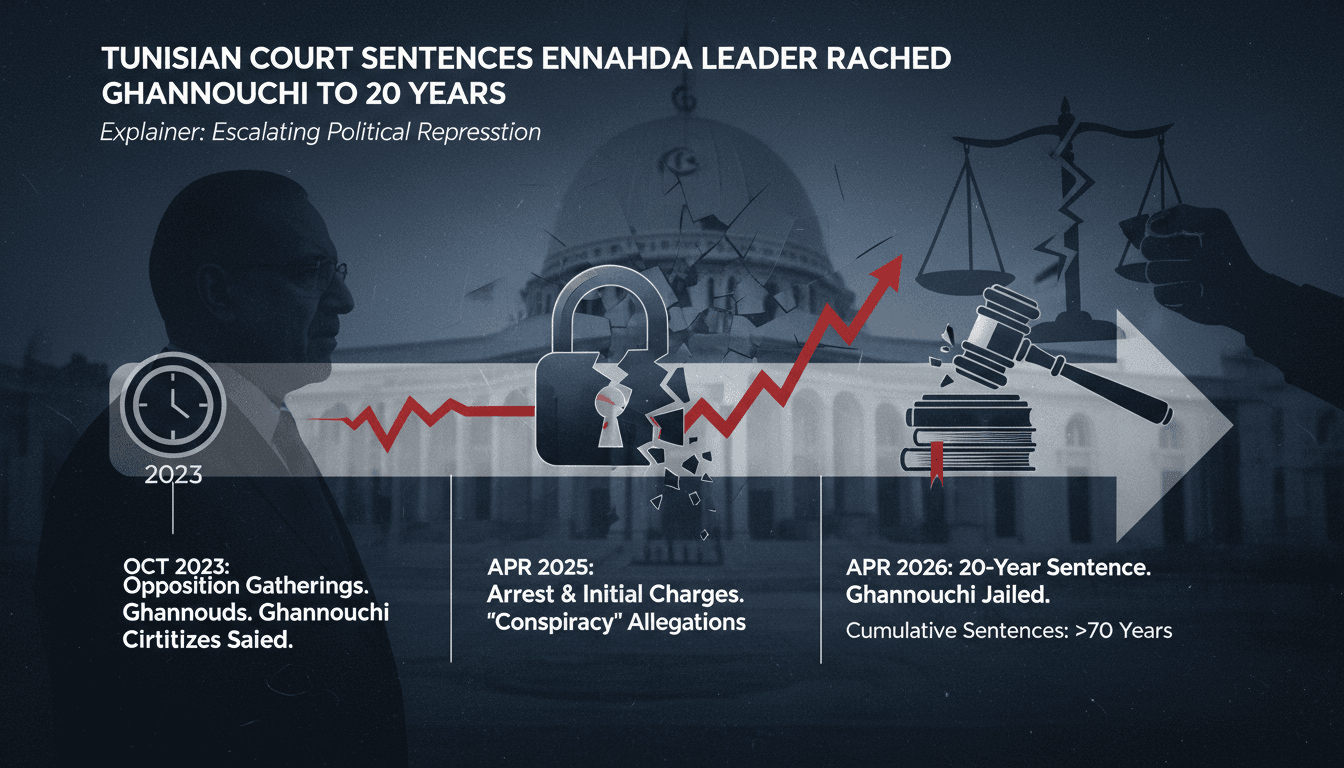
Here's what it means for you.
The political landscape in Tunisia is shifting, which could influence regional stability and economic conditions.
Why it matters
The sentencing of a prominent opposition leader signals a tightening grip on dissent in Tunisia, potentially affecting investor confidence and political dynamics in North Africa.
What happened (in 30 seconds)
- On April 15, 2026, Rached Ghannouchi, leader of the Ennahda Movement, was sentenced to 20 years in prison for conspiracy against state security.
- This verdict adds to Ghannouchi's cumulative sentences, which now exceed 70 years across multiple cases amid a broader political crackdown.
- The trial was boycotted by Ghannouchi, who claims the proceedings were politically motivated.
The context you actually need
- The 'Ramadan Soiree' case stems from a February 2023 gathering that led to arrests of opposition figures, interpreted as incitement against the state.
- President Kais Saied's administration has been consolidating power since 2021, targeting Ennahda and other opposition groups with various charges.
- Human rights organizations have criticized the crackdown, labeling it a systematic effort to silence dissent and undermine democratic processes.
What's really happening
The recent sentencing of Rached Ghannouchi is emblematic of Tunisia's ongoing political turmoil, which has escalated since President Kais Saied's rise to power. Following the suspension of parliament in 2021 and the dissolution of the government, Saied has pursued a strategy of consolidating authority by targeting opposition figures, particularly those associated with the Ennahda Movement. This political maneuvering has been framed as a necessary step to restore order and stability in a country still grappling with the aftermath of the Arab Spring.
The 'Ramadan Soiree' case, which led to Ghannouchi's latest conviction, is rooted in a gathering that took place in February 2023. This event, organized by the National Salvation Front, was intended to express solidarity with political detainees. However, the statements made during the gathering were interpreted by authorities as incitement to chaos and rebellion, leading to a series of arrests of opposition leaders, lawyers, and activists. Ghannouchi's arrest on April 17, 2023, marked a significant escalation in the crackdown on dissent.
The cumulative sentences imposed on Ghannouchi, now exceeding 70 years, reflect a broader strategy to eliminate political opposition and instill fear among potential dissenters. The Tunisian government maintains that these judicial actions are independent and necessary for national security, despite widespread allegations of political motivations behind the charges. Human rights organizations, including Amnesty International, have condemned these actions as part of a systematic effort to suppress dissent and undermine democratic institutions.
As Ghannouchi and other Ennahda leaders face lengthy prison terms, the implications for Tunisia's political landscape are profound. The opposition National Salvation Front has denounced the verdict as a politically motivated settlement aimed at silencing critics of President Saied. This ongoing repression raises concerns about the future of democracy in Tunisia and the potential for increased unrest among the populace.
Who feels it first (and how)
- Political activists: Increased risk of arrest and persecution for dissenting voices.
- Investors: Potential hesitance to engage in Tunisia due to political instability and uncertainty.
- Tunisian expatriates: Heightened political concerns and discussions within the diaspora community, particularly in regions like Dubai.
What to watch next
- Appeals process: The outcomes of Ghannouchi's appeals could influence public sentiment and political stability.
- International reactions: Responses from foreign governments and organizations regarding Tunisia's human rights record may impact diplomatic relations.
- Public protests: Increased dissent among the populace could lead to protests, affecting social stability and economic conditions.
Ghannouchi has been sentenced to 20 years in prison, contributing to a total of over 70 years across multiple cases.
Appeals against the verdict will be pursued, potentially prolonging the legal battle and political tensions.
The long-term impact on Tunisia's political landscape and international relations remains uncertain.
Frequently Asked Questions
- Why it matters?
- The sentencing of a prominent opposition leader signals a tightening grip on dissent in Tunisia, potentially affecting investor confidence and political dynamics in North Africa.
- What happened (in 30 seconds)?
- On April 15, 2026, Rached Ghannouchi, leader of the Ennahda Movement, was sentenced to 20 years in prison for conspiracy against state security. This verdict adds to Ghannouchi's cumulative sentences, which now exceed 70 years across multiple cases amid a broader political crackdown. The trial was boycotted by Ghannouchi, who claims the proceedings were politically motivated.
- What's really happening?
- The recent sentencing of Rached Ghannouchi is emblematic of Tunisia's ongoing political turmoil, which has escalated since President Kais Saied's rise to power. Following the suspension of parliament in 2021 and the dissolution of the government, Saied has pursued a strategy of consolidating authority by targeting opposition figures, particularly those associated with the Ennahda Movement. This political maneuvering has been framed as a necessary step to restore order and stability in a country
- Who feels it first (and how)?
- Political activists: Increased risk of arrest and persecution for dissenting voices. Investors: Potential hesitance to engage in Tunisia due to political instability and uncertainty. Tunisian expatriates: Heightened political concerns and discussions within the diaspora community, particularly in regions like Dubai.
- What to watch next?
- Appeals process: The outcomes of Ghannouchi's appeals could influence public sentiment and political stability. International reactions: Responses from foreign governments and organizations regarding Tunisia's human rights record may impact diplomatic relations. Public protests: Increased dissent among the populace could lead to protests, affecting social stability and economic conditions.
Arabic-language coverage of international news and geopolitics.
"RT Arabic is a Russian state-funded outlet often criticized for promoting Kremlin-aligned narratives."
— A47 Editor
تونس.. السجن 20 عاما للغنوشي في قضية "المسامرة" ليتجاوز مجموع أحكامه 70 عاما
A Tunisian court has sentenced Rached Ghannouchi, the leader of the Ennahda Movement, to 20 years in prison for conspiracy against state security in connection with the 'Ramadan Gathering' case, bringing his total prison sentences to over 70 years.
Pan-Arab political news and analysis.
"Al-Quds Al-Arabi is a London-based Arabic newspaper known for political coverage."
— A47 Editor
محكمة تونسية تصدر حكما بسجن الغنوشي 20 عاما
A Tunisian court has sentenced Rached Ghannouchi, the leader of the Ennahda Islamic Movement, to 20 years in prison for conspiracy against state security in connection with the 'Ramadan gatherings' case. The same sentence was also imposed on movement...
Arabic-language digital news outlet covering UAE, regional, and international developments with broad general-news coverage.
"Al Ain News coverage typically blends UAE-focused reporting with wider Arab regional and international news."
— A47 Editor
لتهديده بالحرب الأهلية.. السجن 20 عاما لزعيم إخوان تونس
A Tunisian court sentenced Rached Ghannouchi, the leader of the Ennahda movement, to 20 years in prison in a case known as the 'Ramadan Gathering,' where he was accused of threatening civil war. This ruling marks a significant development in Tunisia'...