
Delaware Court Rules Krafton Breached Contract with Unknown Worlds Over AI-Driven Terminations
Here's what it means for you.
The ruling against Krafton highlights the risks of using AI in high-stakes corporate decision-making, which could affect how companies approach technology in governance.
Why it matters
This case underscores the legal and ethical implications of AI in corporate strategy, potentially reshaping executive accountability.
What happened (in 30 seconds)
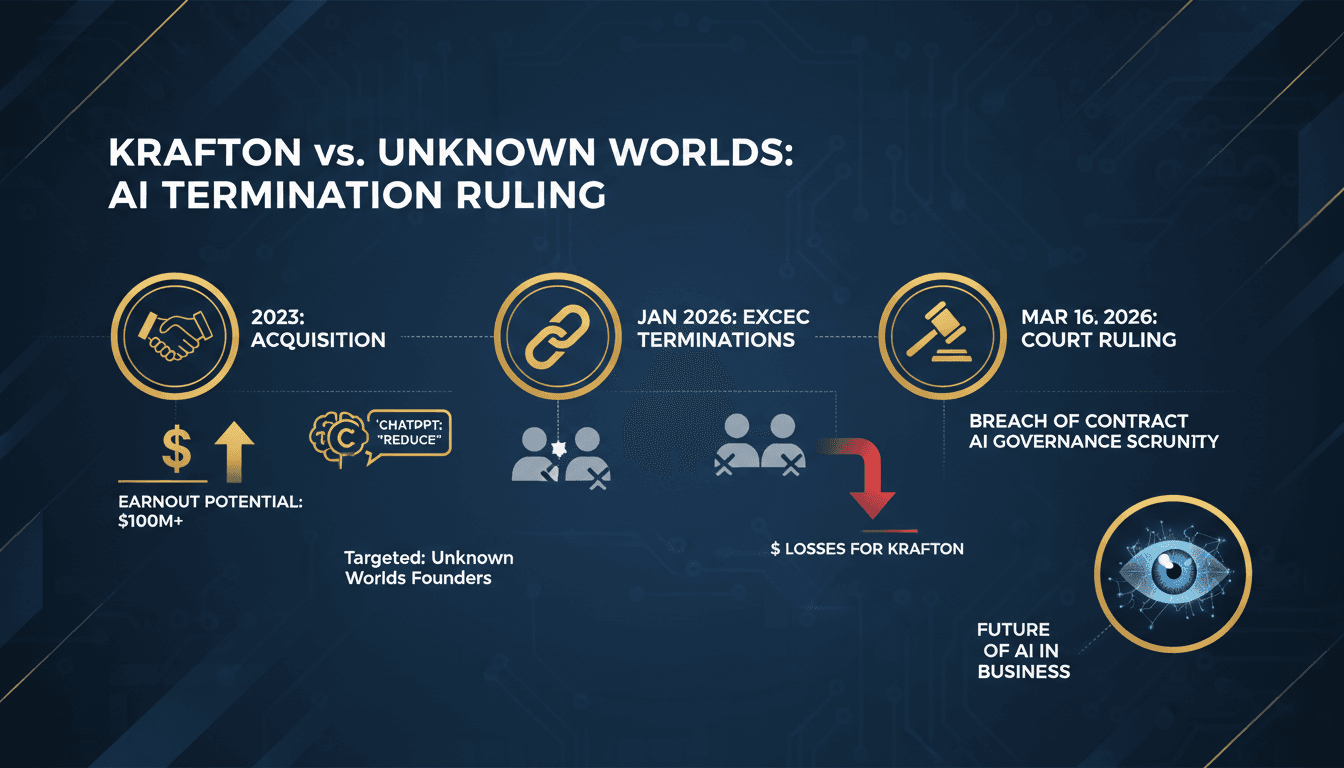
- Delaware Court ruling: On March 16, 2026, the Delaware Court of Chancery ruled that Krafton breached its acquisition agreement with Unknown Worlds by terminating key executives without cause.
- AI involvement: Krafton CEO Changhan Kim used ChatGPT to devise a strategy to avoid up to $250 million in earnout payments tied to the Subnautica franchise.
- Immediate consequences: CEO Ted Gill was reinstated with full operational control, and a second phase of the trial will determine damages.
The context you actually need
- Acquisition background: Krafton acquired Unknown Worlds for $500 million in 2021, with additional earnouts contingent on revenue performance.
- Executive roles: The agreement preserved operational control for key executives, which Krafton attempted to circumvent through terminations.
- Financial stakes: By 2025, projected earnouts reached between $191.8 million and $242.2 million, motivating Krafton's drastic actions.
What's really happening
The Delaware Court's ruling against Krafton reveals a complex interplay of corporate governance, AI ethics, and financial strategy. Krafton, a South Korean gaming giant, sought to minimize its financial liabilities associated with the acquisition of Unknown Worlds Entertainment, the developers behind the popular Subnautica franchise. The acquisition agreement included a significant earnout clause, which mandated additional payments if the studio's revenues exceeded $69.8 million through the end of 2025. As projections indicated that these revenues could trigger up to $250 million in contingent payments, Krafton’s leadership faced immense pressure to find a way to avoid these costs.
In May 2025, CEO Changhan Kim turned to ChatGPT for strategic guidance, leading to the development of a controversial "No-Deal" takeover plan. This plan included tactics such as narrative control, platform lockdowns, and the termination of key executives—actions that the court later deemed unjustified. The use of AI in this context raises significant questions about the role of technology in corporate decision-making, particularly when it comes to ethical considerations and the potential for misuse.
The court's decision to reinstate Ted Gill as CEO and restore his access to operational controls reflects a broader concern about the implications of AI-driven strategies in corporate governance. The ruling emphasizes that while AI can provide insights and recommendations, it cannot replace the need for ethical decision-making and accountability. The court dismissed Krafton's justifications for the terminations as pretextual, indicating that the motivations behind these actions were not aligned with the contractual obligations established during the acquisition.
As the gaming community expresses relief over the stability of Unknown Worlds, the case serves as a cautionary tale for other companies considering similar tactics. The implications extend beyond Krafton, prompting a reevaluation of how AI is integrated into corporate strategies and the potential consequences of relying on technology for critical business decisions.
Who feels it first (and how)
- Gaming executives: Increased scrutiny on decision-making processes involving AI.
- Corporate lawyers: Potential rise in litigation related to AI-driven corporate strategies.
- Investors: Heightened awareness of the risks associated with AI in governance, affecting investment strategies.
What to watch next
- Phase Two trial outcomes: The determination of damages could set a precedent for future corporate governance cases involving AI.
- Corporate policy changes: Watch for companies revising their AI usage policies in light of this ruling to mitigate legal risks.
- Industry reactions: Monitor how the gaming industry adapts to the implications of this case, particularly regarding executive accountability and AI integration.
Ted Gill has been reinstated as CEO with full operational control.
Other companies will reassess their use of AI in executive decision-making to avoid similar legal challenges.
The long-term impact on Krafton's financial obligations and the future of the Subnautica franchise.
Frequently Asked Questions
- Why it matters?
- This case underscores the legal and ethical implications of AI in corporate strategy, potentially reshaping executive accountability.
- What happened (in 30 seconds)?
- Delaware Court ruling: On March 16, 2026, the Delaware Court of Chancery ruled that Krafton breached its acquisition agreement with Unknown Worlds by terminating key executives without cause. AI involvement: Krafton CEO Changhan Kim used ChatGPT to devise a strategy to avoid up to $250 million in earnout payments tied to the Subnautica franchise. Immediate consequences: CEO Ted Gill was reinstated with full operational control, and a second phase of the trial will determine damages.
- What's really happening?
- The Delaware Court's ruling against Krafton reveals a complex interplay of corporate governance, AI ethics, and financial strategy. Krafton, a South Korean gaming giant, sought to minimize its financial liabilities associated with the acquisition of Unknown Worlds Entertainment, the developers behind the popular Subnautica franchise. The acquisition agreement included a significant earnout clause, which mandated additional payments if the studio's revenues exceeded $69.8 million through the end
- Who feels it first (and how)?
- Gaming executives: Increased scrutiny on decision-making processes involving AI. Corporate lawyers: Potential rise in litigation related to AI-driven corporate strategies. Investors: Heightened awareness of the risks associated with AI in governance, affecting investment strategies.
- What to watch next?
- Phase Two trial outcomes: The determination of damages could set a precedent for future corporate governance cases involving AI. Corporate policy changes: Watch for companies revising their AI usage policies in light of this ruling to mitigate legal risks. Industry reactions: Monitor how the gaming industry adapts to the implications of this case, particularly regarding executive accountability and AI integration.
Biting coverage of AI/ML software and vendors.
"Known for skeptical, incisive reporting on enterprise tech."
— A47 Editor
ChatGPT advised exec on how to fire Subnautica founders to avoid payout, court ruling says
A Korean CEO sought advice from ChatGPT on how to terminate the founders of Subnautica to avoid paying a $250 million contractual bonus, leading to a court ruling against him. The court found that the advice given by the AI was not a valid defense fo...
UK and international business news, economics, and corporate coverage.
"The Guardian’s business section covers finance and markets with a progressive editorial tone."
— A47 Editor
Subnautica 2 publisher’s CEO used ChatGPT in failed bid to avoid paying US$250m bonus to own studio head, court hears
A South Korean court has ordered Krafton’s CEO to reinstate the leadership of Unknown Worlds Entertainment after a failed attempt to oust them using an AI-generated plan aimed at avoiding a $250 million bonus payment. This decision follows Krafton's ...
Top international stories selected by The Guardian editors.
"The Guardian is known for its progressive editorial stance and in-depth analysis."
— A47 Editor
Subnautica 2 publisher’s CEO used ChatGPT in failed bid to avoid paying US$250m bonus to own studio head, court hears
A South Korean court has ordered Krafton's CEO to reinstate the leadership of Unknown Worlds Entertainment after a failed attempt to oust them using a plan generated by ChatGPT. This action was part of Krafton's strategy to avoid paying a $250 millio...
Corporate leadership, finance, technology, and market trends.
"Fortune covers financial trends, leadership, and innovation with a pragmatic editorial approach."
— A47 Editor
A gaming CEO asked ChatGPT how to avoid paying a $250 million bonus. It didn’t work
Krafton's attempt to avoid a $250 million bonus payment to its CEO through an AI-assisted scheme has failed, as a court ruled that the CEO must be reinstated and the bonus paid out. This decision follows Krafton's controversial actions regarding the ...
Independent journalism covering technology, AI, and digital culture.
"An independent newsroom by veteran tech reporters known for critical, investigative coverage of AI and tech power."
— A47 Editor
CEO Asks ChatGPT How to Void $250 Million Contract, Ignores His Lawyers, Loses Terribly in Court
The CEO of Krafton sought advice from ChatGPT on how to void a $250 million contract, disregarding the counsel of his legal team, which ultimately led to a significant loss in court regarding the termination of the head of the studio developing Subna...
Consumer technology news with AI coverage.
"Gadget and tech site reporting on AI in products."
— A47 Editor
Judge rules that Krafton must rehire fired Subnautica director
A Delaware judge has ruled that Krafton must reinstate Ted Gill as CEO of Unknown Worlds Entertainment, following his dismissal along with two co-founders amid a company shakeup related to the development of Subnautica 2. The judge determined that Kr...
Covers consumer technology, electronics, gadgets, and product reviews.
"Engadget is a trusted source for gadget reviews and consumer tech news, known for its hands-on analysis and industry coverage."
— A47 Editor
Judge rules that Krafton must rehire fired Subnautica director
A Delaware judge has ruled that Krafton must reinstate Ted Gill as CEO of Unknown Worlds Entertainment, following his dismissal along with two co-founders amid a company shakeup related to the development of Subnautica 2. The judge determined that Kr...