
Netanyahu Initiates Direct Talks with Lebanon Following Major Airstrikes Amid US-Iran Tensions
Here's what it means for you.
The escalating conflict in Lebanon could impact global oil prices and regional stability, affecting markets and consumers worldwide.
Why it matters
The renewed violence and diplomatic efforts signal a critical juncture in Middle Eastern geopolitics, with potential ripple effects on global energy markets.
What happened (in 30 seconds)
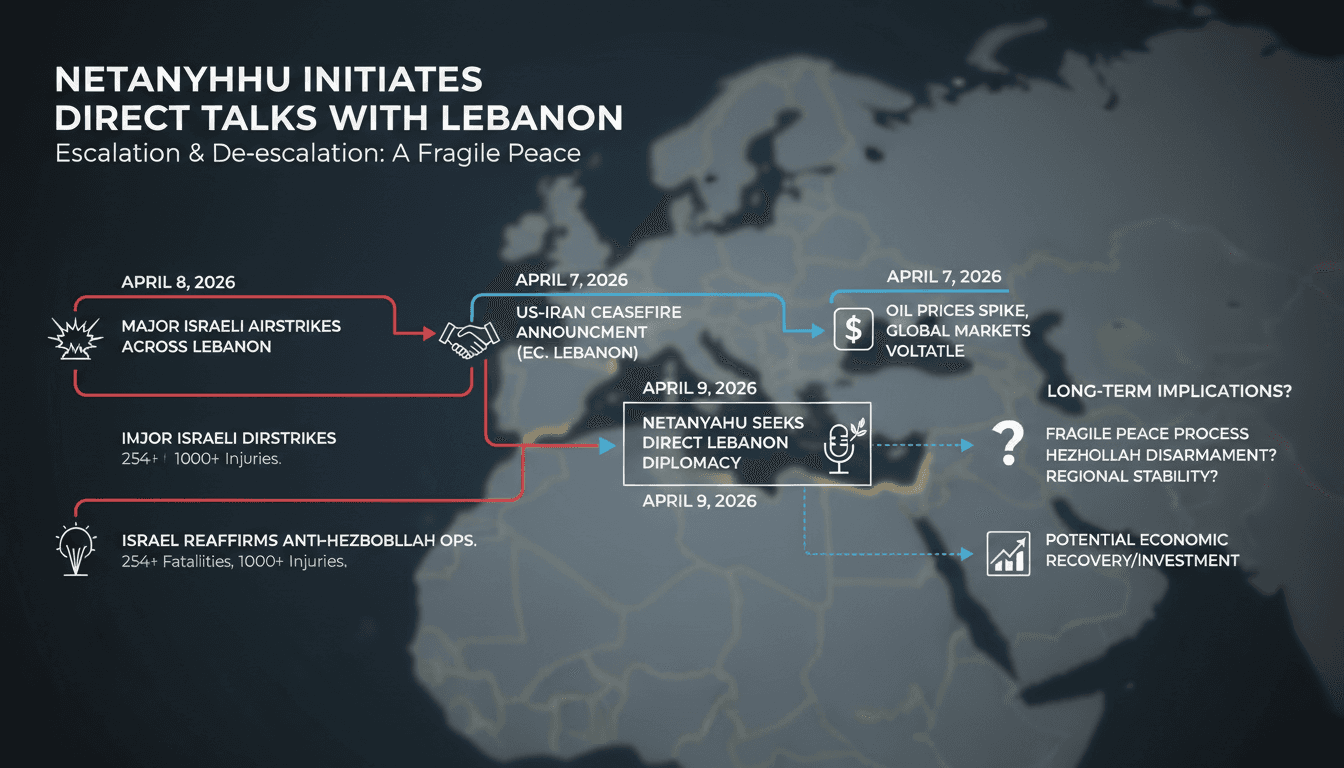
- On April 8, 2026, Israeli forces executed over 100 airstrikes across Lebanon, resulting in at least 254 fatalities and over 1,000 injuries.
- Prime Minister Netanyahu authorized direct negotiations with Lebanon to disarm Hezbollah while continuing military operations.
- The backdrop includes a fragile US-Iran ceasefire that excludes Israel's actions against Hezbollah, heightening tensions in the region.
The context you actually need
- The bombardment is part of the ongoing 2026 Israel-Hezbollah war, which reignited in February amid broader US-Iran conflicts.
- The US-Iran ceasefire, announced on April 7, aimed to halt missile exchanges but did not address Israel's military campaign against Hezbollah.
- Hezbollah's rocket fire into northern Israel prompted Israel's intensified military response, leading to significant civilian casualties in Lebanon.
What's really happening
The recent airstrikes by Israel mark a significant escalation in the ongoing conflict with Hezbollah, a militant group backed by Iran. The strikes, which targeted over 100 sites, were executed in densely populated areas, raising serious humanitarian concerns. The Israeli government claims these operations are necessary to neutralize threats from Hezbollah, particularly in light of ongoing rocket fire into northern Israel. This military action occurred just hours after a US-Iran ceasefire was announced, highlighting the complexities of the regional security landscape.
Netanyahu's decision to authorize direct talks with Lebanon represents a dual strategy: while continuing military operations, he seeks to engage diplomatically to disarm Hezbollah and normalize relations. This approach reflects a recognition that military solutions alone may not suffice to ensure long-term security. The negotiations are set to take place in Washington, indicating a potential shift in how Israel interacts with its northern neighbor amid ongoing tensions.
The backdrop of the US-Iran ceasefire adds another layer of complexity. Although the ceasefire aims to reduce direct hostilities between the US and Iran, it explicitly excludes Israel's operations against Hezbollah. This exclusion has drawn criticism and concern from various international actors, including the Lebanese government and Hezbollah, both of which have condemned the airstrikes as a violation of sovereignty and a targeting of civilians.
The aftermath of the bombardment has seen heightened rhetoric from Hezbollah, which has vowed retaliation, and from Iran, which has warned of strong responses. The international community, including the UK, EU, and UN, has urged restraint and called for the inclusion of Lebanon in any truce discussions. As oil prices surged towards $100 per barrel following the strikes, the economic implications of this conflict extend beyond the immediate region, affecting global markets and energy costs.
Who feels it first (and how)
- Lebanese civilians: Directly impacted by the violence, facing casualties and displacement.
- Energy sector professionals: Oil price fluctuations affect market stability and investment strategies.
- International businesses: Companies with interests in the Middle East may face increased operational risks and costs.
What to watch next
- Negotiation outcomes: The results of the upcoming talks in Washington could reshape regional dynamics and influence future military actions.
- Oil price trends: Continued volatility in oil prices will reflect the broader implications of the conflict on global energy markets.
- Hezbollah's response: Any retaliatory actions from Hezbollah could escalate tensions further, impacting both regional security and international relations.
The airstrikes resulted in significant civilian casualties and ongoing military operations by Israel.
Diplomatic negotiations will occur, but their success remains uncertain amid ongoing hostilities.
The long-term implications for US-Iran relations and regional stability following these events.
Frequently Asked Questions
- Why it matters?
- The renewed violence and diplomatic efforts signal a critical juncture in Middle Eastern geopolitics, with potential ripple effects on global energy markets.
- What happened (in 30 seconds)?
- On April 8, 2026, Israeli forces executed over 100 airstrikes across Lebanon, resulting in at least 254 fatalities and over 1,000 injuries. Prime Minister Netanyahu authorized direct negotiations with Lebanon to disarm Hezbollah while continuing military operations. The backdrop includes a fragile US-Iran ceasefire that excludes Israel's actions against Hezbollah, heightening tensions in the region.
- What's really happening?
- The recent airstrikes by Israel mark a significant escalation in the ongoing conflict with Hezbollah, a militant group backed by Iran. The strikes, which targeted over 100 sites, were executed in densely populated areas, raising serious humanitarian concerns. The Israeli government claims these operations are necessary to neutralize threats from Hezbollah, particularly in light of ongoing rocket fire into northern Israel. This military action occurred just hours after a US-Iran ceasefire was ann
- Who feels it first (and how)?
- Lebanese civilians: Directly impacted by the violence, facing casualties and displacement. Energy sector professionals: Oil price fluctuations affect market stability and investment strategies. International businesses: Companies with interests in the Middle East may face increased operational risks and costs.
- What to watch next?
- Negotiation outcomes: The results of the upcoming talks in Washington could reshape regional dynamics and influence future military actions. Oil price trends: Continued volatility in oil prices will reflect the broader implications of the conflict on global energy markets. Hezbollah's response: Any retaliatory actions from Hezbollah could escalate tensions further, impacting both regional security and international relations.
News from the United States including domestic politics, society, and culture.
"The Guardian is known for its progressive editorial stance and in-depth analysis, often advocating for social justice, environmental issues, and liberal values."
— A47 Editor
Netanyahu says there is no ceasefire in Lebanon as Israel launches fresh strikes
Israeli Prime Minister Benjamin Netanyahu has declared that there will be no ceasefire in Lebanon, as Israel continues its military operations against Hezbollah, resulting in over 300 casualties. This announcement follows a series of airstrikes targe...
International coverage from The Guardian's global desks.
"The Guardian is known for its progressive editorial stance and in-depth analysis."
— A47 Editor
Netanyahu says there is no ceasefire in Lebanon as Israel launches fresh strikes
Israeli Prime Minister Benjamin Netanyahu has declared that there will be no ceasefire in Lebanon, as Israel continues its military operations against Hezbollah, resulting in over 300 casualties. This announcement follows a series of airstrikes targe...
Global news coverage with extensive reporting on Middle Eastern conflicts and geopolitics.
"Al Jazeera is a Qatar-based broadcaster known for wide regional coverage and alternative perspectives."
— A47 Editor
Israel’s Netanyahu ready for talks with Lebanon ‘as soon as possible’
Israeli Prime Minister Benjamin Netanyahu has expressed readiness for negotiations with Lebanon, focusing on disarming Hezbollah and establishing peaceful relations. This statement comes amid ongoing tensions in the region, particularly concerning mi...
Comprehensive coverage of Middle Eastern and global issues.
"Al Jazeera is a prominent voice from the Global South, especially the Middle East, with an emphasis on underreported stories."
— A47 Editor
Israel’s Netanyahu ready for talks with Lebanon ‘as soon as possible’
Israeli Prime Minister Benjamin Netanyahu has expressed readiness for negotiations with Lebanon, focusing on disarming Hezbollah and establishing peaceful relations. This statement comes amid ongoing tensions in the region, particularly concerning mi...
Regional and international reporting focused on Middle Eastern politics, diplomacy, and economics.
"Asharq Al-Awsat is a Saudi-owned international newspaper reflecting mainstream Gulf political perspectives."
— A47 Editor
Netanyahu Authorizes Direct Talks with Lebanon
Israeli Prime Minister Benjamin Netanyahu has authorized direct negotiations with Lebanon, scheduled to take place next week in Washington, amidst rising military tensions and ongoing strikes affecting both nations. This decision marks a significant ...
Oil, metals, and agriculture: supply/demand headlines, OPEC chatter, inventories, and price action.
"Solid tape for energy and metals traders tracking macro and micro catalysts."
— A47 Editor
Lebanon seeks temporary ceasefire to allow broader talks with Israel, official says
Lebanon is seeking a temporary ceasefire to facilitate broader discussions with Israel, as tensions between the two nations continue to escalate amid military confrontations. This request comes in light of recent Israeli airstrikes on Lebanon, which ...