
U.S. Achieves Military Victory Over Iran After Operation Epic Fury
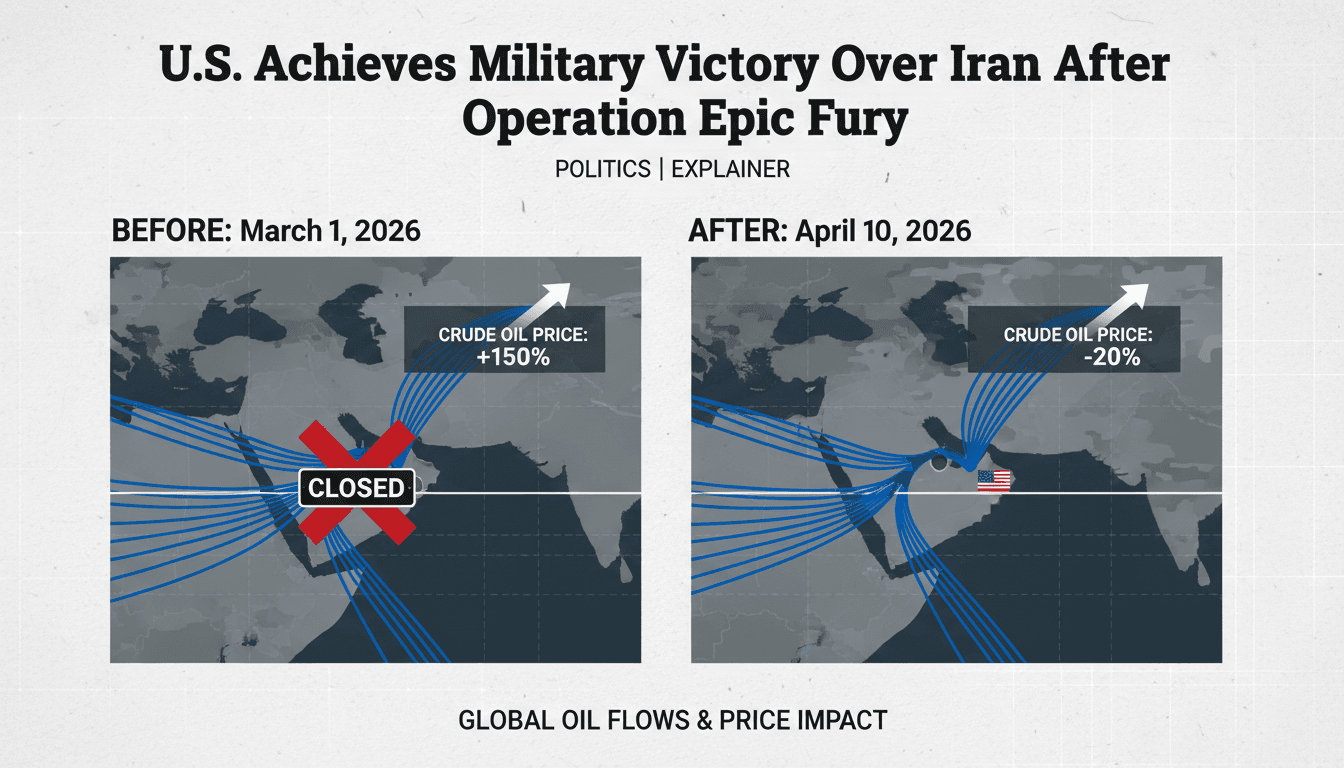
Here's what it means for you.
Your energy costs may fluctuate as global markets adjust to the aftermath of this military operation.
Why it matters
The outcome of this conflict directly impacts global energy supply and geopolitical stability, influencing prices and availability.
What happened (in 30 seconds)
- On April 8, 2026, U.S. Defense Secretary Pete Hegseth announced a decisive military victory over Iran after a 38-day operation.
- Operation Epic Fury was launched following Iran's closure of the Strait of Hormuz, disrupting global shipping and energy prices.
- A two-week ceasefire was negotiated just hours before a full-scale U.S. invasion was set to begin.
The context you actually need
- Iran's closure of the Strait of Hormuz in early March 2026 led to significant disruptions in global oil shipping, causing energy prices to spike.
- Operation Epic Fury targeted Iranian military assets, including missile programs and naval capabilities, aiming to restore shipping routes and stabilize energy markets.
- The ceasefire agreement allows for limited navigation through the Strait, but tensions remain high, with potential for further conflict.
What's really happening
The recent military engagement between the U.S. and Iran, culminating in the declaration of victory by Defense Secretary Pete Hegseth, is a pivotal moment in Middle Eastern geopolitics. The closure of the Strait of Hormuz by Iran not only disrupted global shipping but also sent shockwaves through energy markets, with prices rising sharply due to fears of supply shortages. The U.S. response, characterized by Operation Epic Fury, was a calculated military intervention aimed at neutralizing Iranian threats and restoring stability in a critical maritime corridor.
The operation lasted 38 days, during which U.S. forces executed precision strikes against Iranian naval and missile assets. This military strategy was not merely about immediate tactical gains; it was also about sending a strong signal to both allies and adversaries regarding U.S. resolve in protecting its interests in the region. The timing of the ceasefire, negotiated just hours before a potential full-scale invasion, reflects a complex interplay of military strategy and diplomatic maneuvering. The U.S. sought to avoid a prolonged conflict while ensuring that its military objectives were met.
In the aftermath, the geopolitical landscape remains fraught with uncertainty. Iran has claimed a "historic victory," despite the operational setbacks it faced. The U.S. has positioned its forces to monitor compliance with the ceasefire and to enforce peace, indicating that military readiness remains a priority. This dual approach of military enforcement and diplomatic engagement suggests that the U.S. is prepared for a range of scenarios, including the possibility of renewed hostilities if Iran resumes aggressive actions.
The implications of this conflict extend beyond the immediate military outcomes. Global energy markets are likely to experience volatility as they adjust to the new status quo. With the Strait of Hormuz being a critical chokepoint for oil shipments, any instability in the region can lead to fluctuations in oil prices, affecting consumers worldwide. Additionally, the U.S. military presence in the region may deter further Iranian provocations but could also escalate tensions with other regional actors, including Hezbollah and other proxy groups.
Who feels it first (and how)
- Energy consumers: Fluctuations in oil prices will directly impact fuel costs and household budgets.
- Shipping companies: Increased shipping costs and delays may arise from heightened security measures in the Strait of Hormuz.
- Investors in energy markets: Volatility in oil prices may create opportunities and risks in trading and investment strategies.
What to watch next
- Oil price trends: Monitor fluctuations in global oil prices as markets react to the ceasefire and ongoing tensions in the region.
- Iran's military posture: Watch for any signs of renewed aggression from Iran or its proxies, which could destabilize the ceasefire.
- U.S. military deployments: Keep an eye on changes in U.S. military presence in the region, which may signal shifts in strategy or readiness for further action.
The U.S. has declared a military victory and established a ceasefire with Iran.
Oil prices will remain volatile as markets adjust to the new geopolitical landscape.
The long-term implications of the ceasefire on U.S.-Iran relations and regional stability.
Frequently Asked Questions
- Why it matters?
- The outcome of this conflict directly impacts global energy supply and geopolitical stability, influencing prices and availability.
- What happened (in 30 seconds)?
- On April 8, 2026, U.S. Defense Secretary Pete Hegseth announced a decisive military victory over Iran after a 38-day operation. Operation Epic Fury was launched following Iran's closure of the Strait of Hormuz, disrupting global shipping and energy prices. A two-week ceasefire was negotiated just hours before a full-scale U.S. invasion was set to begin.
- What's really happening?
- The recent military engagement between the U.S. and Iran, culminating in the declaration of victory by Defense Secretary Pete Hegseth, is a pivotal moment in Middle Eastern geopolitics. The closure of the Strait of Hormuz by Iran not only disrupted global shipping but also sent shockwaves through energy markets, with prices rising sharply due to fears of supply shortages. The U.S. response, characterized by Operation Epic Fury, was a calculated military intervention aimed at neutralizing Iranian
- Who feels it first (and how)?
- Energy consumers: Fluctuations in oil prices will directly impact fuel costs and household budgets. Shipping companies: Increased shipping costs and delays may arise from heightened security measures in the Strait of Hormuz. Investors in energy markets: Volatility in oil prices may create opportunities and risks in trading and investment strategies.
- What to watch next?
- Oil price trends: Monitor fluctuations in global oil prices as markets react to the ceasefire and ongoing tensions in the region. Iran's military posture: Watch for any signs of renewed aggression from Iran or its proxies, which could destabilize the ceasefire. U.S. military deployments: Keep an eye on changes in U.S. military presence in the region, which may signal shifts in strategy or readiness for further action.
Pan-Arab news coverage spanning politics, business, sports, and regional affairs.
"Asharq Al-Awsat reflects a broad Arab editorial perspective with strong attention to regional geopolitics."
— A47 Editor
هيغسيث: أميركا حققت انتصاراً عسكرياً حاسماً على إيران
U.S. Secretary of Defense Pete Hegseth announced that the United States has achieved a decisive military victory over Iran, claiming that Tehran's missile program has been destroyed. This statement was made on Wednesday, highlighting a significant de...
Global news coverage with extensive reporting on Middle Eastern conflicts and geopolitics.
"Al Jazeera is a Qatar-based broadcaster known for wide regional coverage and alternative perspectives."
— A47 Editor
Hegseth touts US ‘victory’ over Iran as Tehran hails its own ‘historic’ win
U.S. Defense Secretary Pete Hegseth declared a total military victory over Iran, coinciding with Tehran's assertion of a historic win amid a newly announced two-week ceasefire. This ceasefire follows intense military exchanges and diplomatic negotiat...
Comprehensive coverage of Middle Eastern and global issues.
"Al Jazeera is a prominent voice from the Global South, especially the Middle East, with an emphasis on underreported stories."
— A47 Editor
Hegseth touts US ‘victory’ over Iran as Tehran hails its own ‘historic’ win
U.S. Defense Secretary Pete Hegseth announced a total military victory over Iran, coinciding with Tehran's declaration of a historic win amid a newly agreed two-week ceasefire. This ceasefire follows intense military conflict, during which Hegseth cl...
24/7 international news from a French perspective in multiple languages.
"France 24 is viewed as a globally focused outlet with balanced coverage and a European perspective."
— A47 Editor
Did US really secure 'overwhelming military victory' in Iran?
U.S. Defense Secretary Pete Hegseth claimed that the United States has secured an overwhelming military victory over Iran, asserting that Tehran's missile program has been functionally destroyed. This statement follows a two-week ceasefire agreement ...
International coverage of politics, security, and social issues.
"Global News is a mainstream Canadian outlet with a centrist editorial stance, focusing on factual reporting."
— A47 Editor
U.S. claims ‘victory’ in Iran. What’s the situation on the ground?
U.S. Defense Secretary Pete Hegseth announced that Iran's airforce and missile capabilities have been significantly destroyed, following a week of escalating military tensions that included the downing of a U.S. fighter jet by Iran. This declaration ...