
U.S. Supreme Court Rules Unanimously in Favor of Chevron in Louisiana Wetlands Case
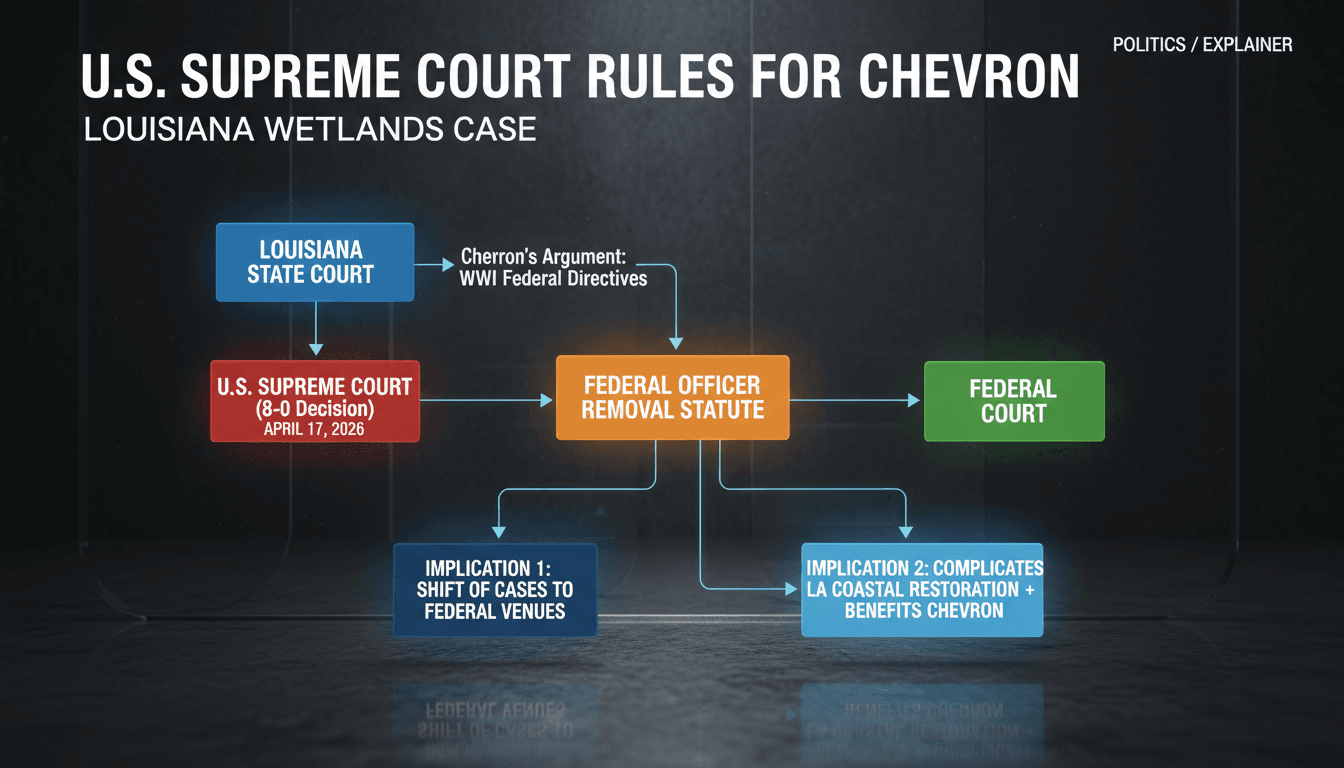
Here's what it means for you.
If you’re involved in environmental law or energy sectors, this ruling could reshape litigation strategies and operational risks.
Why it matters
This decision reinforces the ability of major corporations to navigate legal challenges through federal courts, potentially complicating state-level environmental restoration efforts.
What happened (in 30 seconds)
- The U.S. Supreme Court ruled 8-0 in favor of Chevron, allowing a wetlands damage lawsuit to move from state to federal court.
- The ruling is based on a WWII-era federal officer removal statute, suggesting Chevron's historical oil production was closely tied to federal directives.
- This decision vacates a $744.6 million jury verdict awarded to Plaquemines Parish for alleged environmental damages, complicating local restoration efforts.
The context you actually need
- Louisiana has lost nearly 2,000 square miles of coastal land since the 1930s, largely due to oil and gas activities.
- In 2013, six parishes filed 42 lawsuits against oil companies, claiming violations of coastal restoration laws.
- The April 2025 jury verdict against Chevron was the largest of its kind, highlighting the ongoing tension between energy production and environmental protection.
What's really happening
The Supreme Court's unanimous decision in Chevron USA Inc. v. Plaquemines Parish marks a significant procedural victory for the oil giant, allowing it to shift a high-stakes environmental lawsuit from a state court, where it faced a $744.6 million judgment, to a federal venue. This ruling is rooted in the federal officer removal statute (28 U.S.C. §1442(a)(1)), which permits companies to argue that their actions were directed by federal mandates, particularly during wartime. Chevron contended that its predecessors' oil production during World War II was closely linked to federal directives aimed at conserving steel and producing aviation fuel.
This legal maneuvering is not merely a technicality; it reflects a broader trend where corporations leverage federal statutes to mitigate liability in state courts perceived as less favorable. The implications are profound, particularly for Louisiana's coastal restoration efforts, which have already been hampered by significant land loss attributed to oil and gas activities. The ruling could set a precedent that encourages other companies facing similar lawsuits to seek federal court venues, potentially undermining state-level environmental protections.
The decision has immediate ramifications for the 11 related cases that may now also be transferred to federal courts, which are often viewed as more defendant-friendly. This shift complicates the landscape for local governments and environmental advocates who rely on state courts to hold corporations accountable for environmental degradation. Louisiana Attorney General Liz Murrill expressed confidence in prevailing on the merits in federal court, framing the ruling as a procedural setback rather than a defeat. However, the reality is that the procedural advantages afforded to Chevron could significantly delay or diminish the effectiveness of restoration efforts.
Moreover, the ruling does not appear to have immediate repercussions on Chevron's stock or the broader market, indicating that investors may have already factored in the potential for legal challenges. However, the long-term implications for environmental policy and corporate accountability remain to be seen, as this case could embolden other companies to pursue similar legal strategies.
Who feels it first (and how)
- Environmental advocacy groups: They may face increased challenges in holding corporations accountable for environmental damages.
- Local governments in Louisiana: They could see delays in restoration efforts and increased legal hurdles in pursuing claims against oil companies.
- Energy sector stakeholders: Companies may adjust their litigation strategies based on the precedent set by this ruling, impacting operational risk assessments.
What to watch next
- Federal court proceedings: Monitor how the case unfolds in federal court and its implications for similar lawsuits.
- Legislative responses: Watch for potential changes in state laws regarding environmental protections and corporate liability.
- Market reactions: Observe any shifts in investor sentiment towards energy companies in light of this ruling and its implications for environmental accountability.
The Supreme Court's ruling allows Chevron to move its case to federal court.
Other companies may follow suit, seeking to leverage federal statutes in environmental lawsuits.
The long-term impact on Louisiana's coastal restoration efforts and environmental policy remains uncertain.
Frequently Asked Questions
- Why it matters?
- This decision reinforces the ability of major corporations to navigate legal challenges through federal courts, potentially complicating state-level environmental restoration efforts.
- What happened (in 30 seconds)?
- The U.S. Supreme Court ruled 8-0 in favor of Chevron, allowing a wetlands damage lawsuit to move from state to federal court. The ruling is based on a WWII-era federal officer removal statute, suggesting Chevron's historical oil production was closely tied to federal directives. This decision vacates a $744.6 million jury verdict awarded to Plaquemines Parish for alleged environmental damages, complicating local restoration efforts.
- What's really happening?
- The Supreme Court's unanimous decision in Chevron USA Inc. v. Plaquemines Parish marks a significant procedural victory for the oil giant, allowing it to shift a high-stakes environmental lawsuit from a state court, where it faced a $744.6 million judgment, to a federal venue. This ruling is rooted in the federal officer removal statute (28 U.S.C. §1442(a)(1)), which permits companies to argue that their actions were directed by federal mandates, particularly during wartime. Chevron contended th
- Who feels it first (and how)?
- Environmental advocacy groups: They may face increased challenges in holding corporations accountable for environmental damages. Local governments in Louisiana: They could see delays in restoration efforts and increased legal hurdles in pursuing claims against oil companies. Energy sector stakeholders: Companies may adjust their litigation strategies based on the precedent set by this ruling, impacting operational risk assessments.
- What to watch next?
- Federal court proceedings: Monitor how the case unfolds in federal court and its implications for similar lawsuits. Legislative responses: Watch for potential changes in state laws regarding environmental protections and corporate liability. Market reactions: Observe any shifts in investor sentiment towards energy companies in light of this ruling and its implications for environmental accountability.
Global business headlines with AI angles.
"General business outlet that frequently covers AI."
— A47 Editor
Chevron Scores Supreme Court Win in Louisiana Wetlands Case
Chevron achieved a significant victory in the Supreme Court on Friday, potentially concluding Louisiana's prolonged efforts to hold oil companies accountable for environmental damage to its coastal areas. This ruling marks a pivotal moment in the ong...
News from the United States including domestic politics, society, and culture.
"The Guardian is known for its progressive editorial stance and in-depth analysis, often advocating for social justice, environmental issues, and liberal values."
— A47 Editor
Supreme court sides with oil and gas firms in Louisiana coastal damage fight
The Supreme Court delivered an 8-0 ruling favoring oil and gas companies, including Chevron, in a legal battle concerning coastal damage in Louisiana. This decision allows these firms to contest state jury orders that mandated significant financial c...
U.S. political news and right-leaning commentary.
"Fox News is a highly influential conservative news outlet known for right-leaning political commentary and coverage."
— A47 Editor
Supreme Court sides with Chevron, oil companies in Louisiana environmental lawsuits
The Supreme Court has ruled in favor of Chevron and other oil companies in Louisiana, allowing them to contest state jury orders related to environmental lawsuits alleging rapid coastal erosion due to their drilling activities. This unanimous 8-0 dec...