
Google Launches Personalized Image Generation Feature in Gemini App
Here's what it means for you.
As a user of Google services, you may soon find your digital interactions becoming more personalized and intuitive, but with potential privacy implications.
Why it matters
This integration signals a shift towards more context-aware AI tools, raising questions about data privacy and user control in the digital landscape.
What happened (in 30 seconds)
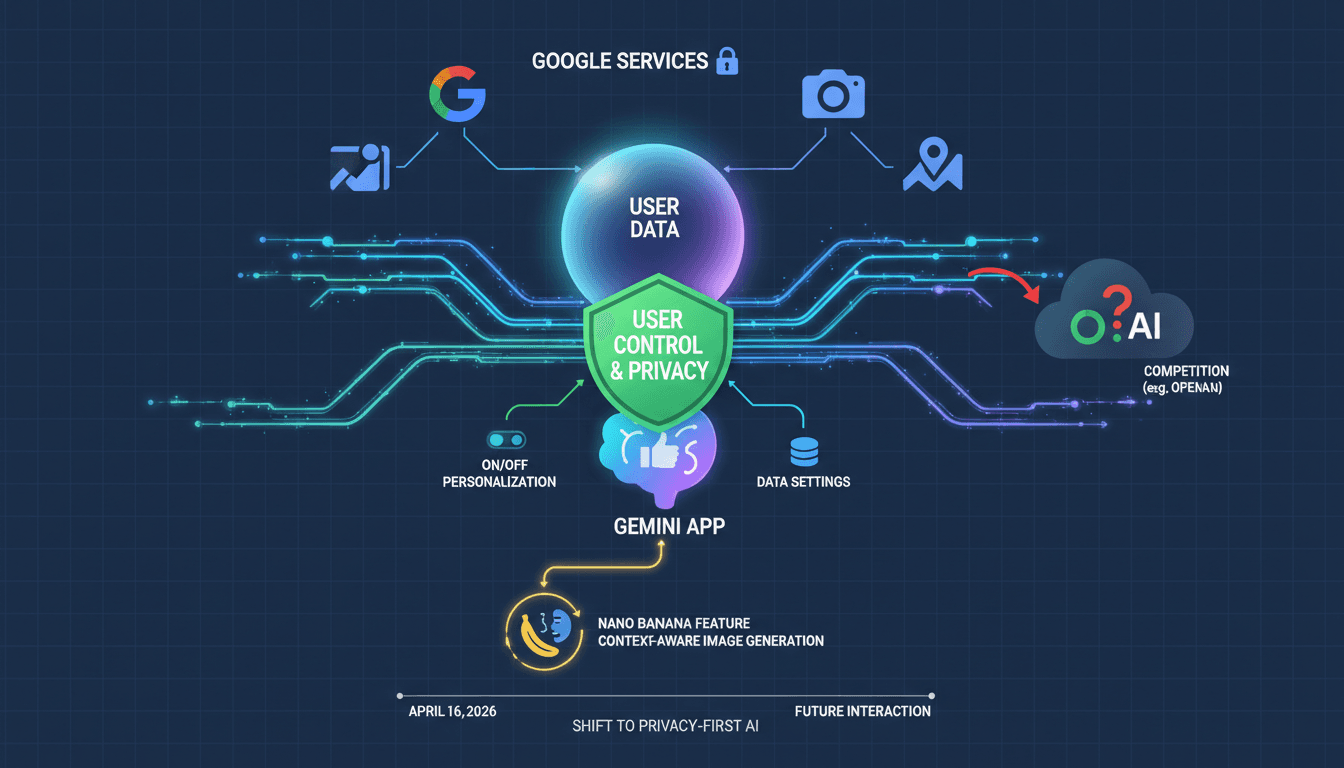
- On April 16, 2026, Google announced the integration of Personal Intelligence into its Gemini app's Nano Banana feature, allowing for personalized image generation.
- The feature utilizes data from users' Google Photos, Gmail, and Drive, enabling the AI to create images without manual uploads or lengthy prompts.
- The rollout targets U.S. subscribers to Google AI Plus, Pro, and Ultra plans, with plans for future expansions.
The context you actually need
- Gemini's user base has surpassed 750 million monthly active users as of early 2026, indicating a significant market presence.
- Personal Intelligence was introduced earlier in 2026 to enhance context-aware responses, reflecting a competitive push against rivals like OpenAI.
- Privacy concerns have emerged, with media outlets describing the feature as potentially invasive, despite Google's assurances of user control and data protection.
What's really happening
Google's latest update to the Gemini app represents a strategic move to enhance user engagement through personalized AI capabilities. By integrating Personal Intelligence with the Nano Banana image generation feature, Google aims to streamline the user experience, allowing for more intuitive interactions. This means that instead of manually uploading images or crafting detailed prompts, users can simply request scenes based on their preferences and past interactions. The AI will then sift through their Google Photos library and other connected services to generate relevant images.
This shift is not just about convenience; it reflects a broader trend in the tech industry where personalization is becoming a key differentiator. As competition intensifies among AI providers, including OpenAI's GPT series, the demand for tools that can intuitively understand user context is growing. Google’s approach leverages its vast ecosystem of services, creating a seamless experience that could keep users more engaged within its platform.
However, this integration raises significant privacy concerns. Critics have pointed out that allowing AI to access personal photos could feel invasive, leading to a perception of "creepiness." Google has responded by emphasizing that users will have control over their data, with no training on private photos occurring without explicit consent. This is a crucial point, as it addresses potential backlash from users wary of how their data is being utilized.
The rollout of this feature is currently limited to U.S. subscribers, which suggests that Google is taking a cautious approach to gauge user reactions before expanding globally. The initial focus on paid subscribers also indicates a strategy to monetize advanced AI features, potentially creating a tiered service model where personalization becomes a premium offering.
As this technology evolves, it will likely influence how users interact with digital content, pushing other companies to adopt similar strategies. The implications for user privacy, data security, and the overall landscape of AI personalization are profound, as companies navigate the balance between enhancing user experience and protecting individual privacy rights.
Who feels it first (and how)
- U.S. Google AI subscribers: They will be the first to experience the personalized image generation feature.
- Content creators and marketers: They may leverage this technology for tailored visual content, enhancing engagement.
- Privacy advocates: They will closely monitor the implications of AI accessing personal data, potentially influencing public discourse on data rights.
What to watch next
- User adoption rates: Monitoring how quickly users embrace this feature will indicate its success and acceptance.
- Privacy policy updates: Watch for any changes in Google's privacy policies as they respond to user feedback and concerns.
- Expansion plans: Keep an eye on when and how Google rolls out this feature to international markets, particularly in regions with strict data privacy laws.
Google has integrated Personal Intelligence into the Gemini app's Nano Banana feature for personalized image generation.
The feature will expand beyond U.S. subscribers as Google assesses user feedback and privacy concerns.
The long-term impact on user trust and privacy perceptions remains uncertain as AI personalization becomes more prevalent.
Frequently Asked Questions
- Why it matters?
- This integration signals a shift towards more context-aware AI tools, raising questions about data privacy and user control in the digital landscape.
- What happened (in 30 seconds)?
- On April 16, 2026, Google announced the integration of Personal Intelligence into its Gemini app's Nano Banana feature, allowing for personalized image generation. The feature utilizes data from users' Google Photos, Gmail, and Drive, enabling the AI to create images without manual uploads or lengthy prompts. The rollout targets U.S. subscribers to Google AI Plus, Pro, and Ultra plans, with plans for future expansions.
- What's really happening?
- Google's latest update to the Gemini app represents a strategic move to enhance user engagement through personalized AI capabilities. By integrating Personal Intelligence with the Nano Banana image generation feature, Google aims to streamline the user experience, allowing for more intuitive interactions. This means that instead of manually uploading images or crafting detailed prompts, users can simply request scenes based on their preferences and past interactions. The AI will then sift throug
- Who feels it first (and how)?
- U.S. Google AI subscribers: They will be the first to experience the personalized image generation feature. Content creators and marketers: They may leverage this technology for tailored visual content, enhancing engagement. Privacy advocates: They will closely monitor the implications of AI accessing personal data, potentially influencing public discourse on data rights.
- What to watch next?
- User adoption rates: Monitoring how quickly users embrace this feature will indicate its success and acceptance. Privacy policy updates: Watch for any changes in Google's privacy policies as they respond to user feedback and concerns. Expansion plans: Keep an eye on when and how Google rolls out this feature to international markets, particularly in regions with strict data privacy laws.
Opinionated AI coverage for general audiences.
"TNW’s AI vertical covering tools, ethics, and trends."
— A47 Editor
Google gives Gemini image generation that knows your life
Google has introduced a new feature to its Gemini Personal Intelligence, enabling image generation powered by the Nano Banana tool. This feature allows the AI to create images based on data from users' Google accounts, including Gmail, Photos, Calend...
Curated tech headlines including AI stories.
"Influential aggregator surfacing the day’s top tech/AI links."
— A47 Editor
Google announces a Gemini app integration between Personal Intelligence and Nano Banana 2 to let the AI image generator "automatically reflect" users' tastes (Abner Li/9to5Google)
Google has announced the integration of its Gemini app with Personal Intelligence and Nano Banana 2, allowing the AI image generator to automatically reflect users' tastes. This feature aims to enhance the personalization of images generated by the A...
Consumer technology news with AI coverage.
"Gadget and tech site reporting on AI in products."
— A47 Editor
Gemini can now draw on your Google data to personalize the images it generates
Google has announced that its Gemini AI can now utilize data from users' Google accounts, including Google Photos, Gmail, and YouTube, to generate personalized images. This feature aims to enhance the user experience by allowing the AI to create imag...
Covers consumer technology, electronics, gadgets, and product reviews.
"Engadget is a trusted source for gadget reviews and consumer tech news, known for its hands-on analysis and industry coverage."
— A47 Editor
Gemini can now draw on your Google data to personalize the images it generates
Google has announced that its Gemini AI can now utilize data from users' Google accounts, including Google Photos, Gmail, and YouTube, to generate personalized images. This feature aims to enhance the user experience by allowing the AI to create imag...
Startup news with frequent AI coverage.
"Covers launches, funding, and product updates in AI."
— A47 Editor
Google adds Nano Banana-powered image generation to Gemini’s Personal Intelligence
Google has introduced a new feature to its Gemini Personal Intelligence, enabling image generation powered by the Nano Banana tool. This advancement allows Gemini to create images based on users' preferences and data from their Google accounts, such ...
Arabic tech news covering startups, apps, AI, and gadgets.
"AITnews is a well-known Arabic technology outlet covering regional tech developments."
— A47 Editor
جوجل تطلق ميزة “الذكاء المخصص” في Gemini للمستخدمين في العالم العربي
Google has launched the 'Personal Intelligence' feature within its Google Gemini assistant for users in the Arab world, aiming to enhance user experience by providing personalized assistance tailored to individual needs. This initiative reflects Goog...
Curated tech headlines including AI stories.
"Influential aggregator surfacing the day’s top tech/AI links."
— A47 Editor
Google launches a Gemini Mac app, featuring a keyboard shortcut, screen sharing for better context, image generation with Nano Banana, and more (Abner Li/9to5Google)
Google has launched a native Gemini app for macOS, marking its first expansion beyond mobile platforms. The app features a keyboard shortcut for quick access, screen sharing capabilities for enhanced context, and image generation using the Nano Banan...