
U.S. Utilities Plan $1.4 Trillion Investment to Meet AI Data Center Electricity Needs
Here's what it means for you.
If you rely on electricity for work or home, expect potential rate increases as utilities invest heavily to meet surging demand.
Why it matters
This unprecedented investment reflects a critical shift in energy demand dynamics, driven by the rapid expansion of AI technologies.
What happened (in 30 seconds)
- PowerLines reported that 51 U.S. investor-owned utilities plan to spend $1.4 trillion from 2026 to 2030.
- Electricity demand from AI data centers is a primary driver, with utilities reporting it as a key load factor in 32 of the plans analyzed.
- Rate increases for consumers may follow, pending state regulatory approvals, amid a backdrop of historical bill rises of 40% since 2021.
The context you actually need
- AI technologies are reversing decades of flat electricity demand growth, necessitating significant infrastructure upgrades.
- Utilities are facing aging grid vulnerabilities and extreme weather challenges, prompting a need for enhanced resiliency.
- Historical trends show a direct correlation between capital expenditures and rate requests, with utilities seeking to recover costs through consumer bills.
What's really happening
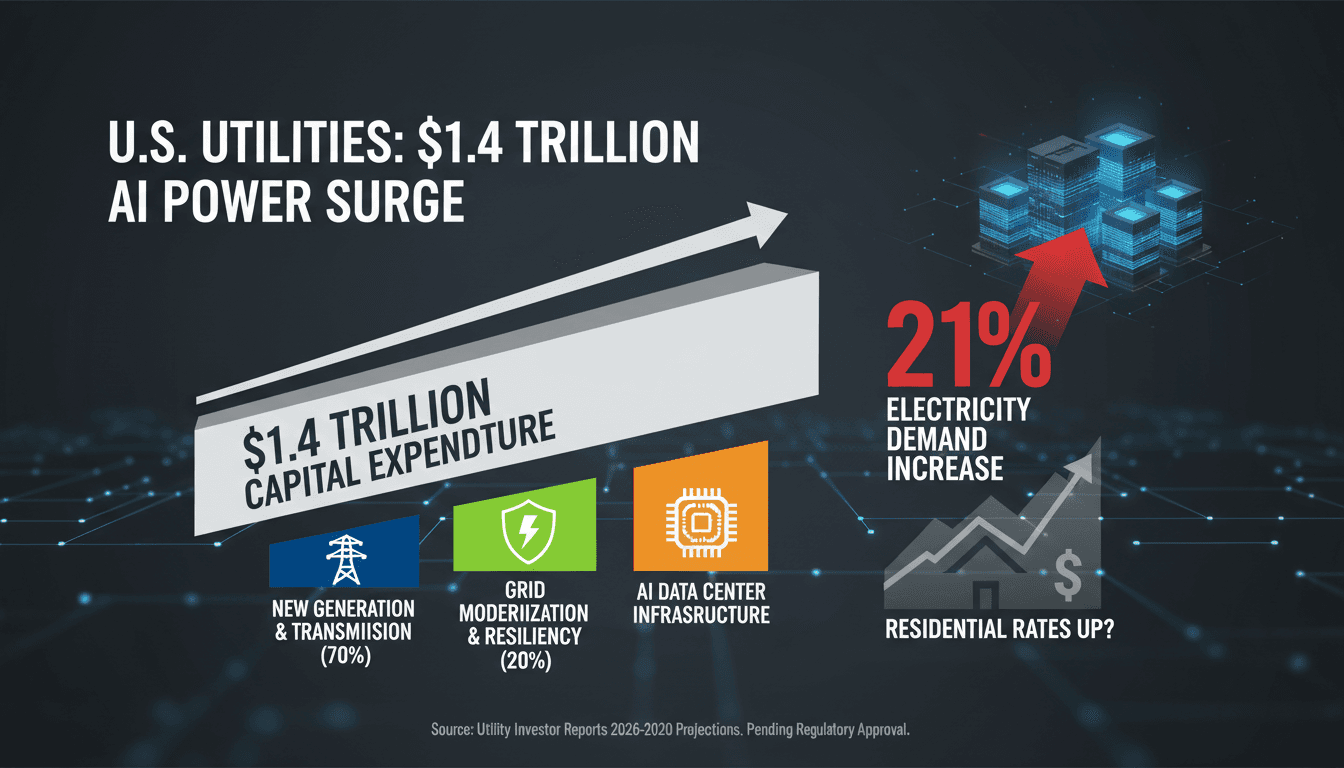
The $1.4 trillion capital expenditure projection by U.S. investor-owned utilities marks a significant escalation in spending, up 21% from previous five-year plans. This surge is largely attributed to the burgeoning demand from AI data centers, which have emerged as a primary load driver for 32 of the 51 utilities analyzed. For instance, American Electric Power anticipates a staggering 56,000 MW growth, with 88% of that demand stemming from data centers. Similarly, Xcel Energy plans to double its capacity to 6,000 MW by 2027, underscoring the urgency of this infrastructure overhaul.
The implications of this spending spree extend beyond mere numbers; they reflect a fundamental shift in how electricity is consumed and managed. As AI technologies proliferate, utilities are compelled to adapt their infrastructure to accommodate this new reality. This includes not only expanding generation capacity but also enhancing transmission and distribution networks to ensure reliability and resiliency against extreme weather events. In fact, 49.3% of the proposed expenditures are earmarked for transmission and distribution improvements, while 29.8% is allocated for generation enhancements.
However, the financial burden of these investments raises concerns about potential rate increases for residential customers. Utilities have historically linked capital expenditures to rate requests, with $31 billion in rate requests made in 2025 alone. As state regulatory bodies review these spending plans, the outcome will significantly impact consumer electricity bills. The Ratepayer Protection Pledge, signed by major tech firms like Google and Microsoft, aims to ensure that these companies contribute to the infrastructure costs associated with their data centers, but the extent to which this will alleviate pressure on residential rates remains uncertain.
Moreover, the backdrop of rising electricity bills—up 40% since 2021—adds another layer of complexity. Consumer advocates and organizations like PowerLines are urging regulators to prioritize efficiency and scrutinize the prudence of these expenditures. With bipartisan concerns about the financial implications for consumers, some states, like Alabama, have implemented measures such as rate freezes to mitigate the impact of rising costs.
Who feels it first (and how)
- Residential consumers: Likely to see increased electricity bills as utilities pass on costs.
- Tech companies: Major players like Google and Microsoft may face higher operational costs, influencing pricing strategies.
- Utility regulators: Under pressure to balance infrastructure needs with consumer protection, impacting decision-making processes.
What to watch next
- State regulatory decisions: Monitor how state commissions respond to utility spending plans and their implications for consumer rates.
- Tech company commitments: Watch for further pledges from tech giants regarding infrastructure funding and their impact on utility costs.
- Consumer advocacy movements: Keep an eye on emerging consumer advocacy efforts aimed at ensuring fair pricing and efficiency in utility spending.
Utilities are planning $1.4 trillion in capital expenditures through 2030.
Residential electricity rates may increase as utilities seek to recover costs.
The extent to which tech companies' pledges will offset costs for consumers.
Frequently Asked Questions
- Why it matters?
- This unprecedented investment reflects a critical shift in energy demand dynamics, driven by the rapid expansion of AI technologies.
- What happened (in 30 seconds)?
- PowerLines reported that 51 U.S. investor-owned utilities plan to spend $1.4 trillion from 2026 to 2030. Electricity demand from AI data centers is a primary driver, with utilities reporting it as a key load factor in 32 of the plans analyzed. Rate increases for consumers may follow, pending state regulatory approvals, amid a backdrop of historical bill rises of 40% since 2021.
- What's really happening?
- The $1.4 trillion capital expenditure projection by U.S. investor-owned utilities marks a significant escalation in spending, up 21% from previous five-year plans. This surge is largely attributed to the burgeoning demand from AI data centers, which have emerged as a primary load driver for 32 of the 51 utilities analyzed. For instance, American Electric Power anticipates a staggering 56,000 MW growth, with 88% of that demand stemming from data centers. Similarly, Xcel Energy plans to double its
- Who feels it first (and how)?
- Residential consumers: Likely to see increased electricity bills as utilities pass on costs. Tech companies: Major players like Google and Microsoft may face higher operational costs, influencing pricing strategies. Utility regulators: Under pressure to balance infrastructure needs with consumer protection, impacting decision-making processes.
- What to watch next?
- State regulatory decisions: Monitor how state commissions respond to utility spending plans and their implications for consumer rates. Tech company commitments: Watch for further pledges from tech giants regarding infrastructure funding and their impact on utility costs. Consumer advocacy movements: Keep an eye on emerging consumer advocacy efforts aimed at ensuring fair pricing and efficiency in utility spending.
Breaking news, politics, business, and entertainment from the U.S. and around the world.
"The New York Post is a tabloid-format newspaper known for its sensationalist headlines and conservative-leaning editorial tone."
— A47 Editor
$1.4 trillion utility spending spree to keep up with AI data centers could hike electric bills: study
US utilities are set to invest a record $1.4 trillion in the power grid to meet the increasing demands of data centers, particularly those driven by artificial intelligence. This significant expenditure is expected to lead to higher electricity bills...
Corporate leadership, finance, technology, and market trends.
"Fortune covers financial trends, leadership, and innovation with a pragmatic editorial approach."
— A47 Editor
U.S. utilities are planning a $1.4 trillion spending spree, up 30%, over the next five years amid the AI construction boom
U.S. utilities are set to embark on a significant $1.4 trillion spending spree over the next five years, marking a 30% increase in capital spending plans. This surge in investment is occurring alongside rising consumer rate hikes, although the two fa...
U.S. business news, corporate developments, and economy.
"The Wall Street Journal is respected for deep financial and economic reporting with a center-right editorial perspective."
— A47 Editor
Utilities Plan to Spend $1.4 Trillion Over Next Five Years to Power AI Boom
A recent report reveals that 51 investor-owned utilities plan to invest $1.4 trillion over the next five years to upgrade the aging power grid and accommodate the increasing electricity demand driven by artificial intelligence (AI) technologies.