
Intensified Israeli Airstrikes and Hezbollah Retaliation Escalate Conflict in Lebanon
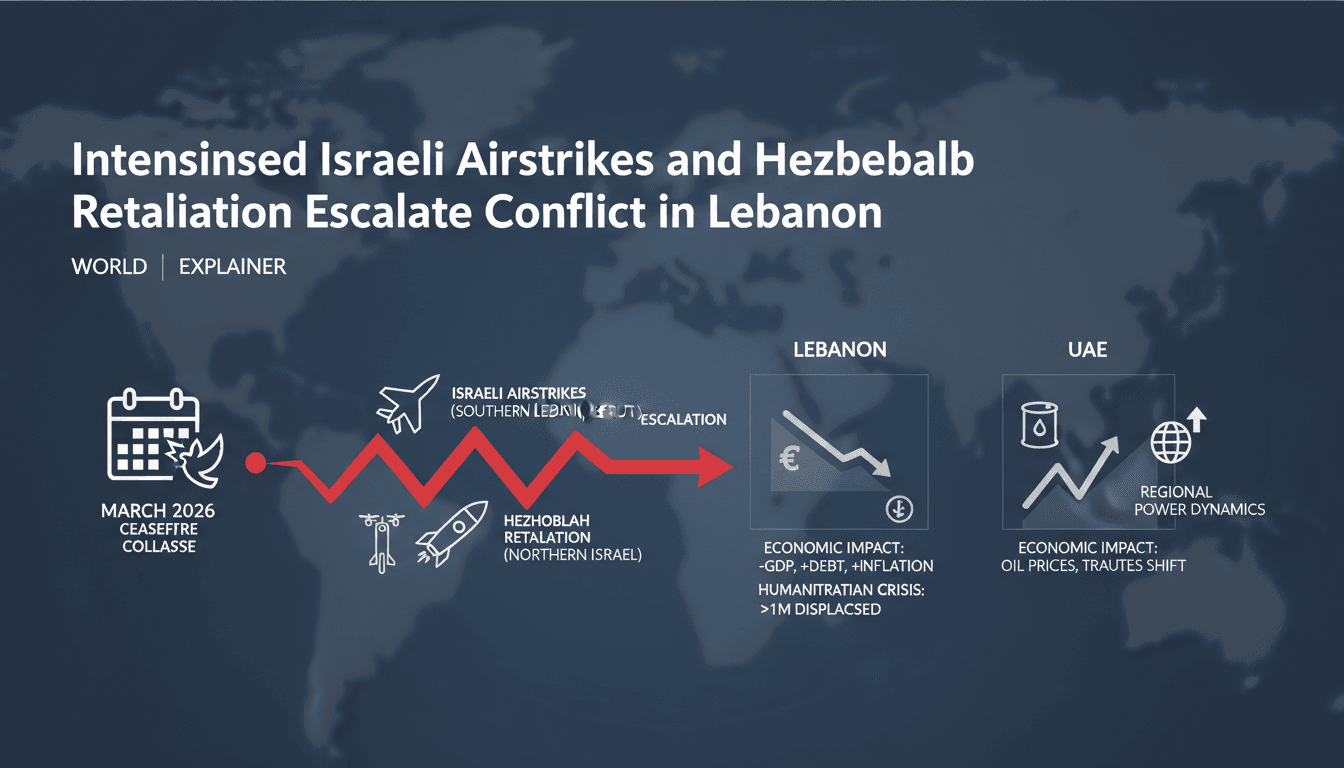
Here's what it means for you.
The escalating conflict in Lebanon could disrupt global markets and impact international travel, affecting your business operations and investments.
Why it matters
The ongoing violence threatens regional stability, which can lead to economic repercussions that ripple across global markets.
What happened (in 30 seconds)
- Israeli airstrikes targeted multiple locations in southern Lebanon and Beirut on April 6, 2026, amid ongoing ground operations.
- Hezbollah retaliated with rocket and drone strikes into northern Israel, escalating the conflict that reignited in early March 2026.
- Over one million Lebanese have been displaced, prompting widespread evacuation orders and significant casualties.
The context you actually need
- Ceasefire collapse: The current escalation follows the breakdown of a November 2024 ceasefire, which ended a prolonged border conflict initiated by the October 2023 Hamas attack on Israel.
- Ongoing violations: Despite the ceasefire, Israel conducted near-daily strikes, leading to a full-scale renewal of hostilities on March 2, 2026, when Hezbollah launched rockets in support of Iran.
- Casualties and displacement: Since early March, 1,497 Lebanese fatalities have been reported, with over 4,639 wounded, highlighting the severe humanitarian impact of the conflict.
What's really happening
The recent escalation of violence in Lebanon is a complex interplay of historical grievances, geopolitical maneuvers, and immediate tactical responses. Following the collapse of the ceasefire in November 2024, tensions simmered as Israel continued its military operations against Hezbollah, which it accused of violating the terms of the ceasefire. The situation intensified dramatically on March 2, 2026, when Hezbollah launched a series of rocket attacks into northern Israel, ostensibly in support of Iran amidst the broader US-Israel conflict against Tehran.
In response, Israel ramped up its military operations, conducting extensive airstrikes across southern Lebanon and targeting Hezbollah infrastructure. This included key sites in the Bekaa Valley and Beirut's southern suburbs, which are known to house both military assets and civilian populations. The Israeli Defense Forces (IDF) aimed to dismantle Hezbollah's operational capabilities, claiming to have killed high-ranking officials and disrupted critical supply lines.
The humanitarian toll has been severe, with over one million Lebanese displaced and significant casualties reported. The Lebanese Health Ministry has documented 1,497 deaths and 4,639 injuries since the escalation began. This has prompted urgent calls for ceasefire negotiations from Lebanese leadership, including Prime Minister Nawaf Salam, who has sought to ban Hezbollah's military activities and enforce army restrictions.
The conflict has broader implications beyond the immediate region. The UAE stock markets have lost over $120 billion in capitalization since late February 2026, reflecting investor fears over the stability of the Middle East. Additionally, travel disruptions, including the cancellation of over 18,400 flights across UAE airports, have severely impacted tourism and real estate sectors, with transactions plummeting by up to 50%.
As the situation continues to evolve, the potential for further escalation remains high, with both sides entrenched in their positions. The international community watches closely, as the ramifications of this conflict could extend far beyond Lebanon, affecting global economic stability and security.
Who feels it first (and how)
- Lebanese civilians: Facing displacement and casualties, with over one million affected.
- Investors in the UAE: Experiencing significant losses in stock markets and real estate transactions.
- Travel and tourism sectors: Suffering from flight cancellations and reduced visitor numbers, impacting local economies.
What to watch next
- International diplomatic efforts: Watch for potential ceasefire negotiations as Lebanese leaders call for talks with Israel, which could stabilize the region.
- Market reactions: Monitor stock market fluctuations in the UAE and other Gulf states, as ongoing violence may lead to further economic instability.
- Humanitarian responses: Keep an eye on international aid efforts aimed at addressing the humanitarian crisis in Lebanon, which could influence public sentiment and regional stability.
The conflict has resulted in significant casualties and displacement in Lebanon.
Continued military operations from both Israel and Hezbollah, with potential for further escalation.
The effectiveness of diplomatic efforts to broker a ceasefire and restore stability in the region.
Frequently Asked Questions
- Why it matters?
- The ongoing violence threatens regional stability, which can lead to economic repercussions that ripple across global markets.
- What happened (in 30 seconds)?
- Israeli airstrikes targeted multiple locations in southern Lebanon and Beirut on April 6, 2026, amid ongoing ground operations. Hezbollah retaliated with rocket and drone strikes into northern Israel, escalating the conflict that reignited in early March 2026. Over one million Lebanese have been displaced, prompting widespread evacuation orders and significant casualties.
- What's really happening?
- The recent escalation of violence in Lebanon is a complex interplay of historical grievances, geopolitical maneuvers, and immediate tactical responses. Following the collapse of the ceasefire in November 2024, tensions simmered as Israel continued its military operations against Hezbollah, which it accused of violating the terms of the ceasefire. The situation intensified dramatically on March 2, 2026, when Hezbollah launched a series of rocket attacks into northern Israel, ostensibly in support
- Who feels it first (and how)?
- Lebanese civilians: Facing displacement and casualties, with over one million affected. Investors in the UAE: Experiencing significant losses in stock markets and real estate transactions. Travel and tourism sectors: Suffering from flight cancellations and reduced visitor numbers, impacting local economies.
- What to watch next?
- International diplomatic efforts: Watch for potential ceasefire negotiations as Lebanese leaders call for talks with Israel, which could stabilize the region. Market reactions: Monitor stock market fluctuations in the UAE and other Gulf states, as ongoing violence may lead to further economic instability. Humanitarian responses: Keep an eye on international aid efforts aimed at addressing the humanitarian crisis in Lebanon, which could influence public sentiment and regional stability.
Arabic-language coverage of international news and geopolitics.
"RT Arabic is a Russian state-funded outlet often criticized for promoting Kremlin-aligned narratives."
— A47 Editor
لحظة بلحظة.. الحرب الإسرائيلية على لبنان تتواصل
The conflict in Lebanon escalates as Israel conducts intensive airstrikes across the southern regions, the suburbs, and the Bekaa Valley, while Hezbollah continues to target Israeli positions, coinciding with Israel's efforts to expand its ground ope...
Arabic-language UAE newspaper coverage focused on domestic affairs, public institutions, business, society, and regional developments.
"Al Khaleej coverage generally reflects a mainstream UAE editorial lens with strong attention to public affairs, institutions, and regional developments."
— A47 Editor
إسرائيل تجمد التوغل وسط معارك جنوب لبنان
Israeli warplanes intensified their airstrikes on southern Lebanon on Monday, extending their operations through the southern suburbs of Beirut. This escalation comes amid ongoing clashes in the region, highlighting the heightened tensions and milita...
Pan-Arab news coverage spanning politics, business, sports, and regional affairs.
"Asharq Al-Awsat reflects a broad Arab editorial perspective with strong attention to regional geopolitics."
— A47 Editor
إسرائيل تحوّل ثقل المعركة مع «حزب الله» إلى محيط بيروت
The Israeli military shifted the focus of its conflict with Hezbollah on Sunday towards the southern suburbs of Beirut, which experienced eight airstrikes amid continuous flights of warplanes. This escalation marks a significant intensification of ho...