
Alex Bores Introduces AI Dividend Plan to Address Job Losses from AI Adoption
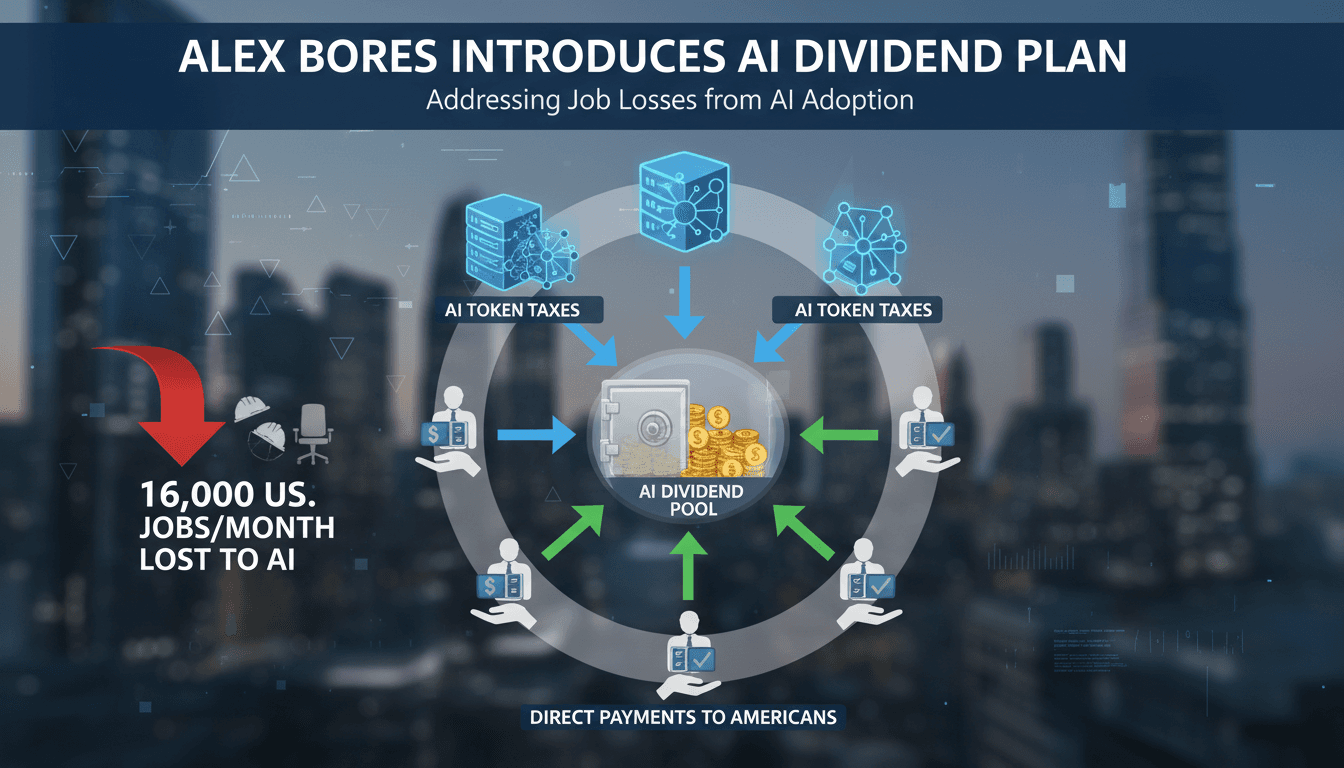
Here's what it means for you.
If you’re in a job vulnerable to AI disruption, this proposal could directly impact your financial security.
Why it matters
The AI Dividend plan addresses growing concerns over job displacement due to artificial intelligence, potentially reshaping the economic landscape for workers.
What happened (in 30 seconds)
- On April 20, 2026, New York Assemblymember Alex Bores announced the AI Dividend plan to provide direct payments to Americans facing job losses from AI.
- The proposal aims to fund these payments through taxes on AI token usage, equity stakes in AI firms, and tax reforms favoring human labor.
- Media coverage has sparked discussions on AI's impact on employment and wealth distribution, with mixed reactions from the public and experts.
The context you actually need
- Job losses attributed to AI have reached a net loss of 16,000 U.S. jobs per month, according to a Goldman Sachs analysis.
- Major tech firms like Amazon and Meta have conducted layoffs linked to AI efficiencies, raising alarms about the future of work.
- Bores' background as a former Palantir engineer positions him uniquely to advocate for AI governance, emphasizing the need for proactive measures.
What's really happening
The AI Dividend proposal by Alex Bores is a response to the increasing fears surrounding job displacement due to artificial intelligence. As AI technologies advance, they are not only automating tasks but also reshaping entire industries, leading to significant job losses. A recent Goldman Sachs report highlighted that AI substitution has resulted in a net loss of approximately 16,000 jobs per month in the U.S., with younger workers being disproportionately affected. This alarming trend has prompted policymakers to consider innovative solutions to mitigate the economic fallout.
Bores' plan is structured around three main funding pillars: a tax on AI inference tokens, government equity stakes in leading AI companies, and tax reforms that incentivize human hiring over capital investments in AI. The tax on AI tokens aims to create a revenue stream directly linked to the technologies that are causing job displacement. By taxing the very tools that contribute to job losses, the proposal seeks to redistribute wealth generated by AI productivity gains.
The equity stakes in AI firms represent a forward-thinking approach to ensure that the public benefits from the profits generated by these companies. As AI firms continue to grow and dominate the market, having a stake in their success could provide a sustainable funding source for the AI Dividend. This aligns with the broader conversation about wealth concentration and the need for equitable distribution of resources in an increasingly automated economy.
Tax reforms favoring human labor over AI investments are crucial for encouraging companies to retain and hire human workers. By adjusting the tax code, Bores aims to create a financial incentive for businesses to prioritize human capital, which could help counterbalance the trend of automation-driven job losses.
The proposal has sparked a heated debate, with supporters viewing it as a necessary insurance policy against economic disruption, while critics label it as a form of "AI socialism." The mixed reactions highlight the complexities of addressing AI's impact on the labor market. As discussions continue, the proposal could serve as a blueprint for other regions grappling with similar challenges.
Who feels it first (and how)
- Young workers: Most vulnerable to job losses due to AI adoption.
- Tech industry employees: Facing layoffs as companies streamline operations through AI efficiencies.
- Low-income workers: Likely to experience the most significant impact from job displacement without adequate safety nets.
What to watch next
- Public response: Monitor how constituents react to the AI Dividend proposal and its potential influence on Bores' congressional campaign.
- Legislative developments: Watch for any formal governmental responses or similar proposals emerging in other states.
- Job market trends: Keep an eye on employment statistics to see if AI adoption continues to correlate with job losses or if new opportunities arise.
AI adoption is leading to significant job losses, particularly among younger workers.
The AI Dividend proposal will continue to generate public discourse and may influence future policy discussions.
The long-term effectiveness of the AI Dividend in mitigating job displacement remains to be seen.
Frequently Asked Questions
- Why it matters?
- The AI Dividend plan addresses growing concerns over job displacement due to artificial intelligence, potentially reshaping the economic landscape for workers.
- What happened (in 30 seconds)?
- On April 20, 2026, New York Assemblymember Alex Bores announced the AI Dividend plan to provide direct payments to Americans facing job losses from AI. The proposal aims to fund these payments through taxes on AI token usage, equity stakes in AI firms, and tax reforms favoring human labor. Media coverage has sparked discussions on AI's impact on employment and wealth distribution, with mixed reactions from the public and experts.
- What's really happening?
- The AI Dividend proposal by Alex Bores is a response to the increasing fears surrounding job displacement due to artificial intelligence. As AI technologies advance, they are not only automating tasks but also reshaping entire industries, leading to significant job losses. A recent Goldman Sachs report highlighted that AI substitution has resulted in a net loss of approximately 16,000 jobs per month in the U.S., with younger workers being disproportionately affected. This alarming trend has prom
- Who feels it first (and how)?
- Young workers: Most vulnerable to job losses due to AI adoption. Tech industry employees: Facing layoffs as companies streamline operations through AI efficiencies. Low-income workers: Likely to experience the most significant impact from job displacement without adequate safety nets.
- What to watch next?
- Public response: Monitor how constituents react to the AI Dividend proposal and its potential influence on Bores' congressional campaign. Legislative developments: Watch for any formal governmental responses or similar proposals emerging in other states. Job market trends: Keep an eye on employment statistics to see if AI adoption continues to correlate with job losses or if new opportunities arise.
Real-time updates, analysis, and reports on the blockchain and cryptocurrency sectors.
"Crypto News delivers real-time updates, analysis, and reports on the blockchain and cryptocurrency sectors."
— A47 Editor
New York candidate proposes AI dividend plan as job loss debate grows
New York lawmaker Alex Bores has proposed an AI dividend plan aimed at addressing potential job losses due to automation, suggesting that funding could come from taxes on AI and equity stakes in AI companies. This proposal emerges amid growing concer...
Covers blockchain, cryptocurrency news, project analysis, and market insights.
"Cointelegraph is a leading crypto-focused media outlet known for timely news, analysis, and educational content related to blockchain and digital assets."
— A47 Editor
NY lawmaker proposes ‘AI dividend’ to address potential job losses
A New York lawmaker has proposed an 'AI dividend' aimed at addressing potential job losses resulting from automation. This initiative would be funded through taxes on artificial intelligence usage and equity stakes in AI companies, providing financia...