
Sullivan & Cromwell Admits AI Errors in Bankruptcy Filing Amid Legal Scrutiny
Here's what it means for you.
If you're in the legal profession or rely on legal services, the implications of AI errors could affect the reliability of legal documents you encounter.
Why it matters
The incident underscores the growing risks associated with AI in high-stakes legal environments, raising questions about accountability and verification.
What happened (in 30 seconds)
- On April 9, 2026, Sullivan & Cromwell filed a motion in bankruptcy court that contained numerous AI-generated errors, including fabricated case citations.
- Opposing counsel Boies Schiller Flexner LLP identified these errors, prompting an apology from Sullivan & Cromwell's partner Andrew Dietderich on April 18, 2026.
- No sanctions were imposed by Judge Martin Glenn as of April 22, 2026, but the firm committed to improving its AI usage policies.
The context you actually need
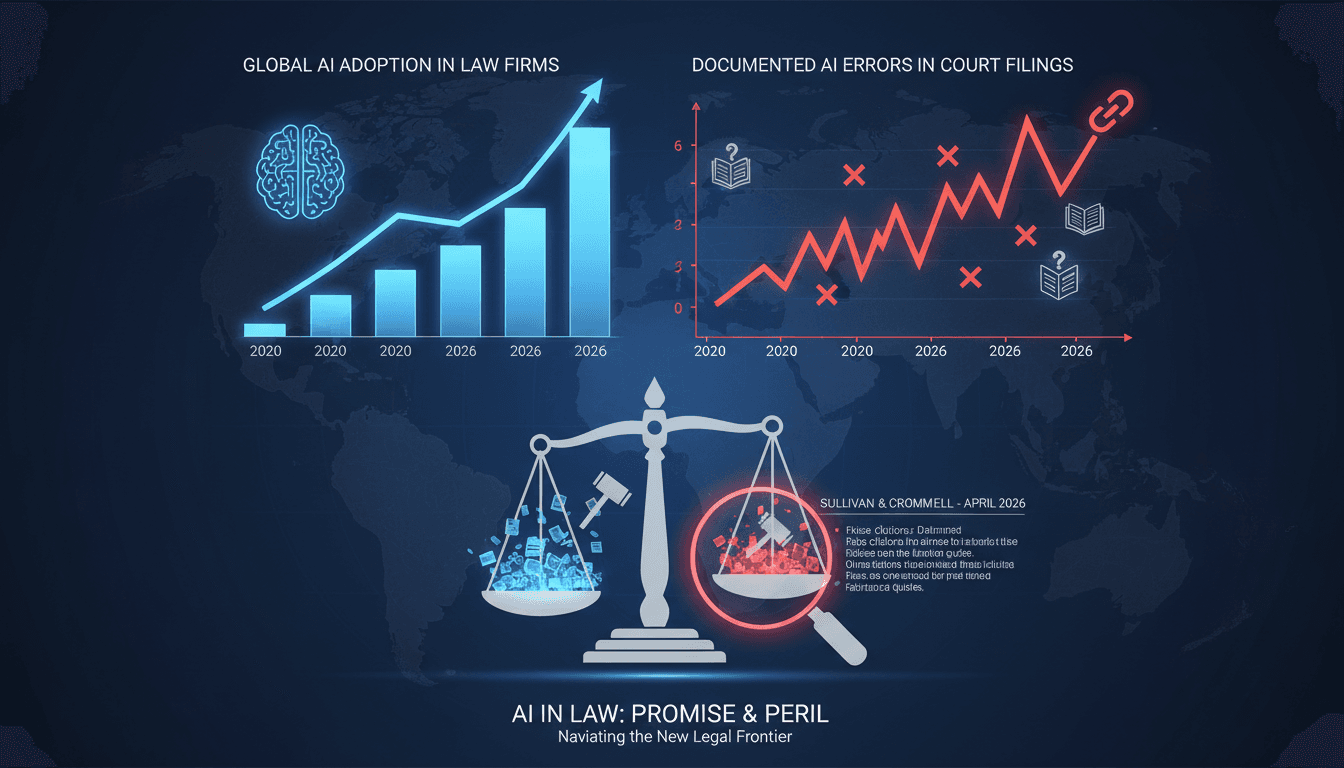
- Generative AI hallucinations—the phenomenon of AI producing plausible but false information—have been documented in over 650 U.S. court cases, raising concerns about their reliability.
- Sullivan & Cromwell, a prestigious law firm, has previously advised on AI ethics, making this incident particularly ironic and damaging to its reputation.
- The legal actions against Prince Global Holdings Limited, linked to a multibillion-dollar forced-labor scam, highlight the intersection of technology and serious criminal activity, amplifying the stakes involved.
What's really happening
The recent incident involving Sullivan & Cromwell reveals a critical tension between the adoption of advanced AI technologies and the fundamental need for accuracy in legal documentation. As law firms increasingly integrate AI tools to streamline processes and enhance efficiency, the risk of errors—especially those stemming from AI hallucinations—has become a pressing concern.
In this case, Sullivan & Cromwell's use of AI in preparing a motion for the U.S. Bankruptcy Court resulted in significant inaccuracies, including incorrect citations and misquotes of the U.S. bankruptcy code. These errors were not merely clerical; they could have substantial implications for the legal proceedings involving Prince Global Holdings Limited, a company already embroiled in serious allegations of fraud and forced labor.
The firm’s reliance on AI reflects a broader trend in the legal industry where firms are under pressure to reduce costs and improve turnaround times. However, this rush to adopt AI without stringent oversight can lead to lapses in quality control. The fact that Sullivan & Cromwell, a firm known for its expertise and advisory role in AI ethics, fell victim to such errors raises questions about the adequacy of existing policies and training regarding AI usage.
Moreover, the incident has sparked discussions within the legal community about the ethical obligations of lawyers to verify AI-generated content. As AI continues to evolve, the legal profession must grapple with the balance between leveraging technology for efficiency and ensuring the integrity of legal processes. The absence of sanctions from Judge Glenn may indicate a recognition of the complexities involved, but it also highlights the need for clearer guidelines and accountability measures in the use of AI in legal contexts.
As the legal landscape adapts to these technological advancements, firms must prioritize robust training and verification processes to mitigate the risks associated with AI. The Sullivan & Cromwell case serves as a cautionary tale, emphasizing that while AI can enhance legal practice, it must be approached with caution and diligence to avoid undermining the very foundations of the legal system.
Who feels it first (and how)
- Legal professionals: Lawyers and paralegals may face increased scrutiny and pressure to ensure the accuracy of AI-generated documents.
- Clients: Individuals and businesses relying on legal services could experience delays or complications due to potential inaccuracies in filings.
- Regulatory bodies: Organizations overseeing legal practices may need to implement new guidelines for AI usage to safeguard against errors.
What to watch next
- Increased scrutiny on AI policies: Watch for law firms to enhance their AI usage policies and training programs in response to this incident, which could set new industry standards.
- Regulatory developments: Keep an eye on potential regulatory changes regarding AI in legal practice, as authorities may seek to establish clearer guidelines for accountability.
- Litigation outcomes: Monitor the ongoing bankruptcy proceedings involving Prince Global Holdings Limited, as the implications of the AI errors could influence the case's trajectory.
AI-generated errors can undermine the integrity of legal documents and proceedings.
Law firms will face increased pressure to implement rigorous verification processes for AI-generated content.
The long-term impact of this incident on public trust in legal services and AI technology remains to be seen.
Frequently Asked Questions
- Why it matters?
- The incident underscores the growing risks associated with AI in high-stakes legal environments, raising questions about accountability and verification.
- What happened (in 30 seconds)?
- On April 9, 2026, Sullivan & Cromwell filed a motion in bankruptcy court that contained numerous AI-generated errors, including fabricated case citations. Opposing counsel Boies Schiller Flexner LLP identified these errors, prompting an apology from Sullivan & Cromwell's partner Andrew Dietderich on April 18, 2026. No sanctions were imposed by Judge Martin Glenn as of April 22, 2026, but the firm committed to improving its AI usage policies.
- What's really happening?
- The recent incident involving Sullivan & Cromwell reveals a critical tension between the adoption of advanced AI technologies and the fundamental need for accuracy in legal documentation. As law firms increasingly integrate AI tools to streamline processes and enhance efficiency, the risk of errors—especially those stemming from AI hallucinations—has become a pressing concern. In this case, Sullivan & Cromwell's use of AI in preparing a motion for the U.S. Bankruptcy Court resulted in signific
- Who feels it first (and how)?
- Legal professionals: Lawyers and paralegals may face increased scrutiny and pressure to ensure the accuracy of AI-generated documents. Clients: Individuals and businesses relying on legal services could experience delays or complications due to potential inaccuracies in filings. Regulatory bodies: Organizations overseeing legal practices may need to implement new guidelines for AI usage to safeguard against errors.
- What to watch next?
- Increased scrutiny on AI policies: Watch for law firms to enhance their AI usage policies and training programs in response to this incident, which could set new industry standards. Regulatory developments: Keep an eye on potential regulatory changes regarding AI in legal practice, as authorities may seek to establish clearer guidelines for accountability. Litigation outcomes: Monitor the ongoing bankruptcy proceedings involving Prince Global Holdings Limited, as the implications of the AI error
News and features on AI from The Guardian.
"Progressive-leaning international outlet with critical AI coverage."
— A47 Editor
AI hallucinations found in high-profile Wall Street law firm filing
Sullivan & Cromwell, a prominent Wall Street law firm, has issued an apology to a New York federal judge after acknowledging that a major filing in the Prince Group case contained errors attributed to artificial intelligence 'hallucinations.' The fir...
UK and international business news, economics, and corporate coverage.
"The Guardian’s business section covers finance and markets with a progressive editorial tone."
— A47 Editor
AI hallucinations found in high-profile Wall Street law firm filing
The elite Wall Street law firm Sullivan & Cromwell has issued an apology to a New York federal judge after acknowledging that errors in a major filing for the Prince Group case were caused by artificial intelligence 'hallucinations.' The mistakes inc...
Tech culture, product news, and critical takes on the tech industry's social impact.
"The Guardian's tech coverage blends mainstream news, critical analysis, and cultural commentary on emerging technologies and digital trends."
— A47 Editor
AI hallucinations found in high-profile Wall Street law firm filing
The elite Wall Street law firm Sullivan & Cromwell has issued an apology to a New York federal judge after acknowledging that errors in a major filing for the Prince Group case were caused by artificial intelligence 'hallucinations.' The mistakes inc...
Real-time updates, analysis, and reports on the blockchain and cryptocurrency sectors.
"Crypto News delivers real-time updates, analysis, and reports on the blockchain and cryptocurrency sectors."
— A47 Editor
Top US law firm admits AI hallucinations in legal filing
Sullivan & Cromwell, a prominent U.S. law firm, has publicly apologized after a legal filing contained approximately 40 incorrect citations and errors attributed to the use of artificial intelligence (AI), referred to as AI hallucinations. This incid...
Covers blockchain, cryptocurrency news, project analysis, and market insights.
"Cointelegraph is a leading crypto-focused media outlet known for timely news, analysis, and educational content related to blockchain and digital assets."
— A47 Editor
US law firm apologizes after AI hallucinations made it to legal filing
Sullivan & Cromwell, a prominent U.S. law firm, has issued a public apology after a legal filing was found to contain approximately 40 incorrect citations and errors due to the use of artificial intelligence, commonly referred to as AI hallucinations...
Curated tech headlines including AI stories.
"Influential aggregator surfacing the day’s top tech/AI links."
— A47 Editor
Top law firm Sullivan & Cromwell told a US federal bankruptcy court that a major filing it made in a high-profile case contained multiple AI hallucinations (Financial Times)
Sullivan & Cromwell, a prominent law firm, informed a US federal bankruptcy court that a significant filing in a high-profile case contained multiple instances of AI hallucinations, leading to erroneous citations generated by artificial intelligence.
Business and tech news excluding paywalled content.
"High-volume business/tech outlet with frequent AI coverage."
— A47 Editor
AI hallucinated — and now an elite law firm is profusely apologizing to a federal judge
Sullivan & Cromwell, a prominent law firm, has issued a public apology to a federal bankruptcy judge after submitting a court motion that included erroneous citations generated by artificial intelligence, a phenomenon referred to as AI hallucination....
Technology business and AI-related headlines.
"Data-driven tech newsroom with global scope."
— A47 Editor
Top Law Firm Apologizes to Bankruptcy Judge for AI Hallucination
Sullivan & Cromwell, a leading law firm on Wall Street, has issued an apology to a bankruptcy judge after submitting a court motion that contained inaccurate citations generated by artificial intelligence. This incident was reported in a filing to th...
Technology business news, market impacts, and innovation trends.
"Bloomberg is a premier financial and tech news provider, respected for its in-depth reporting and analytical rigor."
— A47 Editor
Top Law Firm Apologizes to Bankruptcy Judge for AI Hallucination
Sullivan & Cromwell, a leading law firm on Wall Street, has issued an apology to a bankruptcy judge after submitting a court motion that contained inaccurate citations generated by artificial intelligence. This incident was reported in a filing to th...
Editor-curated FT homepage stories spanning markets, business, world, and opinion.
"The Financial Times is a globally respected business publication with a centrist/center-left tone and strong markets focus."
— A47 Editor
Elite law firm Sullivan & Cromwell admits to AI ‘hallucinations’
Elite law firm Sullivan & Cromwell has publicly acknowledged errors attributed to artificial intelligence, referred to as 'hallucinations,' during a bankruptcy case, leading to an apology to the presiding judge. This admission highlights the challeng...