
Israel Launches Airstrikes on Hezbollah in Lebanon Amid US-Iran Ceasefire Announcement
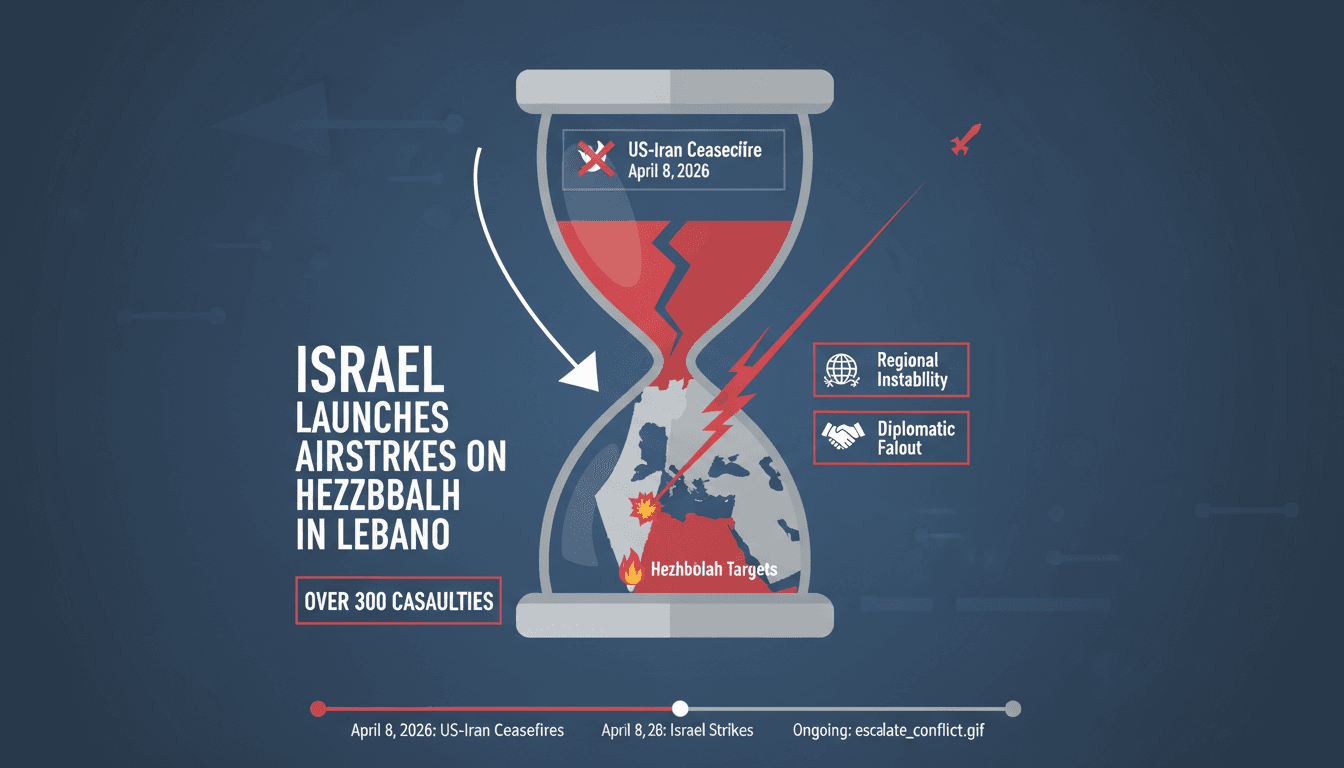
Here's what it means for you.
The ongoing conflict in Lebanon could lead to significant economic repercussions across the Gulf Cooperation Council (GCC), affecting trade, investment, and regional stability.
Why it matters
This escalation in Lebanon could destabilize the region further, impacting global energy markets and international trade routes.
What happened (in 30 seconds)
- Netanyahu announced there is "no ceasefire in Lebanon" as Israel conducted airstrikes on Hezbollah, resulting in over 300 fatalities.
- The strikes targeted more than 100 Hezbollah sites, including command centers and launch sites, shortly after a US-Iran ceasefire was brokered.
- Lebanon's government declared national mourning as civilian casualties mounted, with the international community calling for an immediate ceasefire.
The context you actually need
- The 2026 Iran War began on February 28, escalating tensions in the region and drawing Hezbollah into the conflict.
- A US-brokered ceasefire was announced on April 8, 2026, but Israel maintained that it did not apply to Lebanon, aiming to neutralize Hezbollah threats.
- Lebanon's Health Ministry reported over 300 killed and more than 1,000 wounded in the airstrikes, highlighting the severe humanitarian impact of the conflict.
What's really happening
On April 8, 2026, a ceasefire between the US and Iran was announced, mediated by Pakistan, which aimed to de-escalate tensions in the region. However, Israel quickly rejected the notion that this truce applied to its operations in Lebanon, emphasizing its ongoing campaign against Hezbollah. The Israeli military launched a series of airstrikes targeting Hezbollah infrastructure, which they claim poses a direct threat to Israeli security.
The airstrikes were executed with precision, involving heavy munitions and targeting over 100 sites within a short timeframe. This rapid escalation resulted in significant civilian casualties, with reports indicating that more than 300 people were killed and over 1,000 injured within 24 hours. The strikes were not only a military operation but also a strategic message from Israel, reinforcing its stance against Hezbollah and its allies.
Netanyahu's declaration of "no ceasefire" reflects a broader strategy to dismantle Hezbollah's capabilities, which Israel perceives as a critical threat. The Israeli government is likely motivated by both security concerns and domestic political pressures, as the ongoing conflict has become a focal point in Israeli politics. The decision to continue strikes despite international calls for restraint indicates a willingness to prioritize military objectives over diplomatic negotiations.
The aftermath of these events has drawn condemnation from various international actors, including Iran, which threatened to close the Strait of Hormuz in response to the airstrikes. This threat has significant implications for global oil markets, as the Strait is a critical passage for oil shipments. The EU, UK, France, Canada, and Japan have all called for a ceasefire, highlighting the international community's concern over the escalating violence and its potential to destabilize the region further.
As the situation unfolds, the humanitarian crisis in Lebanon is expected to worsen, with the government declaring national mourning and facing immense pressure to respond to civilian casualties. The economic implications are also significant, as the conflict could lead to a slowdown in the GCC's projected economic growth, impacting sectors such as real estate and investment.
Who feels it first (and how)
- Lebanese civilians: Directly impacted by airstrikes, facing casualties and displacement.
- Hezbollah operatives: Targeted by Israeli military actions, facing operational disruptions.
- GCC investors: Potentially affected by economic slowdown and instability in the region.
- International shipping companies: Risk exposure due to threats to the Strait of Hormuz.
- Humanitarian organizations: Increased demand for aid in response to civilian casualties and displacement.
What to watch next
- International diplomatic responses: Watch for shifts in negotiations or calls for ceasefire from global powers, which could influence regional stability.
- Economic indicators in the GCC: Monitor economic growth projections and market reactions, particularly in real estate and investment sectors, as they may signal broader regional impacts.
- Hezbollah's military response: Any retaliatory actions from Hezbollah could escalate tensions further, affecting both local and international security dynamics.
Over 300 people were killed in the Israeli airstrikes on April 8, 2026.
Continued Israeli military operations against Hezbollah, with potential for further civilian casualties and international condemnation.
The long-term implications for regional stability and economic growth in the GCC following this escalation.
Frequently Asked Questions
- Why it matters?
- This escalation in Lebanon could destabilize the region further, impacting global energy markets and international trade routes.
- What happened (in 30 seconds)?
- Netanyahu announced there is "no ceasefire in Lebanon" as Israel conducted airstrikes on Hezbollah, resulting in over 300 fatalities. The strikes targeted more than 100 Hezbollah sites, including command centers and launch sites, shortly after a US-Iran ceasefire was brokered. Lebanon's government declared national mourning as civilian casualties mounted, with the international community calling for an immediate ceasefire.
- What's really happening?
- On April 8, 2026, a ceasefire between the US and Iran was announced, mediated by Pakistan, which aimed to de-escalate tensions in the region. However, Israel quickly rejected the notion that this truce applied to its operations in Lebanon, emphasizing its ongoing campaign against Hezbollah. The Israeli military launched a series of airstrikes targeting Hezbollah infrastructure, which they claim poses a direct threat to Israeli security. The airstrikes were executed with precision, involving he
- Who feels it first (and how)?
- Lebanese civilians: Directly impacted by airstrikes, facing casualties and displacement. Hezbollah operatives: Targeted by Israeli military actions, facing operational disruptions. GCC investors: Potentially affected by economic slowdown and instability in the region. International shipping companies: Risk exposure due to threats to the Strait of Hormuz. Humanitarian organizations: Increased demand for aid in response to civilian casualties and displacement.
- What to watch next?
- International diplomatic responses: Watch for shifts in negotiations or calls for ceasefire from global powers, which could influence regional stability. Economic indicators in the GCC: Monitor economic growth projections and market reactions, particularly in real estate and investment sectors, as they may signal broader regional impacts. Hezbollah's military response: Any retaliatory actions from Hezbollah could escalate tensions further, affecting both local and international security dyna
News from the United States including domestic politics, society, and culture.
"The Guardian is known for its progressive editorial stance and in-depth analysis, often advocating for social justice, environmental issues, and liberal values."
— A47 Editor
Netanyahu says there is no ceasefire in Lebanon as Israel launches fresh strikes
Israeli Prime Minister Benjamin Netanyahu has declared that there will be no ceasefire in Lebanon, as Israel continues its military operations against Hezbollah, resulting in over 300 casualties. This announcement follows a series of airstrikes targe...
International coverage from The Guardian's global desks.
"The Guardian is known for its progressive editorial stance and in-depth analysis."
— A47 Editor
Netanyahu says there is no ceasefire in Lebanon as Israel launches fresh strikes
Israeli Prime Minister Benjamin Netanyahu has declared that there will be no ceasefire in Lebanon, as Israel continues its military operations against Hezbollah, resulting in over 300 casualties. This announcement follows a series of airstrikes targe...
European coverage of Middle East politics and security issues.
"France 24 offers international reporting with a European editorial perspective."
— A47 Editor
Netanyahu greenlights Israel-Lebanon talks in Washington amid ceasefire tensions
Israeli Prime Minister Benjamin Netanyahu has approved negotiations with Lebanon to be held in Washington next week, amid escalating tensions and ongoing military actions in the region. This meeting comes as both countries face heavy strikes and risi...
Coverage of current events and conflicts in the Middle East.
"France 24 is viewed as a globally focused outlet with balanced coverage and a European perspective."
— A47 Editor
Netanyahu greenlights Israel-Lebanon talks in Washington amid ceasefire tensions
Israeli Prime Minister Benjamin Netanyahu has approved negotiations with Lebanon to be held in Washington next week, amid escalating tensions and ongoing military actions in the region. This meeting comes as both countries face heavy strikes and risi...
Global political, business, and cultural coverage from WSJ international desks.
"The Wall Street Journal offers extensive international reporting with a reputation for financial insight and a center-right editorial stance."
— A47 Editor
U.S. Races to Keep Israel’s Fight in Lebanon From Derailing Cease-Fire
U.S. President Donald Trump has urged Israeli Prime Minister Benjamin Netanyahu to restrain military actions against Hezbollah in Lebanon to prevent the escalation of conflict that could jeopardize a ceasefire agreement with Iran. This request comes ...