
Trump Considers Troop Withdrawal from Non-Supportive NATO Members Amid Iran Conflict
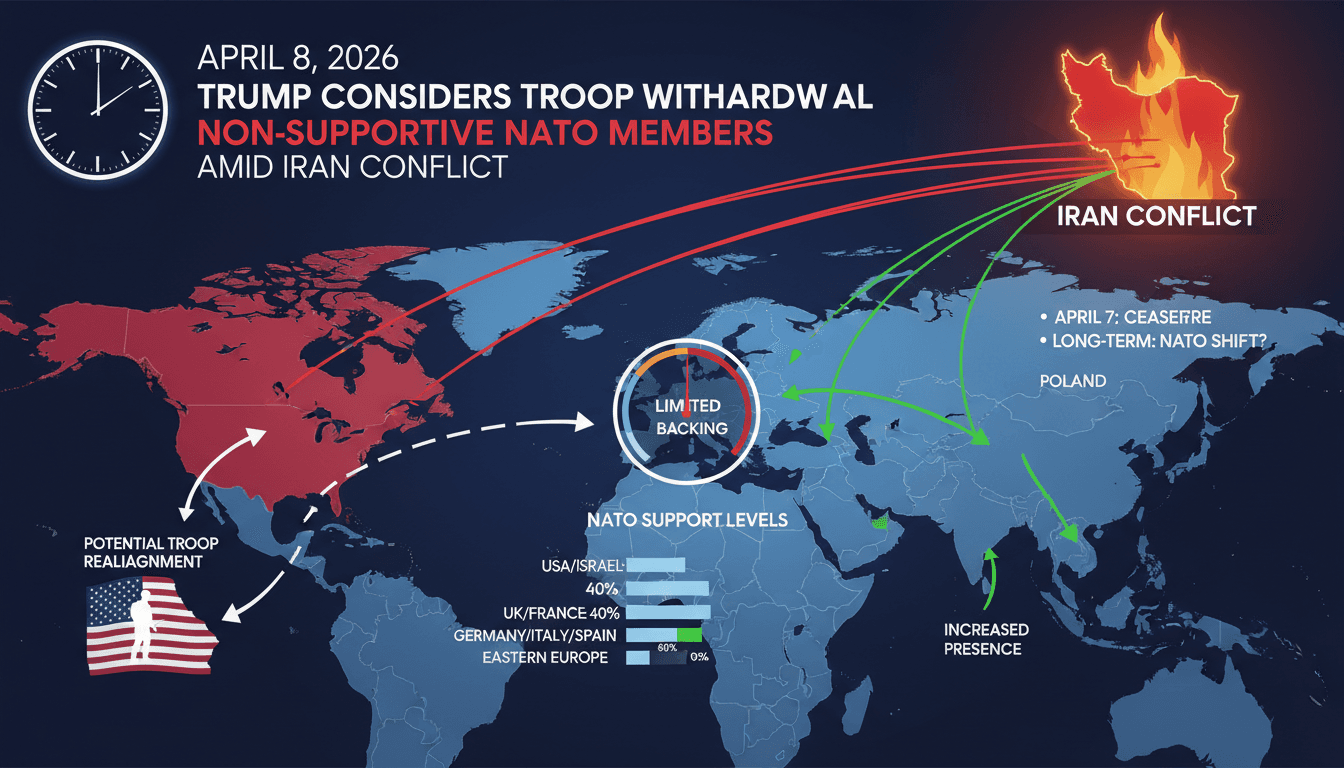
Here's what it means for you.
The potential shift in U.S. military presence could reshape global alliances and impact oil prices, affecting your business operations and travel plans.
Why it matters
The proposed troop relocations highlight fractures within NATO and could lead to increased geopolitical instability, influencing global markets.
What happened (in 30 seconds)
- On April 8, 2026, President Trump considered withdrawing U.S. troops from NATO countries that did not support the U.S.-Israel war against Iran.
- Only six NATO members publicly backed the U.S. actions, prompting discussions of troop realignment to more supportive allies.
- A ceasefire was announced on April 7, 2026, but tensions remain high due to the closure of the Strait of Hormuz.
The context you actually need
- The U.S.-Israel conflict with Iran escalated in March 2026, leading to airstrikes and a subsequent ceasefire that left the Strait of Hormuz closed.
- Trump's longstanding skepticism of NATO has been exacerbated by perceived insufficient support from key allies like the UK and France.
- A 2023 law requires congressional approval for any troop withdrawals, complicating Trump's proposal despite his administration's discussions.
What's really happening
The recent deliberations within the Trump administration about relocating U.S. troops from NATO member states that have not supported military actions against Iran underscore a significant shift in U.S. foreign policy. This move is not merely a tactical adjustment; it reflects deeper frustrations with NATO allies perceived as non-supportive during a critical geopolitical crisis.
The backdrop of this proposal is the ongoing conflict between the U.S. and Iran, which has intensified since the U.S. and Israel launched strikes against Iranian targets in March 2026. The closure of the Strait of Hormuz by Iran has not only escalated military tensions but also disrupted global oil supply chains, leading to soaring oil prices. With Brent crude exceeding $120 per barrel, the economic implications are profound, particularly for oil-dependent economies like Dubai, where rising fuel costs could stifle growth.
Trump's approach to NATO has always been transactional, emphasizing the need for allies to contribute more to collective defense. His administration's frustration is palpable, especially given that only six out of 32 NATO members publicly supported the U.S. and Israeli strikes. This limited backing has prompted discussions about punishing non-supportive nations, such as the UK, France, Italy, and Spain, by reallocating U.S. troops to countries that have shown solidarity, like Canada and the Czech Republic.
The implications of this strategy are multifaceted. On one hand, it could strengthen ties with supportive allies, reinforcing a more exclusive coalition. On the other hand, it risks fracturing NATO unity, which has been a cornerstone of transatlantic security since the Cold War. The potential for troop relocations raises questions about the future of U.S. military commitments in Europe and the broader implications for global security architecture.
Moreover, the 2023 law requiring congressional approval for troop withdrawals adds a layer of complexity to Trump's proposal. While the administration may be exploring these options, actual implementation would require navigating significant political hurdles. The reactions from NATO Secretary General Mark Rutte and U.S. Secretary of State Marco Rubio indicate a recognition of the delicate balance at play—one that could redefine U.S.-NATO relations in the post-conflict landscape.
Who feels it first (and how)
- NATO member states: Countries like the UK, France, Italy, and Spain may face diplomatic isolation and security vulnerabilities.
- Oil markets: Increased instability in the Middle East could lead to further price spikes, affecting consumers and businesses globally.
- UAE residents: Higher fuel costs and supply chain disruptions could impact daily life and economic growth in the region.
What to watch next
- Congressional response: Watch for legislative discussions regarding troop withdrawals, as this will indicate the level of support or opposition within the U.S. government.
- NATO summit outcomes: Future NATO meetings will reveal how member states respond to U.S. troop relocation proposals and their willingness to address collective defense responsibilities.
- Oil price fluctuations: Monitor Brent crude prices, as any escalation in the Iran conflict or changes in U.S. military posture could significantly impact global oil markets.
Only six NATO members publicly supported U.S. actions against Iran.
Increased tensions within NATO could lead to a reevaluation of military commitments and alliances.
The actual implementation of troop relocations remains uncertain due to legal and political constraints.
Insights by A47 Intelligence
Business, investment, entrepreneurship, leadership, and innovation.
"Forbes is known for its coverage of business leaders, market trends, and entrepreneurial ventures with a pro-business editorial stance."
— A47 Editor
Trump Mulls Pulling U.S. Troops Out Of NATO Countries Opposing Iran War, Report Says
President Donald Trump is reportedly considering withdrawing U.S. troops from NATO countries that have opposed the ongoing war with Iran, following his recent criticisms of several NATO members for their lack of support. This potential troop pullout ...
Breaking news, politics, business, and entertainment from the U.S. and around the world.
"The New York Post is a tabloid-format newspaper known for its sensationalist headlines and conservative-leaning editorial tone."
— A47 Editor
Trump mulls punishing NATO countries that didn’t assist Iran war effort: report
President Trump is reportedly considering punitive measures against NATO allies that did not support the U.S. in its military efforts against Iran, reflecting his dissatisfaction with their lack of assistance. This comes amid escalating tensions in t...
Global political, business, and cultural coverage from WSJ international desks.
"The Wall Street Journal offers extensive international reporting with a reputation for financial insight and a center-right editorial stance."
— A47 Editor
Trump Team Explores Punishment for NATO Countries That Didn’t Support Iran War
President Trump is exploring punitive measures against NATO countries that did not support U.S. military operations in Iran, potentially shifting U.S. troops to nations that align with his administration's stance. This move reflects growing frustrati...
RT is a Russian state-funded network covering global events from a Russian perspective.
"RT is widely criticized for promoting pro-Kremlin narratives and is considered by many to be a state propaganda outlet."
— A47 Editor
Trump could ‘punish’ NATO as Iran vows revenge on Israel (PHOTOS, VIDEOS)
President Donald Trump is contemplating punitive measures against NATO members that have not supported U.S. military operations in Iran, amidst rising tensions in the region. This consideration follows a recent ceasefire agreement between the U.S. an...
Comprehensive coverage of Middle Eastern and global issues.
"Al Jazeera is a prominent voice from the Global South, especially the Middle East, with an emphasis on underreported stories."
— A47 Editor
Trump administration signals it is mulling NATO withdrawal after Iran war
The Trump administration is contemplating a withdrawal from NATO following dissatisfaction with European allies' contributions to the military efforts in Iran. President Trump has expressed frustration over the lack of support from NATO countries ami...
Global news coverage with extensive reporting on Middle Eastern conflicts and geopolitics.
"Al Jazeera is a Qatar-based broadcaster known for wide regional coverage and alternative perspectives."
— A47 Editor
Trump administration signals it is mulling NATO withdrawal after Iran war
The Trump administration is contemplating a withdrawal from NATO following dissatisfaction with European allies' contributions to the military efforts in Iran. President Trump has expressed frustration over the lack of support from NATO countries ami...
Pan-Arab news coverage spanning politics, business, sports, and regional affairs.
"Asharq Al-Awsat reflects a broad Arab editorial perspective with strong attention to regional geopolitics."
— A47 Editor
تقرير: ترمب يدرس معاقبة دول بـ«الناتو» لعدم دعمها حرب إيران
According to a report by the Wall Street Journal, U.S. officials have indicated that former President Trump is considering a plan to penalize certain NATO members for their insufficient support during the Iran War. This development reflects ongoing t...
Macro commentary, policy analysis, growth/inflation themes, and global outlooks.
"Contextual macro coverage that complements day-to-day market headlines."
— A47 Editor
Trump team mulls troop shifts to punish NATO allies over Iran war - WSJ
The Trump administration is reportedly considering troop withdrawals from NATO countries that have opposed U.S. military actions in Iran, reflecting ongoing tensions between the U.S. and its NATO allies. This decision follows President Trump's critic...