
Cronos Validators Rollback Blockchain to Recover $111.2 Million from Tectonic Exploit
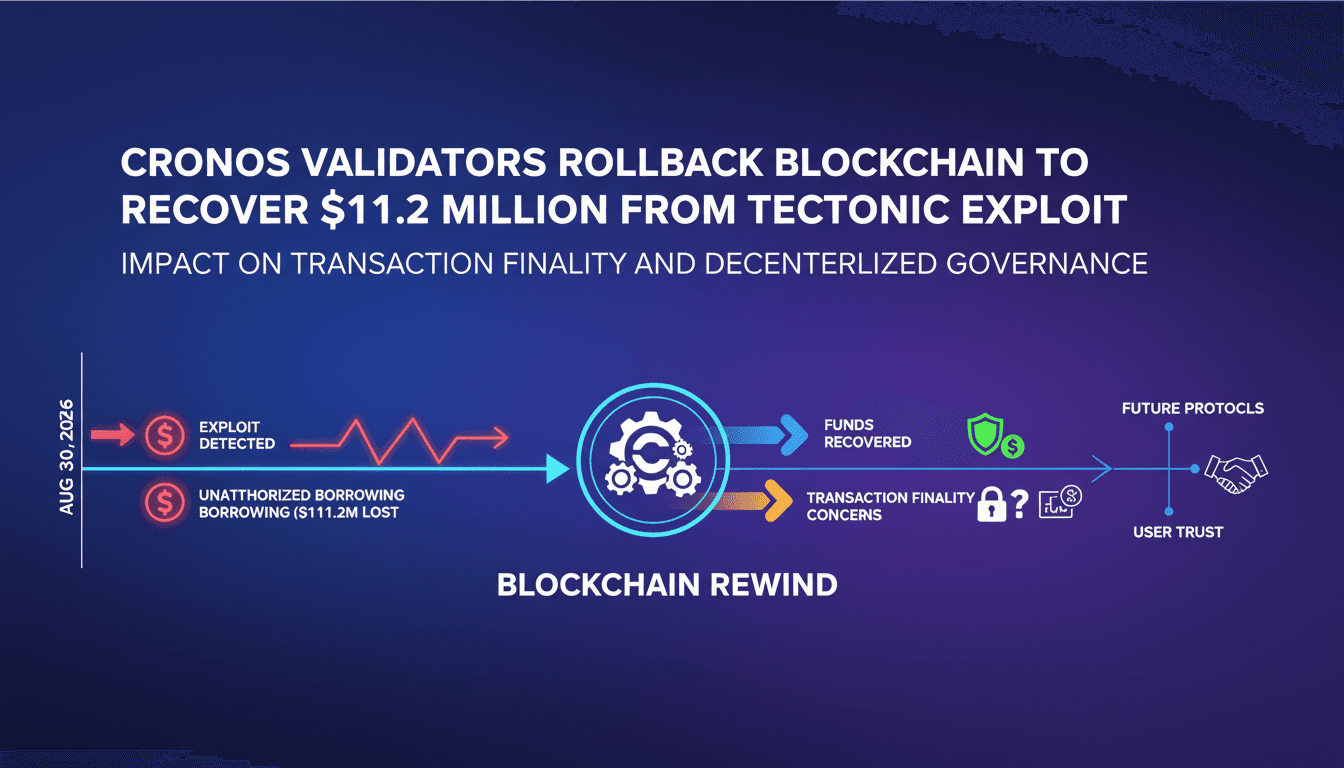
Here's what it means for you.
If you engage with decentralized finance (DeFi) platforms, this rollback raises critical questions about transaction security and the reliability of blockchain governance.
Why it matters
This incident underscores the vulnerabilities in DeFi ecosystems and the potential for drastic measures that can affect all users.
What happened (in 30 seconds)
- Cronos executed a rollback on August 30, 2026, to recover $111.2 million lost in a Tectonic exploit.
- Validators reversed nearly two hours of blockchain history, impacting legitimate transactions alongside the exploit.
- $9.19 million remains unrecovered, having exited the network before the rollback was initiated.
The context you actually need
- The exploit targeted Tectonic, a decentralized lending platform, using price manipulation of the TONIC token to facilitate unauthorized borrowing.
- Validators halted operations to prevent further losses, showcasing the governance structure's ability to respond to crises but also its limitations.
- The rollback action prioritized fund recovery over transaction finality, raising concerns about the integrity of blockchain transactions.
What's really happening
On August 30, 2026, the Cronos blockchain faced a significant exploit involving the Tectonic lending protocol. An attacker manipulated the price of the TONIC token, inflating it nearly 100-fold, which allowed them to borrow $120.4 million in various assets, including stablecoins and Bitcoin. This manipulation occurred in a thinly traded market, highlighting the risks associated with low liquidity in decentralized finance.
In response to the exploit, Cronos validators coordinated to halt block production and execute a rollback of 10,961 blocks, effectively rewinding the blockchain to a state before the exploit occurred. This rollback, which took place at approximately 14:32 UTC, restored $111.2 million in affected balances but also reversed all transactions within that timeframe, including those that were legitimate and unrelated to the exploit.
The decision to prioritize fund recovery over transaction finality has sparked debate within the blockchain community. While the rollback successfully recovered a significant portion of the stolen funds, it also nullified the transactions of innocent users, raising ethical questions about the governance of decentralized networks. The incident illustrates the delicate balance between maintaining the integrity of the blockchain and ensuring user trust.
The aftermath of the rollback saw no immediate disruption to Crypto.com services, indicating that the broader market may not have been significantly affected. However, the incident has highlighted the inherent risks in validator-consensus emergency actions on proof-of-stake networks. As DeFi continues to grow, the implications of such drastic measures could lead to increased scrutiny of governance mechanisms and the need for more robust security protocols.
Who feels it first (and how)
- DeFi users: Those who engaged in legitimate transactions during the rollback window may find their activities erased, leading to potential financial losses.
- Investors in TONIC: Holders of the manipulated token may experience volatility and loss of confidence in its value.
- Validators and developers: They face increased pressure to implement more secure protocols and governance structures to prevent future exploits.
What to watch next
- Regulatory responses: Watch for potential regulations aimed at enhancing security in DeFi platforms, which could reshape operational frameworks.
- Market reactions: Monitor how the rollback affects user trust and participation in Cronos and similar DeFi ecosystems.
- Security upgrades: Look for announcements regarding enhanced security measures from Cronos and other blockchain networks to prevent similar exploits.
The rollback successfully recovered $111.2 million, but $9.19 million remains unrecovered.
Increased scrutiny on governance practices within DeFi platforms will emerge as a result of this incident.
The long-term impact on user trust and participation in the Cronos network and the broader DeFi ecosystem remains uncertain.
Frequently Asked Questions
- Why it matters?
- This incident underscores the vulnerabilities in DeFi ecosystems and the potential for drastic measures that can affect all users.
- What happened (in 30 seconds)?
- Cronos executed a rollback on August 30, 2026, to recover $111.2 million lost in a Tectonic exploit. Validators reversed nearly two hours of blockchain history, impacting legitimate transactions alongside the exploit. $9.19 million remains unrecovered, having exited the network before the rollback was initiated.
- What's really happening?
- On August 30, 2026, the Cronos blockchain faced a significant exploit involving the Tectonic lending protocol. An attacker manipulated the price of the TONIC token, inflating it nearly 100-fold, which allowed them to borrow $120.4 million in various assets, including stablecoins and Bitcoin. This manipulation occurred in a thinly traded market, highlighting the risks associated with low liquidity in decentralized finance. In response to the exploit, Cronos validators coordinated to halt block p
- Who feels it first (and how)?
- DeFi users: Those who engaged in legitimate transactions during the rollback window may find their activities erased, leading to potential financial losses. Investors in TONIC: Holders of the manipulated token may experience volatility and loss of confidence in its value. Validators and developers: They face increased pressure to implement more secure protocols and governance structures to prevent future exploits.
- What to watch next?
- Regulatory responses: Watch for potential regulations aimed at enhancing security in DeFi platforms, which could reshape operational frameworks. Market reactions: Monitor how the rollback affects user trust and participation in Cronos and similar DeFi ecosystems. Security upgrades: Look for announcements regarding enhanced security measures from Cronos and other blockchain networks to prevent similar exploits.
Covers blockchain, cryptocurrency news, project analysis, and market insights.
"CoinDesk is a well-established cryptocurrency and blockchain news provider, offering comprehensive insights, market data, and industry research."
— A47 Editor
Cronos executes controversial blockchain rollback to recover crypto worth $111 million
Cronos executed a controversial rollback of nearly two hours of blockchain history to recover approximately $111 million in user assets following a significant exploit. Despite this intervention, attackers managed to siphon off $9.19 million before t...
Covers blockchain, cryptocurrency news, project analysis, and market insights.
"Cointelegraph is a leading crypto-focused media outlet known for timely news, analysis, and educational content related to blockchain and digital assets."
— A47 Editor
Cronos confirms $9.2M slipped away before Tectonic exploit rollback
Cronos has confirmed that $9.2 million was lost before the rollback of the Tectonic exploit, which had affected borrowing worth $120.4 million, with 7.6% of the funds transferred off-network prior to intervention by validators.
Real-time updates, analysis, and reports on the blockchain and cryptocurrency sectors.
"Crypto News delivers real-time updates, analysis, and reports on the blockchain and cryptocurrency sectors."
— A47 Editor
Cronos says $9.19M remains unrecovered after $120M Tectonic exploit
Cronos has reported that $9.19 million remains unrecovered following a significant exploit involving Tectonic, where an attacker borrowed $120.4 million. A validator-backed rollback managed to reverse approximately $111.2 million in affected value, b...