
SEC Grants Five-Year Exemption for Tokenized Stock Trading on Permissioned Venues
Why it matters
This exemption represents a significant step toward integrating blockchain technology into traditional equity markets.
What happened (in 30 seconds)
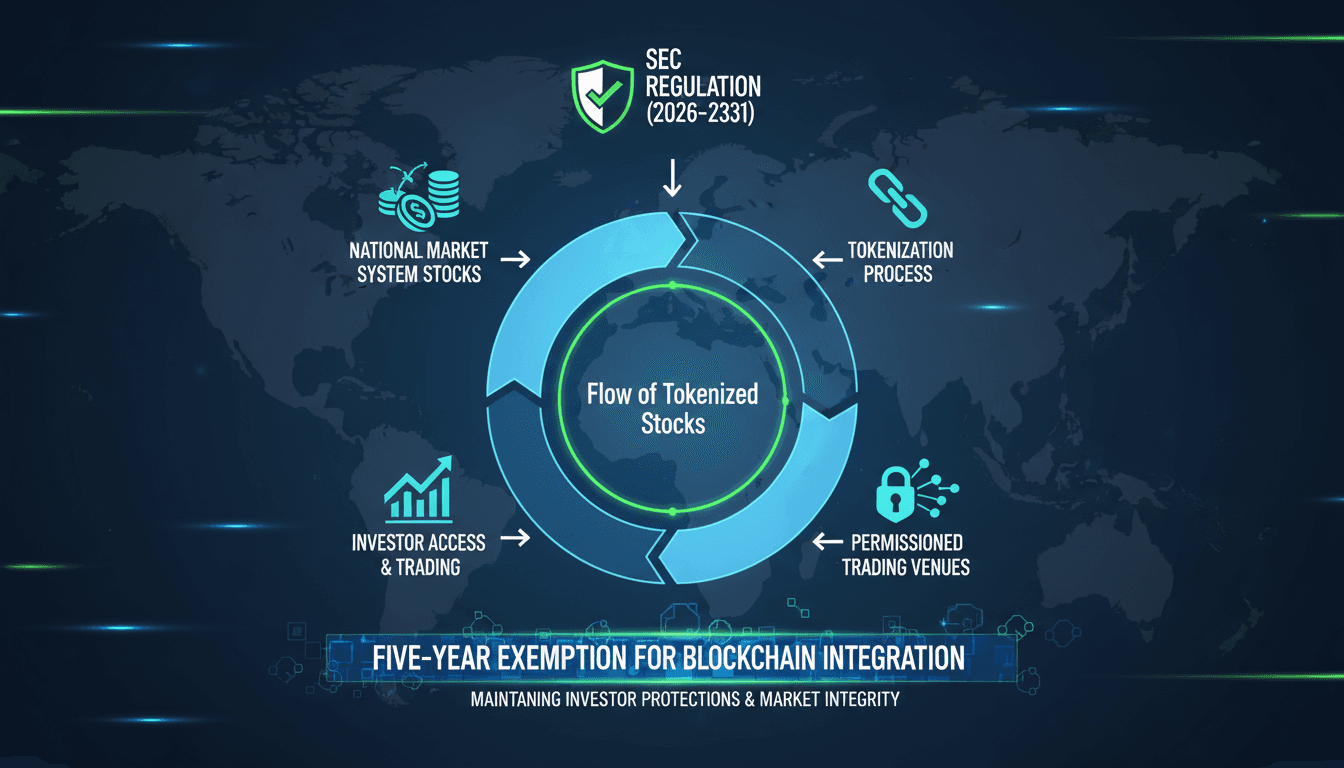
- On September 17, 2026, the SEC granted a five-year conditional exemption for Tokenized Securities Venues (TSVs) to trade tokenized NMS stocks.
- The exemption allows permissioned automated market makers and liquidity pools to operate under strict conditions to protect investor rights.
- Public comments are being solicited to shape future regulatory frameworks for tokenized securities trading.
The context you actually need
- Tokenization has been hindered by existing securities regulations that favor centralized market structures, creating compliance barriers for on-chain trading.
- Prior to this order, platforms struggled to register as exchanges or dealers under the Securities Exchange Act of 1934 when offering tokenized versions of NMS stocks.
- This exemption is part of a broader trend to explore blockchain's potential in capital markets amid ongoing legislative discussions on digital assets.
What's really happening
On September 17, 2026, the U.S. Securities and Exchange Commission (SEC) issued a groundbreaking order that grants Tokenized Securities Venues (TSVs) a five-year exemption from the Exchange Act's definition of an exchange. This allows these venues to facilitate trading of tokenized National Market System (NMS) stocks through permissioned automated market makers (AMMs) and liquidity pools on public blockchains. The SEC's Innovation Exemption is not a permanent regulatory overhaul but rather a controlled experiment aimed at gathering data for potential future rulemaking.
The exemption comes with strict conditions designed to maintain investor rights and market integrity. For instance, tokenized shares must confer identical rights to conventional shares, including voting rights and dividends. Trading halts must align with those of primary exchanges, and there are volume and symbol limits to ensure orderly trading. Additionally, smart contracts used in these transactions must be auditable, and issuers have the option to opt out of the tokenization process. Notably, the order explicitly excludes synthetic tokens that lack direct backing and full rights, ensuring that only compliant tokenized assets are traded.
This regulatory move is significant as it opens the door for on-chain equity trading while maintaining a framework that prioritizes investor protection. The SEC has framed this measure as a bridge for experimentation, allowing the agency to collect valuable data on how tokenized securities can function within existing market structures. The public comment period is also crucial, as it invites feedback from market participants and stakeholders, which could influence future regulations.
Market participants and infrastructure providers have welcomed this clarity, viewing it as an opportunity for innovation in equity trading. However, the SEC has emphasized that investor protections remain paramount, and no immediate major market shifts have been reported following the announcement. International observers see this exemption as a step toward regulated tokenized markets without fundamentally altering core securities frameworks.
Who feels it first (and how)
- Investors: They may gain access to new trading options and liquidity through tokenized securities.
- Tokenized Securities Venues (TSVs): These platforms will be able to operate legally, expanding their offerings.
- Liquidity Providers: They can engage in trading without the burden of dealer registration, potentially increasing market participation.
- Regulatory Bodies: They will monitor the outcomes of this exemption to inform future regulations.
- International Market Participants: They may find new opportunities or restrictions when accessing U.S. tokenized securities.
What to watch next
- Public Comment Outcomes: The feedback received during the public comment period will shape future regulatory frameworks and could lead to further adjustments in the exemption.
- Market Adoption Rates: Monitor how quickly and widely TSVs adopt this exemption and the volume of trading in tokenized NMS stocks.
- International Reactions: Watch for how other countries respond to this U.S. regulatory shift, as it may influence their own approaches to tokenized securities.
The SEC has granted a five-year exemption for TSVs to trade tokenized NMS stocks.
Increased experimentation and innovation in on-chain equity trading will occur during this exemption period.
The long-term impact on traditional equity markets and investor behavior remains to be seen.
Frequently Asked Questions
- Why it matters?
- This exemption represents a significant step toward integrating blockchain technology into traditional equity markets.
- What happened (in 30 seconds)?
- On September 17, 2026, the SEC granted a five-year conditional exemption for Tokenized Securities Venues (TSVs) to trade tokenized NMS stocks. The exemption allows permissioned automated market makers and liquidity pools to operate under strict conditions to protect investor rights. Public comments are being solicited to shape future regulatory frameworks for tokenized securities trading.
- What's really happening?
- On September 17, 2026, the U.S. Securities and Exchange Commission (SEC) issued a groundbreaking order that grants Tokenized Securities Venues (TSVs) a five-year exemption from the Exchange Act's definition of an exchange. This allows these venues to facilitate trading of tokenized National Market System (NMS) stocks through permissioned automated market makers (AMMs) and liquidity pools on public blockchains. The SEC's Innovation Exemption is not a permanent regulatory overhaul but rather a con
- Who feels it first (and how)?
- Investors: They may gain access to new trading options and liquidity through tokenized securities. Tokenized Securities Venues (TSVs): These platforms will be able to operate legally, expanding their offerings. Liquidity Providers: They can engage in trading without the burden of dealer registration, potentially increasing market participation. Regulatory Bodies: They will monitor the outcomes of this exemption to inform future regulations. International Market Participants: They may fin
- What to watch next?
- Public Comment Outcomes: The feedback received during the public comment period will shape future regulatory frameworks and could lead to further adjustments in the exemption. Market Adoption Rates: Monitor how quickly and widely TSVs adopt this exemption and the volume of trading in tokenized NMS stocks. International Reactions: Watch for how other countries respond to this U.S. regulatory shift, as it may influence their own approaches to tokenized securities.
Bitcoin news, technical analysis, and forecasts across crypto markets.
"NewsBTC covers Bitcoin news, technical analysis, and forecasts across crypto markets and major blockchain projects."
— A47 Editor
SEC Grants Five-Year Exemption For Tokenized Stock Trading Venues
The U.S. Securities and Exchange Commission (SEC) has granted a five-year exemption for tokenized stock trading venues, allowing limited transactions on blockchain platforms. This decision aims to facilitate the trading of tokenized U.S. stocks while...
Real-time updates, analysis, and reports on the blockchain and cryptocurrency sectors.
"Crypto News delivers real-time updates, analysis, and reports on the blockchain and cryptocurrency sectors."
— A47 Editor
Tokenized stocks face 24/7 pricing gap: RedStone COO
The U.S. Securities and Exchange Commission (SEC) has granted a temporary exemption for trading tokenized U.S. stocks, allowing limited transactions on on-chain platforms. However, the traditional 32.5-hour trading week of the NYSE and Nasdaq creates...
Covers blockchain, cryptocurrency news, project analysis, and market insights.
"CoinDesk is a well-established cryptocurrency and blockchain news provider, offering comprehensive insights, market data, and industry research."
— A47 Editor
Real stocks are finally coming on blockchain. Here’s how the SEC wants it to work
The U.S. Securities and Exchange Commission (SEC) is advancing a regulated pathway for tokenized stocks, aiming to modernize the trading landscape while maintaining strict controls over trading volumes, access, and issuer rights. This initiative is p...
Corporate finance news, M&A, deals, and executive interviews.
"Finance Monthly serves a professional readership with corporate finance coverage."
— A47 Editor
SEC Opens Five-Year Path for Tokenized Stock Trading
The U.S. Securities and Exchange Commission has announced a five-year regulatory exemption that permits eligible Tokenized Securities Venues to facilitate the trading of tokenized versions of U.S.-listed stocks on blockchain infrastructure. This move...
Covers blockchain, cryptocurrency news, project analysis, and market insights.
"CoinDesk is a well-established cryptocurrency and blockchain news provider, offering comprehensive insights, market data, and industry research."
— A47 Editor
SEC opens door to tokenized U.S. stock trading. Here’s who could benefit
The U.S. Securities and Exchange Commission (SEC) has initiated a five-year experiment allowing tokenized U.S. stock trading, providing a regulatory pathway for decentralized finance (DeFi) platforms, tokenization firms, and liquidity providers, whil...
Real-time updates, analysis, and reports on the blockchain and cryptocurrency sectors.
"Crypto News delivers real-time updates, analysis, and reports on the blockchain and cryptocurrency sectors."
— A47 Editor
SEC grants 5-year exemption for tokenized stock trading
The U.S. Securities and Exchange Commission (SEC) has granted a five-year exemption for tokenized securities venues, allowing them to trade tokenized U.S. stocks through permissioned automated market makers and liquidity pools. This decision marks a ...
Beginner-friendly crypto tutorials, guides, and news.
"99Bitcoins is a crypto education and news site known for easy-to-understand content and comprehensive guides."
— A47 Editor
SEC Sets Guardrails for Tokenized Stock Trading Venues
The U.S. Securities and Exchange Commission (SEC) has established conditional relief allowing permissioned venues to trade tokenized stocks through automated market makers (AMMs) and liquidity pools, implementing specific caps and safeguards. This in...
Covers blockchain, cryptocurrency news, project analysis, and market insights.
"Cointelegraph is a leading crypto-focused media outlet known for timely news, analysis, and educational content related to blockchain and digital assets."
— A47 Editor
SEC grants temporary exemption for tokenized US stock trading
The U.S. Securities and Exchange Commission (SEC) has granted a temporary exemption for tokenized U.S. stock trading, allowing limited trading on on-chain venues with specific trading caps and transparency requirements. This innovation exemption aims...
Covers blockchain, cryptocurrency news, project analysis, and market insights.
"CoinDesk is a well-established cryptocurrency and blockchain news provider, offering comprehensive insights, market data, and industry research."
— A47 Editor
SEC rolls out long-awaited 'innovation exemption' for tokenized securities venues
The U.S. Securities and Exchange Commission (SEC) has introduced a five-year blanket exemption allowing tokenized securities to be listed and traded without the need for exchange registration. This move is seen as a significant step towards modernizi...
Markets desk coverage, trading insights, and investor updates.
"WSJ’s markets reporting provides in-depth analysis and context for investors."
— A47 Editor
Tokenized Stocks Get U.S. Regulator’s Green Light to Come Ashore
The U.S. Securities and Exchange Commission (SEC) has granted exemptions that allow venues to trade digital tokens, specifically tokenized stocks, while also giving corporate issuers the authority to block these offerings. This decision marks a signi...