
Australia Proposes Draft Legislation for OECD Crypto-Asset Reporting Framework
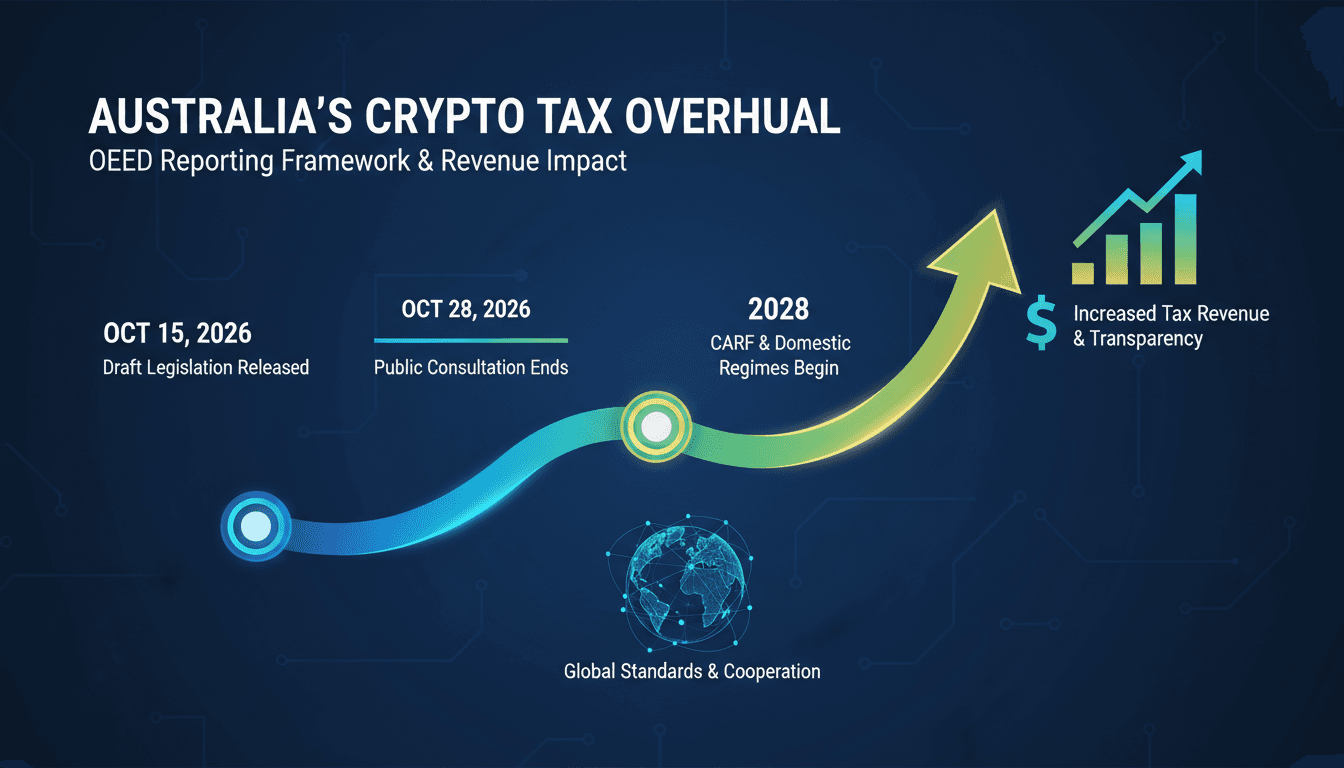
If you engage with crypto assets in Australia, expect increased scrutiny and potential tax implications starting in 2027.
Why it matters
This legislation aims to enhance tax transparency and deter offshore tax evasion, impacting how crypto transactions are reported globally.
What happened (in 30 seconds)
- On October 15, 2026, the Australian Treasury released draft legislation for the OECD Crypto-Asset Reporting Framework (CARF).
- Starting July 2027, Australian residents will need to report crypto transactions to the Australian Taxation Office (ATO).
- International exchanges of taxpayer information are set to begin in 2028, involving 77 jurisdictions.
The context you actually need
- The OECD developed CARF to close gaps in tax transparency for crypto assets, building on existing financial reporting standards.
- Australia is part of a global commitment with 77 jurisdictions to implement CARF, enhancing cooperation on tax matters.
- The proposed measures are expected to generate AUD 170 million in additional tax revenue over the next two fiscal years.
What's really happening
On October 15, 2026, the Australian Treasury unveiled the exposure draft of the Treasury Laws Amendment Bill 2026: Tax Information Reporting. This draft legislation is a significant step towards integrating the OECD's Crypto-Asset Reporting Framework (CARF) into Australian law. The CARF aims to address the growing concerns around tax evasion and lack of transparency in the crypto market, particularly for assets held or traded through foreign providers.
The draft legislation mandates that crypto service providers report transactions involving Australian residents to the ATO. This includes exchanges between fiat and crypto, transfers between different crypto assets, and certain other transactions. The domestic reporting obligations are set to commence in July 2027, with the first reports to the ATO and international exchanges scheduled for 2028. This timeline aligns with the broader international framework, as Australia joins 76 other jurisdictions committed to implementing CARF.
The implications of this legislation are profound. By requiring crypto service providers to report transactions, Australia aims to enhance tax compliance and deter offshore tax evasion. The ATO will be able to cross-reference data from international jurisdictions, creating a more robust system for tracking crypto transactions. This move is expected to yield an additional AUD 170 million in tax revenue over the 2027–28 and 2028–29 fiscal years, indicating the government's intent to capitalize on the growing crypto market while ensuring compliance.
Public consultation on the draft legislation is open until October 28, 2026, allowing stakeholders to provide feedback before the bill is potentially introduced to Parliament. This consultation period is crucial, as it may influence the final form of the legislation and its implementation timeline.
The draft legislation also updates the existing Common Reporting Standard (CRS) to include electronic money, Central Bank Digital Currencies (CBDCs), and crypto derivatives. This comprehensive approach reflects the Australian government's commitment to aligning its tax reporting framework with international standards, ensuring that it remains competitive and compliant in the global financial landscape.
Who feels it first (and how)
- Crypto service providers: They will need to adapt their reporting systems to comply with new regulations.
- Australian residents engaging in crypto transactions: They will face increased scrutiny and potential tax liabilities.
- International investors: Those holding Australian assets may need to navigate new reporting requirements if they engage with Australian exchanges.
What to watch next
- Public consultation outcomes: The feedback received by October 28, 2026, could shape the final legislation and its implementation.
- International participation: Watch for updates on how other jurisdictions respond and align with CARF, particularly those with significant crypto markets.
- Market reactions: Monitor how crypto service providers and investors adjust to these new reporting requirements and any shifts in market behavior.
The draft legislation is currently under public consultation and has not yet been enacted into law.
The ATO will enhance its data-matching capabilities to track crypto transactions more effectively.
The full impact on the crypto market and investor behavior remains to be seen as the legislation progresses.
Frequently Asked Questions
- Why it matters?
- This legislation aims to enhance tax transparency and deter offshore tax evasion, impacting how crypto transactions are reported globally.
- What happened (in 30 seconds)?
- On October 15, 2026, the Australian Treasury released draft legislation for the OECD Crypto-Asset Reporting Framework (CARF). Starting July 2027, Australian residents will need to report crypto transactions to the Australian Taxation Office (ATO). International exchanges of taxpayer information are set to begin in 2028, involving 77 jurisdictions.
- What's really happening?
- On October 15, 2026, the Australian Treasury unveiled the exposure draft of the Treasury Laws Amendment Bill 2026: Tax Information Reporting. This draft legislation is a significant step towards integrating the OECD's Crypto-Asset Reporting Framework (CARF) into Australian law. The CARF aims to address the growing concerns around tax evasion and lack of transparency in the crypto market, particularly for assets held or traded through foreign providers. The draft legislation mandates that crypto
- Who feels it first (and how)?
- Crypto service providers: They will need to adapt their reporting systems to comply with new regulations. Australian residents engaging in crypto transactions: They will face increased scrutiny and potential tax liabilities. International investors: Those holding Australian assets may need to navigate new reporting requirements if they engage with Australian exchanges.
- What to watch next?
- Public consultation outcomes: The feedback received by October 28, 2026, could shape the final legislation and its implementation. International participation: Watch for updates on how other jurisdictions respond and align with CARF, particularly those with significant crypto markets. Market reactions: Monitor how crypto service providers and investors adjust to these new reporting requirements and any shifts in market behavior.
Real-time updates, analysis, and reports on the blockchain and cryptocurrency sectors.
"Crypto News delivers real-time updates, analysis, and reports on the blockchain and cryptocurrency sectors."
— A47 Editor
Australia moves to share crypto tax data globally by 2028
Australia has proposed new crypto tax reporting rules under the OECD framework, with public feedback due by October 28, and plans to exchange data globally by 2028. This initiative aligns Australia with 77 jurisdictions committed to the OECD's Crypto...
Covers blockchain, cryptocurrency news, project analysis, and market insights.
"Cointelegraph is a leading crypto-focused media outlet known for timely news, analysis, and educational content related to blockchain and digital assets."
— A47 Editor
Australia releases draft bill to adopt OECD crypto tax reporting framework
Australia has released a draft bill to adopt the OECD's Crypto-Asset Reporting Framework (CARF), joining 77 jurisdictions committed to this international standard, with the first exchanges of crypto tax data expected in 2028.
English-language digital publication covering business, politics, technology, and current affairs.
"The Arabian Post mixes original and syndicated-style coverage with a broad regional and global business-news orientation."
— A47 Editor
Australia proposes mandatory crypto tax reporting from 2027
Australia has proposed draft legislation that mandates cryptocurrency platforms to report transactions involving Australian residents to tax authorities starting in July 2027. The Treasury announced this proposal on October 15, 2026, and is currently...