
ASIC Proposes Stricter Capital and Custody Standards for Cryptocurrency Exchanges Ahead of 2027 Framework
Why it matters
Stricter regulations aim to enhance consumer protection and market integrity in the rapidly evolving digital asset landscape.
What happened (in 30 seconds)
- On October 15, 2026, ASIC proposed new capital and custody standards for cryptocurrency exchanges as part of a broader regulatory framework.
- The consultation period is open until November 27, 2026, with final guidance expected in March 2027.
- Existing operators must apply for new licenses by October 7, 2027, to continue trading under the new rules.
The context you actually need
- The Corporations Amendment (Digital Assets Framework) Act 2026 was enacted to integrate digital asset platforms into Australia's financial services licensing regime, following significant industry failures.
- The 2022 FTX collapse highlighted vulnerabilities in the crypto market, affecting around 30,000 Australian customers and prompting regulatory scrutiny.
- ASIC's Consultation Paper 392 outlines three capital requirement models, with the strictest requiring AU$14 million in net tangible assets for exchanges holding client assets.
What's really happening
The Australian Securities and Investments Commission (ASIC) is taking a proactive stance in regulating cryptocurrency exchanges and tokenized custody platforms. This initiative is part of the Corporations Amendment (Digital Assets Framework) Act 2026, which aims to address the gaps in consumer protection and market integrity that were exposed by previous industry failures, notably the FTX collapse in 2022.
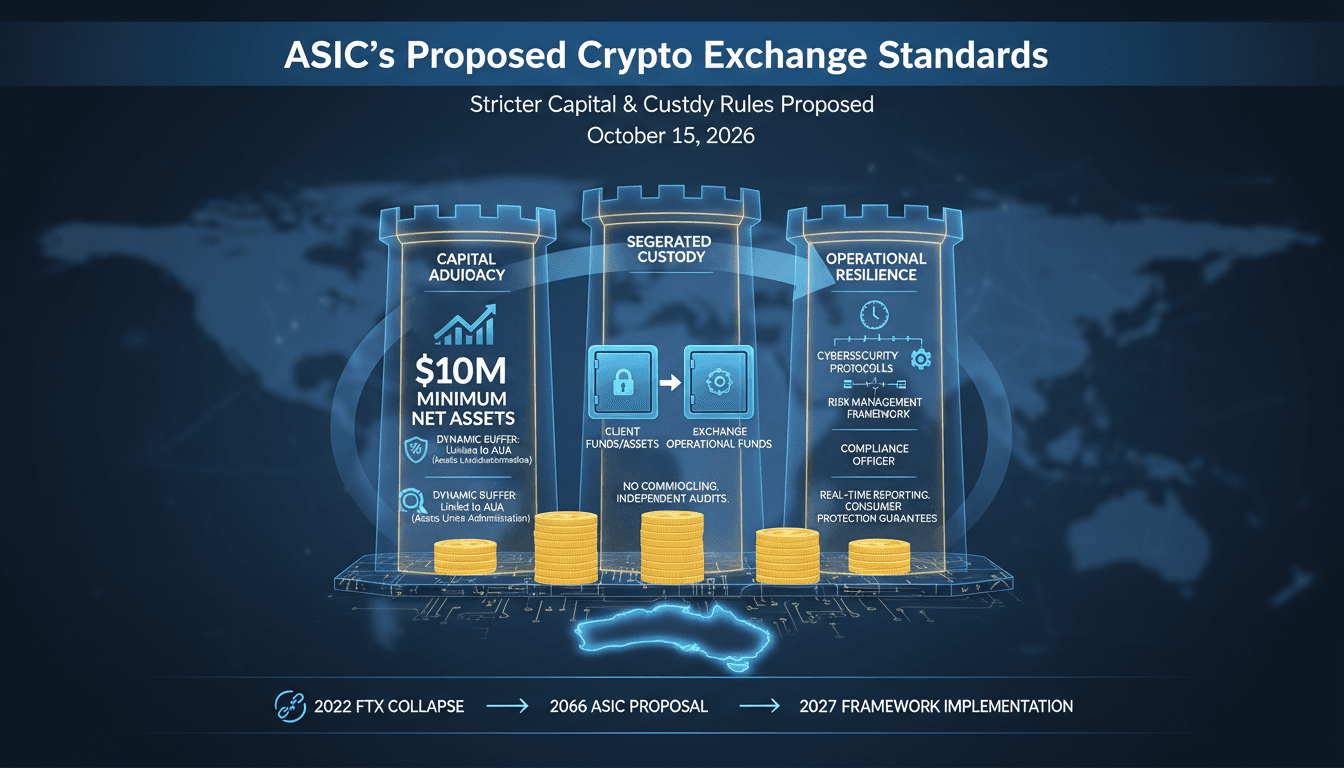
The proposed regulations include three capital requirement models for platforms that hold client assets. The most stringent model mandates that exchanges maintain a minimum of AU$14 million in net tangible assets or 10% of their average revenue. This is a significant increase in capital requirements compared to previous standards, reflecting a shift towards greater accountability and financial stability in the crypto sector. For platforms that utilize qualified third-party custodians, the capital thresholds are reduced, with minimum requirements as low as AU$200,000.
In addition to capital requirements, the proposed standards encompass various operational aspects, including asset segregation, trading transparency, settlement processes, conflict management, and measures to prevent market manipulation. These comprehensive guidelines are designed to create a more robust framework for digital asset trading, ensuring that exchanges operate with a higher level of integrity and security.
The consultation period, which runs until November 27, 2026, allows industry stakeholders to provide feedback on the proposed regulations. Final guidance is expected in March 2027, aligning with the framework's effective date. Existing operators will have until October 7, 2027, to apply for or vary their Australian Financial Services licenses, ensuring they can continue trading under the new regulatory landscape.
Industry reactions have been largely supportive, with organizations like the Digital Economy Council of Australia and OKX Australia expressing approval for the alignment with global standards. This sentiment suggests a potential for market consolidation as firms adapt to the new requirements. However, as of now, there have been no immediate governmental responses or significant market price shifts following the announcement.
Who feels it first (and how)
- Cryptocurrency exchanges: Must adapt to new capital and operational requirements to remain compliant.
- Digital asset custodians: Will need to reassess their custody models and ensure they meet the new standards.
- Investors and traders: May experience changes in trading conditions and asset security as exchanges implement new regulations.
- Regulatory bodies: Will be tasked with overseeing compliance and enforcing the new standards.
What to watch next
- Consultation feedback: Monitor industry responses and suggestions during the consultation period, as they could influence final regulations.
- License applications: Watch for the number of existing operators applying for licenses by the October 2027 deadline, indicating market adaptation.
- Market consolidation trends: Observe potential mergers or acquisitions among exchanges as firms seek to strengthen their positions under the new regulatory framework.
ASIC's proposed regulations aim to enhance consumer protection and market integrity.
Increased compliance costs for cryptocurrency exchanges may lead to market consolidation.
The long-term impact on trading volumes and investor confidence in the Australian crypto market remains to be seen.
Frequently Asked Questions
- Why it matters?
- Stricter regulations aim to enhance consumer protection and market integrity in the rapidly evolving digital asset landscape.
- What happened (in 30 seconds)?
- On October 15, 2026, ASIC proposed new capital and custody standards for cryptocurrency exchanges as part of a broader regulatory framework. The consultation period is open until November 27, 2026, with final guidance expected in March 2027. Existing operators must apply for new licenses by October 7, 2027, to continue trading under the new rules.
- What's really happening?
- The Australian Securities and Investments Commission (ASIC) is taking a proactive stance in regulating cryptocurrency exchanges and tokenized custody platforms. This initiative is part of the Corporations Amendment (Digital Assets Framework) Act 2026, which aims to address the gaps in consumer protection and market integrity that were exposed by previous industry failures, notably the FTX collapse in 2022. The proposed regulations include three capital requirement models for platforms that hol
- Who feels it first (and how)?
- Cryptocurrency exchanges: Must adapt to new capital and operational requirements to remain compliant. Digital asset custodians: Will need to reassess their custody models and ensure they meet the new standards. Investors and traders: May experience changes in trading conditions and asset security as exchanges implement new regulations. Regulatory bodies: Will be tasked with overseeing compliance and enforcing the new standards.
- What to watch next?
- Consultation feedback: Monitor industry responses and suggestions during the consultation period, as they could influence final regulations. License applications: Watch for the number of existing operators applying for licenses by the October 2027 deadline, indicating market adaptation. Market consolidation trends: Observe potential mergers or acquisitions among exchanges as firms seek to strengthen their positions under the new regulatory framework.
Covers blockchain, cryptocurrency news, project analysis, and market insights.
"CoinDesk is a well-established cryptocurrency and blockchain news provider, offering comprehensive insights, market data, and industry research."
— A47 Editor
Australia’s financial watchdog seeks stiffer rules for crypto exchanges ahead of licensing deadline
Australia's financial regulator, the Australian Securities and Investments Commission (ASIC), has proposed stricter regulations for cryptocurrency exchanges to enhance user protection and ensure financial stability ahead of a licensing deadline. This...
Real-time updates, analysis, and reports on the blockchain and cryptocurrency sectors.
"Crypto News delivers real-time updates, analysis, and reports on the blockchain and cryptocurrency sectors."
— A47 Editor
Australia proposes new crypto exchange rules for 2027
Australia has proposed new regulations for cryptocurrency exchanges, which will cover licensing, trading practices, customer fund management, and capital requirements, with public feedback due by November 27, 2026, ahead of a planned rollout in 2027.
Covers blockchain, cryptocurrency news, project analysis, and market insights.
"Cointelegraph is a leading crypto-focused media outlet known for timely news, analysis, and educational content related to blockchain and digital assets."
— A47 Editor
Australia seeks feedback on crypto platform rules ahead of 2027 rollout
Australia is seeking public feedback on proposed regulations for cryptocurrency platforms ahead of a planned rollout in 2027, following the passage of digital asset legislation by Parliament in April. The Australian securities regulator is now outlin...