
Circle Defends USDC Revenue Model Amidst Competitive Pressure from Rivals
Why it matters
The competition among stablecoin issuers is reshaping revenue-sharing models, influencing liquidity and compliance standards across the market.
What happened (in 30 seconds)
- Circle defended its USDC revenue model amid rising competition from rivals like Open USD (OUSD) that offer higher revenue shares to partners.
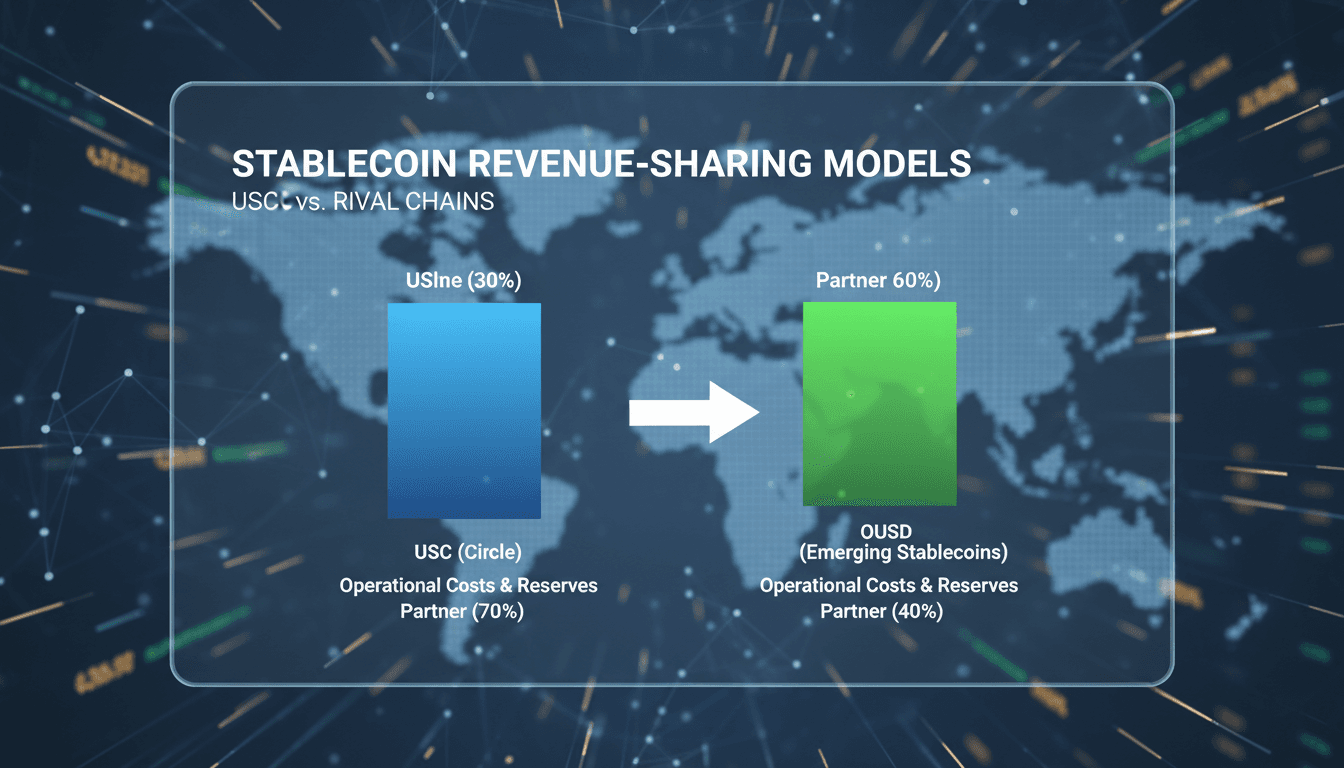
- Circle reported $1.4 billion in revenue for the first half of 2026, allocating 59% to partners and transaction costs, while retaining only 7% as net profit.
- The stablecoin sector is experiencing tensions as established players balance partner incentives against operational sustainability.
The context you actually need
- Stablecoin issuance has surged, with USDC being the second-largest stablecoin by market cap, primarily generating revenue from interest on reserves.
- New entrants like OUSD are challenging traditional models by offering free minting and direct pass-through of reserve yields, appealing to distribution partners.
- Circle's response highlights the importance of compliance and infrastructure, warning against models that prioritize immediate partner yields over long-term sustainability.
What's really happening
The stablecoin market is undergoing a significant transformation as new players enter the space, challenging established models like Circle's USDC. On October 17, 2026, Circle's Chief Commercial Officer, Kash Razzaghi, publicly defended the company's revenue-sharing model in response to competitive pressures from rivals such as Open USD (OUSD). This consortium, backed by major players like Coinbase, Stripe, and BlackRock, has been courting distribution partners with promises of larger shares of reserve income, which has raised questions about the sustainability of Circle's approach.
Circle reported a substantial revenue of $1.4 billion in the first half of 2026, with 59% allocated to partners and transaction costs, 34% to operations, and only 7% retained as net profit. This breakdown underscores the operational costs associated with maintaining compliance, liquidity, and redemption capabilities, which are critical for the long-term viability of any stablecoin. Razzaghi's statement emphasized that while higher immediate yields may be attractive, they often come at the expense of essential infrastructure and regulatory compliance.
The emergence of OUSD and similar initiatives reflects a broader trend in the stablecoin sector, where new entrants are willing to offer more favorable economic terms to attract partners. These models often promise free minting and redemption, along with direct pass-through of reserve yields, which can be appealing to distribution partners looking for immediate financial benefits. However, such models may overlook the importance of maintaining a robust operational framework that ensures liquidity and compliance with regulatory standards.
Circle's defense of its model highlights the ongoing tension between immediate partner incentives and the need for sustainable operations. As Coinbase, Circle's largest distribution partner, simultaneously supports OUSD, the dynamics of the stablecoin market are becoming increasingly complex. Market participants are now faced with evaluating the trade-offs between higher yields from newer issuers and the established liquidity and regulatory standing of USDC.
In this competitive landscape, the stakes are high. The decisions made by distribution partners will not only impact their immediate financial outcomes but also shape the future of stablecoin economics. As the market evolves, the balance between partner incentives and operational sustainability will be crucial for the long-term success of any stablecoin issuer.
Who feels it first (and how)
- Distribution partners: Exchanges and payment platforms evaluating revenue-sharing models.
- Investors: Individuals and institutions assessing the stability and profitability of stablecoin investments.
- Regulators: Authorities monitoring compliance and operational standards in the evolving stablecoin landscape.
What to watch next
- Partner shifts: Monitor which distribution partners choose to align with Circle or newer entrants like OUSD, as this will indicate market confidence.
- Regulatory developments: Keep an eye on any regulatory responses to the evolving stablecoin models, which could impact operational frameworks.
- Market performance: Watch how USDC and its competitors perform in terms of liquidity and user adoption, as this will reflect the effectiveness of their revenue-sharing strategies.
Circle's revenue model allocates a significant portion to partners and operational costs.
Increased competition will lead to further innovations in revenue-sharing models among stablecoin issuers.
The long-term sustainability of models that prioritize immediate partner yields over compliance and infrastructure.
Frequently Asked Questions
- Why it matters?
- The competition among stablecoin issuers is reshaping revenue-sharing models, influencing liquidity and compliance standards across the market.
- What happened (in 30 seconds)?
- Circle defended its USDC revenue model amid rising competition from rivals like Open USD (OUSD) that offer higher revenue shares to partners. Circle reported $1.4 billion in revenue for the first half of 2026, allocating 59% to partners and transaction costs, while retaining only 7% as net profit. The stablecoin sector is experiencing tensions as established players balance partner incentives against operational sustainability.
- What's really happening?
- The stablecoin market is undergoing a significant transformation as new players enter the space, challenging established models like Circle's USDC. On October 17, 2026, Circle's Chief Commercial Officer, Kash Razzaghi, publicly defended the company's revenue-sharing model in response to competitive pressures from rivals such as Open USD (OUSD). This consortium, backed by major players like Coinbase, Stripe, and BlackRock, has been courting distribution partners with promises of larger shares of
- Who feels it first (and how)?
- Distribution partners: Exchanges and payment platforms evaluating revenue-sharing models. Investors: Individuals and institutions assessing the stability and profitability of stablecoin investments. Regulators: Authorities monitoring compliance and operational standards in the evolving stablecoin landscape.
- What to watch next?
- Partner shifts: Monitor which distribution partners choose to align with Circle or newer entrants like OUSD, as this will indicate market confidence. Regulatory developments: Keep an eye on any regulatory responses to the evolving stablecoin models, which could impact operational frameworks. Market performance: Watch how USDC and its competitors perform in terms of liquidity and user adoption, as this will reflect the effectiveness of their revenue-sharing strategies.
Covers blockchain, cryptocurrency news, project analysis, and market insights.
"CoinDesk is a well-established cryptocurrency and blockchain news provider, offering comprehensive insights, market data, and industry research."
— A47 Editor
Circle defends USDC economics as stablecoin rivals court its partners with bigger cut
Circle has defended the economic model of its USD Coin (USDC) amid increasing competition from rivals like Open USD, which offers more favorable revenue-sharing terms to partners. Coinbase, a key partner of Circle, is also backing Open USD, raising c...
Bitcoin news, technical analysis, and forecasts across crypto markets.
"NewsBTC covers Bitcoin news, technical analysis, and forecasts across crypto markets and major blockchain projects."
— A47 Editor
Circle Reveals $819 Million USDC Payouts As Stablecoin Economics Come Under Scrutiny
Circle has disclosed that it generated approximately $1.4 billion in revenue during the first half of 2026, while incurring $819 million in payouts to distribution partners and related costs. This highlights the significant expenses associated with e...
Real-time updates, analysis, and reports on the blockchain and cryptocurrency sectors.
"Crypto News delivers real-time updates, analysis, and reports on the blockchain and cryptocurrency sectors."
— A47 Editor
Circle wants to enter 40 more markets. Where can USDC actually be used?
Circle is planning to expand its presence into approximately 40 emerging and developing markets, raising questions about the current usability of its stablecoin, USDC, in these regions. The company seeks to understand where businesses can accept USDC...