
HSBC Launches RedCoin Hong Kong Dollar Stablecoin Via PayMe to 3.3 Million Users
Why it matters
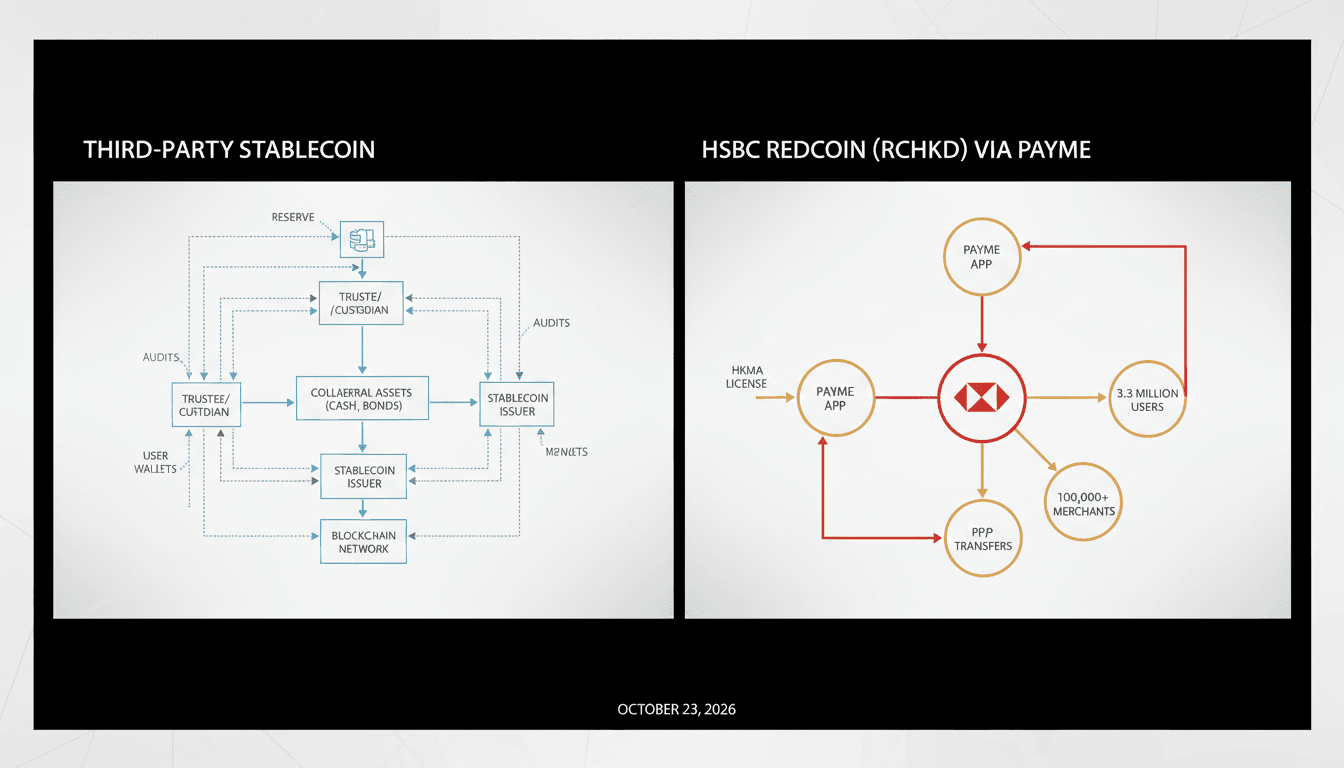
The direct issuance of a retail stablecoin by a global systemic bank bridges traditional fractional reserves with on-chain settlement, bypassing third-party crypto-native intermediaries within a dedicated regulatory regime.
What happened (in 30 seconds)
- HSBC issued RedCoin (RCHKD) on October 23, 2026, marking Hong Kong's first licensed bank-issued Hong Kong dollar-denominated stablecoin for retail payments.
- PayMe wallet integration commenced immediate rollout to over 3.3 million registered users for peer-to-peer transfers and payments across more than 100,000 merchant terminals.
- The regulatory rollout follows the stablecoin issuer license (FRS02) granted by the Hong Kong Monetary Authority (HKMA) on April 10, 2026, backed 1:1 by segregated liquid assets.
The context you actually need
- Hong Kong's legislative framework established clear boundary lines in August 2025 via the Stablecoins Ordinance, setting strict licensing requirements for fiat-referenced token issuers.
- The dual-license milestone in April 2026 authorized HSBC alongside a Standard Chartered joint venture to prepare retail stablecoin implementations for live deployment.
- Internal bank trials conducted prior to launch included staff testing across nearly 100 participants to validate ledger performance ahead of broad retail exposure.
What's really happening
The rollout of RedCoin represents a fundamental shift in stablecoin architecture: traditional banks are moving from custodial partners for crypto issuers to primary issuers themselves.
Historically, fiat-backed stablecoins such as USDT and USDC relied on commercial banking partners merely to hold treasury bills and cash deposits in segregated accounts. This arrangement created counterparty exposure for crypto users while depriving issuing banks of direct transaction data and fee structures inside retail payment rails. By launching RedCoin under HKMA license FRS02, HSBC closes this gap entirely. The bank holds the segregated reserve assets, mints the tokens, and routes them through its existing consumer app, PayMe.
The operational mechanism is direct. Every RCHKD is 1:1 backed by segregated, high-quality liquid assets and remains directly redeemable for physical Hong Kong dollars. Integrating these tokens into PayMe gives the token instantaneous utility: 3.3 million users gain the ability to make payments across 100,000 retail merchants without interacting with secondary exchanges or non-custodial crypto infrastructure.
The institutional incentive centers on capital stickiness and transactional sovereignty. Central banks and commercial balance sheets face long-term deposit attrition if unregulated stablecoins capture merchant checkout rails. By deploying a regulated token on domestic digital rails, HSBC insulates its deposit base from non-bank fintechs and offshore stablecoin operators.
Furthermore, this infrastructure serves as the base layer for subsequent institutional balance-sheet products. Hong Kong's phased rollout prioritizes retail P2P and merchant payments first, neutralizing operational risk through capped consumer environments. Later phases will link RedCoin to the broader HSBC HK Mobile Banking App and tokenized investment products. As banking ledgers converge with tokenized asset issuance, settling against a bank-issued stablecoin eliminates settlement latency while preserving regulatory compliance. This positions Hong Kong's domestic clearing structure ahead of offshore payment channels without compromising liquidity controls.
Who feels it first (and how)
- Hong Kong retail merchants: Over 100,000 retail points of sale gain access to instant digital settlement rails that resolve directly against HKD-backed reserves without traditional card-network interchange friction.
- PayMe consumers: A base of 3.3 million verified account holders transitions into on-chain digital currency rails through phased wallet activation without changing their daily transaction workflow.
- Regional corporate treasurers: Financial managers monitoring Hong Kong dollar liquidity gain a tested precedent for managing tokenized commercial payments backed directly by tier-one bank capital.
- Third-party stablecoin issuers: Offshore operators see regulated bank balance sheets capture direct merchant point-of-sale volume across Hong Kong's retail market.
What to watch next
- HSBC Mobile Banking App integration: The scheduled expansion from PayMe into HSBC's core mobile banking platform later in 2026 will test stablecoin adoption among broader wealth and retail segments.
- Tokenized investment deployment: The rollout of bank-supported tokenized financial products will indicate whether RCHKD functions as institutional settlement cash or remains confined to point-of-sale retail transactions.
- Standard Chartered joint venture launch: The market entrance of Hong Kong's other licensed stablecoin issuer will establish fee and liquidity competition within the HKMA regulatory sandbox.
HSBC launched the RCHKD stablecoin on October 23, 2026, activated it across PayMe for 3.3 million users, holds an HKMA issuer license (FRS02), and backs tokens 1:1 with segregated liquid assets.
Merchant payment processing costs on the PayMe network will adjust as transactions move directly across the tokenized ledger rather than traditional card rails.
Whether cross-border corridors or Dubai and international financial centers will establish regulatory interoperability to accept bank-issued HKD stablecoins outside Hong Kong.
Frequently Asked Questions
- Why it matters?
- The direct issuance of a retail stablecoin by a global systemic bank bridges traditional fractional reserves with on-chain settlement, bypassing third-party crypto-native intermediaries within a dedicated regulatory regime.
- What happened (in 30 seconds)?
- HSBC issued RedCoin (RCHKD) on October 23, 2026, marking Hong Kong's first licensed bank-issued Hong Kong dollar-denominated stablecoin for retail payments. PayMe wallet integration commenced immediate rollout to over 3.3 million registered users for peer-to-peer transfers and payments across more than 100,000 merchant terminals. The regulatory rollout follows the stablecoin issuer license (FRS02) granted by the Hong Kong Monetary Authority (HKMA) on April 10, 2026, backed 1:1 by segregated liqu
- What's really happening?
- The rollout of RedCoin represents a fundamental shift in stablecoin architecture: traditional banks are moving from custodial partners for crypto issuers to primary issuers themselves. Historically, fiat-backed stablecoins such as USDT and USDC relied on commercial banking partners merely to hold treasury bills and cash deposits in segregated accounts. This arrangement created counterparty exposure for crypto users while depriving issuing banks of direct transaction data and fee structures ins
- Who feels it first (and how)?
- Hong Kong retail merchants: Over 100,000 retail points of sale gain access to instant digital settlement rails that resolve directly against HKD-backed reserves without traditional card-network interchange friction. PayMe consumers: A base of 3.3 million verified account holders transitions into on-chain digital currency rails through phased wallet activation without changing their daily transaction workflow. Regional corporate treasurers: Financial managers monitoring Hong Kong dollar liquidity
- What to watch next?
- HSBC Mobile Banking App integration: The scheduled expansion from PayMe into HSBC's core mobile banking platform later in 2026 will test stablecoin adoption among broader wealth and retail segments. Tokenized investment deployment: The rollout of bank-supported tokenized financial products will indicate whether RCHKD functions as institutional settlement cash or remains confined to point-of-sale retail transactions. Standard Chartered joint venture launch: The market entrance of Hong Kong's othe
Covers Bitcoin plus altcoin news, market updates, and educational resources.
"Bitcoin.com provides news, market data, and guides focused on Bitcoin and the wider crypto industry."
— A47 Editor
HSBC Launches First Stablecoin, Bringing Hong Kong Dollar Payments to 3.3M Users
HSBC has launched its first stablecoin, RedCoin, a digital currency backed by the Hong Kong dollar, aimed at enhancing everyday payments for its 3.3 million users through the PayMe platform. This initiative marks a significant step in the bank's effo...
Real-time updates, analysis, and reports on the blockchain and cryptocurrency sectors.
"Crypto News delivers real-time updates, analysis, and reports on the blockchain and cryptocurrency sectors."
— A47 Editor
HSBC launches RedCoin stablecoin, plans HK$100 tokenized fund investments
HSBC has launched its first stablecoin, RedCoin, which is backed by the Hong Kong dollar and aims to enhance payment solutions for its 3.3 million PayMe users. This initiative is part of HSBC's strategy to integrate cryptocurrency into its banking se...
Beginner-friendly crypto tutorials, guides, and news.
"99Bitcoins is a crypto education and news site known for easy-to-understand content and comprehensive guides."
— A47 Editor
China Wants $5.1B in Bitcoin, Now HSBC Is Launching RedCoin in Hong Kong
China is pursuing the confiscation of 61,896 Bitcoin valued at approximately $5.1 billion, linked to a significant investment fraud case involving UK authorities. This move follows a recent court ruling that allows the Chinese government to claim the...
Covers blockchain, cryptocurrency news, project analysis, and market insights.
"Cointelegraph is a leading crypto-focused media outlet known for timely news, analysis, and educational content related to blockchain and digital assets."
— A47 Editor
HSBC launches Hong Kong dollar stablecoin for retail payments
HSBC has launched RedCoin, a Hong Kong dollar stablecoin, aimed at enhancing retail payments through its PayMe platform. This initiative is part of HSBC's broader strategy to integrate cryptocurrency solutions into its banking services, allowing user...