
Ethereum Postpones Glamsterdam Hoodi Testnet Activation After ChainSecurity Flags 13 Mainnet Contracts Vulnerable Under Proposed Gas Changes
If you build, allocate capital, or maintain infrastructure on Ethereum, your active deployments remain completely safe, but your timeline for scaling benefits and gas fee relief just moved further back.
Why it matters
The postponement highlights the constant structural friction between raising network throughput and protecting immutable legacy smart contract code from systemic execution failures.
What happened (in 30 seconds)
- The testnet launch paused: Ethereum core developers called off the October 26, 2026 activation of the Glamsterdam upgrade on the Hoodi testnet during ACDE meeting #248.
- Vulnerabilities surfaced: Security firm ChainSecurity discovered that changes to gas accounting under EIP-8037 and EIP-8038 could push 13 active mainnet smart contracts into permanent failure states.
- Mainnet targets shifted: With the Hoodi activation paused and client software adjustments required, the tentative December 2026 mainnet deployment window now faces scheduling uncertainty.
The context you actually need
- Scaling targets collide with history: Glamsterdam aims to expand transaction capacity by testing a gas limit of roughly 200 million on testnets—more than three times the mainnet's baseline of approximately 60 million.
- Sepolia tested cleanly first: The initial testnet rollout on Sepolia succeeded on October 6, 2026, meaning the flaw sits inside specific accounting rules rather than baseline node consensus stability.
- State growth prompted the shift: Both EIP-8037 and EIP-8038 were engineered to refine gas accounting for state creation and access, aiming to manage the database footprint of the network as transaction volume grows.
What's really happening
The core tension on Ethereum is that you cannot retroactively patch immutable code once it hits the blockchain. When core developers alter the underlying virtual machine's economics, every line of logic written under older assumptions must continue working as originally intended.
The Glamsterdam hard fork couples two core goals: expanding execution throughput and curbing database bloat. To do that, the upgrade introduces EIP-8037 and EIP-8038, which overhaul how the Ethereum Virtual Machine (EVM) prices state creation and data access. The goal is to charge users accurately for the long-term hardware costs their data imposes on node runners. Alongside these accounting tweaks, developers planned to test a 200-million gas limit on the Hoodi testnet, a major bump over the mainnet standard of roughly 60 million.
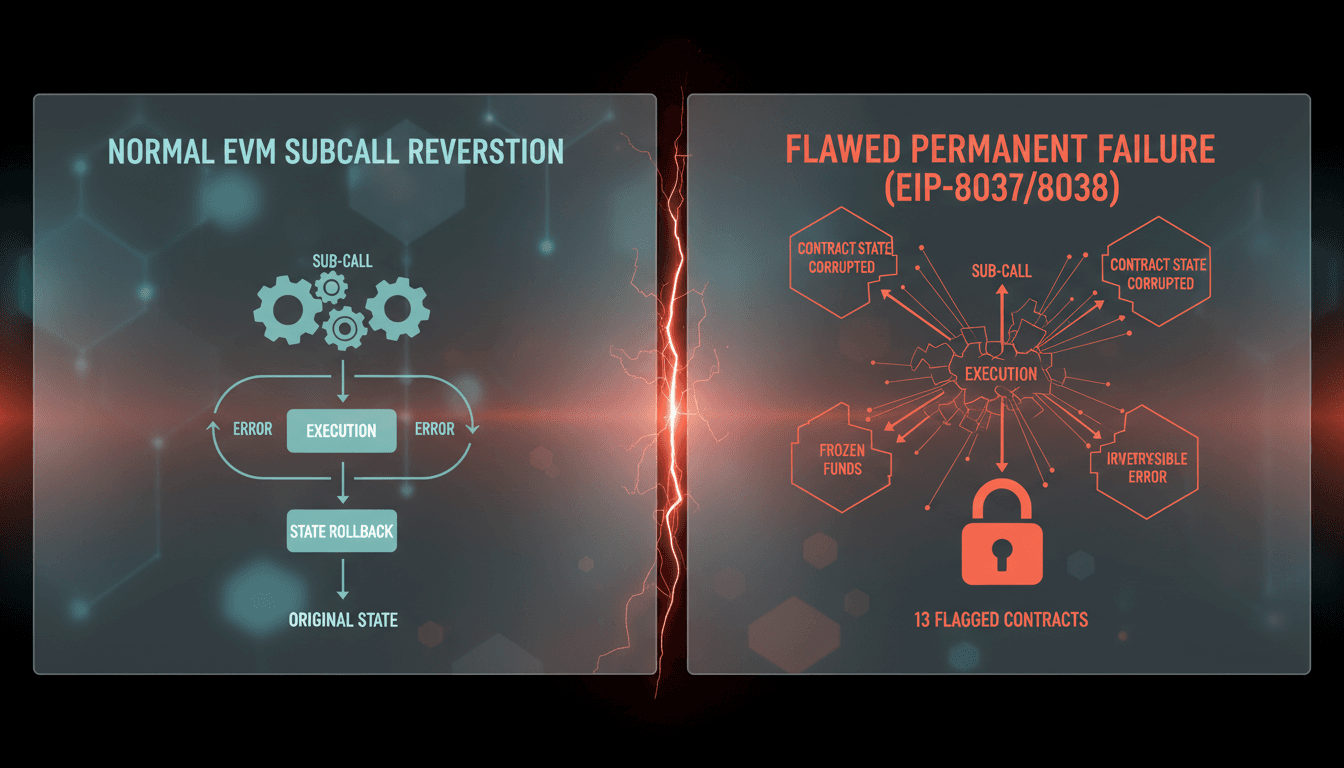
However, ChainSecurity's October 13, 2026 audit uncovered a fatal side effect within these gas repricing mechanisms. A smart contract frequently executes "subcalls"—nested instructions that trigger external contracts. Many production systems incorporate error-handling routines: if a subcall runs out of gas or fails, the transaction catches the failure, reverts the inner step, and triggers an alternate pathway or a retry routine.
Under the proposed gas changes, the shifts in execution fees and refund structures alter the exact gas returned to the parent contract. ChainSecurity confirmed that in 13 live mainnet contracts, this shift allows subcalls that previously failed safely to execute partial, corrupted failure-handling logic. Instead of rolling back cleanly, the affected contracts process the failure as resolved, locking their internal states into irreversible dead ends.
During the All Core Developers Execution meeting (ACDE #248) on October 22, 2026, developers chose protocol safety over scheduling velocity. Rather than proceeding with the scheduled activation at Hoodi epoch 132,352, the Ethereum Foundation and client teams stripped the activation rules from their client releases.
For the broader market, the immediate impact remains contained. Ether traded steadily near $2,296 following the announcement because the pause occurred early in the deployment pipeline. But this decision reveals the ongoing trade-off Ethereum faces: client teams cannot easily raise throughput without risking the architectural foundation of the applications already running on the ledger.
Who feels it first (and how)
- Protocol engineering teams: Must wait for clear client specifications on gas repricing before finalizing smart contract architectures reliant on subcall return data.
- Node and testnet operators: Required to update their client configurations immediately to decouple Hoodi nodes from the canceled October 26 activation logic.
- Institutional capital allocators: Face longer horizons for planned layer-1 capacity improvements, keeping fee dynamics pinned to existing limits.
- Dubai and global retail holders: Experience zero direct friction; mainnet assets, balances, and operational contracts remain completely untouched.
What to watch next
- Core developer consensus updates: Monitor subsequent ACDE calls to see whether developers modify EIP-8037 and EIP-8038 or decouple them entirely from the Glamsterdam package.
- Responsible disclosure resolutions: Watch for ChainSecurity and affected teams to release technical post-mortems once mitigation steps for the 13 flagged contracts are established.
- Hoodi testnet rescheduling: The posting of a new activation epoch will indicate that client teams have resolved the gas calculation edge cases.
The Hoodi testnet activation on October 26, 2026, is officially postponed after 13 mainnet contracts were found vulnerable to permanent execution failure under EIP-8037 and EIP-8038.
The tentative December 2026 mainnet target for Glamsterdam will slip into 2027 while client teams re-engineer the fee mechanisms to safeguard legacy code.
Whether core developers will strip the problematic EIPs to push through the gas limit increases, or delay the entire upgrade until the accounting mechanics are completely rewritten.
Frequently Asked Questions
- Why it matters?
- The postponement highlights the constant structural friction between raising network throughput and protecting immutable legacy smart contract code from systemic execution failures.
- What happened (in 30 seconds)?
- The testnet launch paused: Ethereum core developers called off the October 26, 2026 activation of the Glamsterdam upgrade on the Hoodi testnet during ACDE meeting #248. Vulnerabilities surfaced: Security firm ChainSecurity discovered that changes to gas accounting under EIP-8037 and EIP-8038 could push 13 active mainnet smart contracts into permanent failure states. Mainnet targets shifted: With the Hoodi activation paused and client software adjustments required, the tentative December 2026 mai
- What's really happening?
- The core tension on Ethereum is that you cannot retroactively patch immutable code once it hits the blockchain. When core developers alter the underlying virtual machine's economics, every line of logic written under older assumptions must continue working as originally intended. The Glamsterdam hard fork couples two core goals: expanding execution throughput and curbing database bloat. To do that, the upgrade introduces EIP-8037 and EIP-8038, which overhaul how the Ethereum Virtual Machine (E
- Who feels it first (and how)?
- Protocol engineering teams: Must wait for clear client specifications on gas repricing before finalizing smart contract architectures reliant on subcall return data. Node and testnet operators: Required to update their client configurations immediately to decouple Hoodi nodes from the canceled October 26 activation logic. Institutional capital allocators: Face longer horizons for planned layer-1 capacity improvements, keeping fee dynamics pinned to existing limits. Dubai and global retail holder
- What to watch next?
- Core developer consensus updates: Monitor subsequent ACDE calls to see whether developers modify EIP-8037 and EIP-8038 or decouple them entirely from the Glamsterdam package. Responsible disclosure resolutions: Watch for ChainSecurity and affected teams to release technical post-mortems once mitigation steps for the 13 flagged contracts are established. Hoodi testnet rescheduling: The posting of a new activation epoch will indicate that client teams have resolved the gas calculation edge cases.
Covers Bitcoin plus altcoin news, market updates, and educational resources.
"Bitcoin.com provides news, market data, and guides focused on Bitcoin and the wider crypto industry."
— A47 Editor
Ethereum Delays Glamsterdam Testing After 13 Contracts Trigger Concerns
Ethereum has postponed the testing of its Glamsterdam upgrade after concerns arose regarding 13 smart contracts that may be impacted by changes in gas pricing. This decision comes as part of a broader effort to ensure the security and stability of th...
Covers blockchain, cryptocurrency news, project analysis, and market insights.
"Cointelegraph is a leading crypto-focused media outlet known for timely news, analysis, and educational content related to blockchain and digital assets."
— A47 Editor
Ethereum delays Glamsterdam Hoodi testnet launch over security risks
Ethereum has postponed the launch of its Glamsterdam Hoodi testnet due to identified security risks, specifically concerning 13 smart contracts that could be affected by changes in gas pricing. ChainSecurity is coordinating a responsible disclosure w...
Real-time updates, analysis, and reports on the blockchain and cryptocurrency sectors.
"Crypto News delivers real-time updates, analysis, and reports on the blockchain and cryptocurrency sectors."
— A47 Editor
Ethereum postpones Glamsterdam after EIP-8037 raises security concerns
Ethereum has postponed the Glamsterdam upgrade's Hoodi testnet launch, originally scheduled for October 26, due to security concerns related to EIP-8037 compatibility. This decision follows the identification of risks affecting 13 smart contracts tha...