
Saudi Arabia's inflation rate remains stable at 1.8% in June 2026
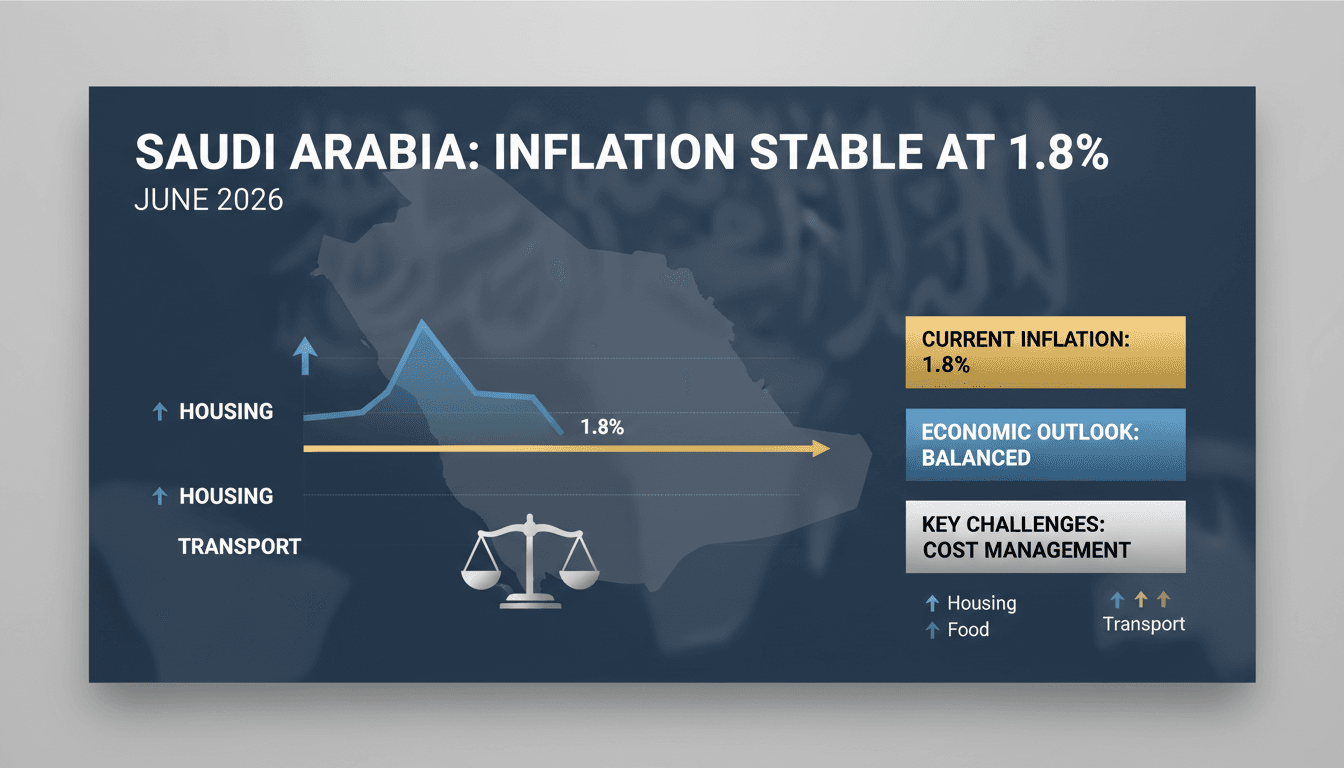
Here's what it means for you.
The stability of Saudi Arabia's inflation rate at 1.8% signals a resilient economic environment, particularly in the face of rising global inflation pressures. This steadiness may bolster consumer confidence and influence market dynamics, especially in sectors sensitive to price fluctuations such as housing and food. Policymakers will need to remain vigilant in monitoring these areas to ensure continued economic stability.
What happened
In June 2026, Saudi Arabia's annual inflation rate held steady at 1.8%, marking one of the lowest rates among G20 economies. This stability comes despite a slight monthly uptick of 0.2% compared to May 2026. The increase in inflation was primarily driven by rising costs in housing, food, and transport, which are critical components of the Consumer Price Index (CPI).
The CPI reflects changes in prices for a fixed basket of goods and services, providing insight into consumer spending patterns. The stability in the inflation rate indicates that the Saudi economy is managing to balance these rising costs effectively.
The Context
Saudi Arabia's inflation rate of 1.8% is among the lowest in the G20, showcasing the country's relative economic stability. However, significant increases in housing costs, which rose by 3.5%, alongside a 1.4% rise in food and beverage prices, highlight areas of concern for consumers. These rising costs could impact consumer behavior and overall economic sentiment.
The government may need to address these inflationary pressures to maintain consumer confidence and economic stability. As global economic conditions evolve, the local inflation rate could be influenced by external factors, necessitating close monitoring by policymakers.
Takeaway
The current stability in Saudi Arabia's inflation suggests a resilient economic environment, but ongoing vigilance is essential. Future developments in the housing market and the impact of global economic trends on local inflation rates will be crucial to watch. Policymakers may need to implement strategies to manage rising costs in housing and food to sustain this stability.
As the situation evolves, stakeholders should remain attentive to potential shifts in consumer behavior and market dynamics that could arise from these inflationary pressures.
Pan-Arab news coverage spanning politics, business, sports, and regional affairs.
"Asharq Al-Awsat reflects a broad Arab editorial perspective with strong attention to regional geopolitics."
— A47 Editor
السعودية تحافظ على تضخم عند 1.8 %
Saudi Arabia maintained an annual inflation rate of 1.8% in June, continuing to record one of the lowest inflation rates among the G20 economies amid rising global inflation pressures.
English-language reporting on Saudi politics, policy, and society.
"Saudi Gazette reflects mainstream Saudi institutional perspectives."
— A47 Editor
Saudi inflation reaches 1.8% in June, driven by housing costs
Saudi Arabia's annual inflation rate reached 1.8% in June 2026, primarily driven by rising costs in housing, food, and transport, as reported by the General Authority for Statistics (GASTAT). Housing-related costs saw a notable increase of 3.5%, with...
English-language reporting focused on Saudi Arabia and regional affairs.
"Saudi Gazette provides English-language coverage that often aligns with mainstream Saudi news priorities."
— A47 Editor
Saudi inflation reaches 1.8% in June, driven by housing costs
Saudi Arabia's annual inflation rate reached 1.8% in June 2026, primarily driven by rising costs in housing, food, and transport, as reported by the General Authority for Statistics (GASTAT). Housing-related costs saw a notable increase of 3.5%, with...
Sports reporting with a focus on Saudi and regional competitions.
"Okaz sports coverage is broad and audience-friendly, with strong attention to Saudi teams and leagues."
— A47 Editor
التضخم في السعودية يستقر عند 1.8%
The General Authority for Statistics in Saudi Arabia reported that the consumer price index (CPI) remained stable at 1.8% in June 2026, unchanged from the previous month. Year-on-year, inflation rose by 1.8%, primarily driven by increases in housing,...