
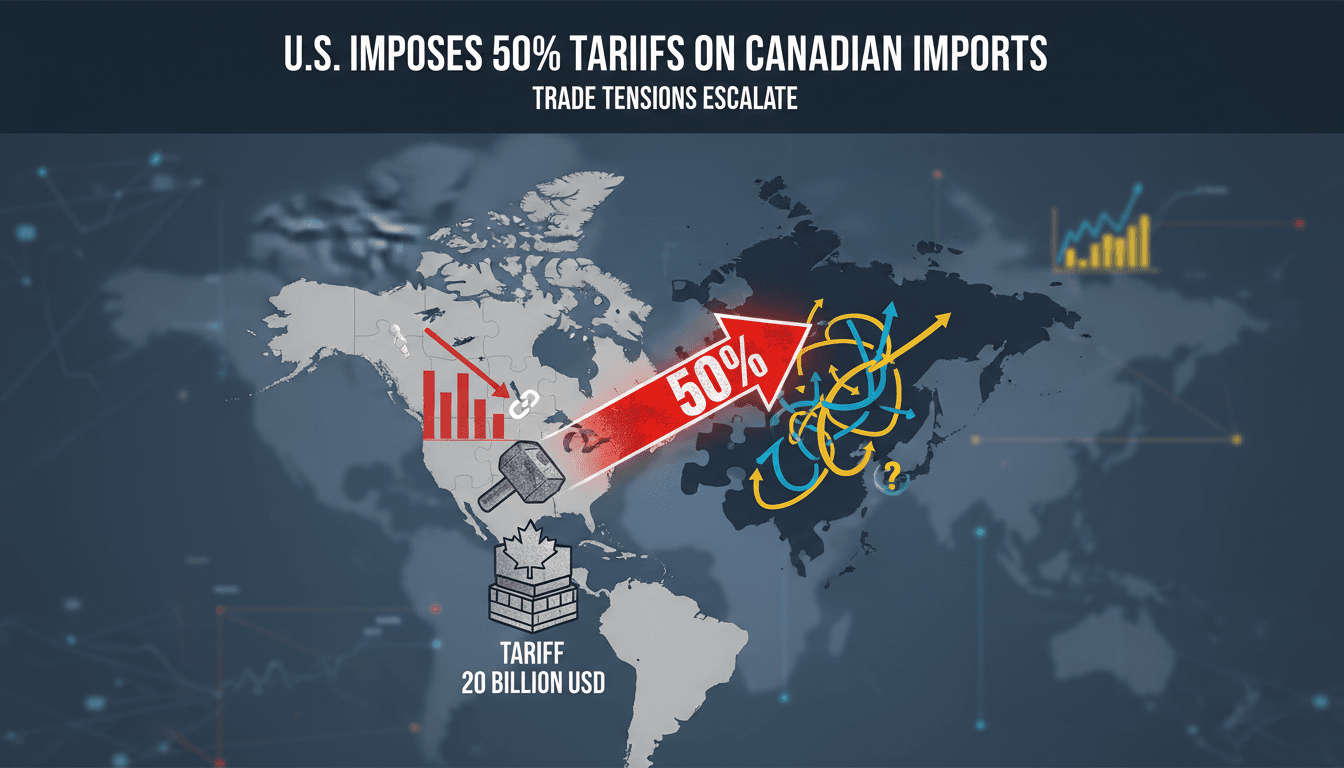
U.S. imposes 50% tariffs on $20 billion worth of Canadian imports
Here's what it means for you.
The recent imposition of a 50% tariff on $20 billion worth of Canadian imports signifies a major shift in U.S.-Canada trade relations. This move is likely to affect a wide range of consumer goods, impacting both markets and consumers. Businesses on both sides of the border may need to reassess their supply chains and pricing strategies in light of these tariffs. As the trade conflict escalates, stakeholders should prepare for potential retaliatory measures from Canada, which could further complicate the economic landscape. The long-term implications may lead to a reevaluation of trade agreements and relationships between the two nations.
What happened
The U.S. has officially announced a 50% tariff on Canadian imports valued at approximately $20 billion. This decision marks a significant escalation in the ongoing trade tensions between the two countries. The tariffs will affect hundreds of product categories, including various consumer goods, which could have widespread implications for both economies.
President Donald Trump made the announcement as part of a broader strategy to renegotiate trade terms. This move is seen as a continuation of the trade war initiated by the U.S. against various countries, further intensifying the economic conflict.
The Context
The imposition of these tariffs comes amid rising trade tensions between the U.S. and Canada, with both nations grappling with the repercussions of previous trade disputes. The Trump administration's strategy aims to reshape trade relationships and protect domestic industries, which has led to a more aggressive stance on tariffs.
Canadian exporters are expected to feel the impact of these tariffs, potentially leading to retaliatory measures from the Canadian government. The timing of this announcement suggests a calculated effort to leverage trade negotiations, as both countries navigate complex economic landscapes.
Takeaway
As the trade conflict intensifies, stakeholders should closely monitor potential retaliatory tariffs from Canada. Responses from Canadian businesses and government officials will be critical in shaping the next steps in this ongoing dispute. The situation may lead to further negotiations or additional retaliatory actions, which could have lasting effects on both economies.
The imposition of these tariffs highlights the fragility of international trade relationships and the potential for escalating economic repercussions. Observers should remain vigilant as developments unfold in the coming weeks.
National coverage of politics and current events across Canada.
"Global News is a mainstream Canadian outlet with a centrist editorial stance, focusing on factual reporting."
— A47 Editor
From wigs to wine, Canadian goods targeted in Trump’s latest tariff threats
U.S. President Donald Trump has announced a sweeping 50% tariff on a wide range of Canadian goods, including dairy, alcohol, and automobiles, citing discriminatory trade practices as the rationale. This decision, which targets products valued at appr...
Currency market headlines, FX rates, central-bank chatter, and macro drivers moving major pairs.
"Investing.com’s forex stream is useful for fast updates across USD, EUR, JPY, GBP and emerging-market FX."
— A47 Editor
US imposes new 50% tariffs on $20 billion worth of Canadian products
The United States has announced a new 50% tariff on approximately $20 billion worth of Canadian products, including key sectors such as dairy and alcohol, effective in 30 days. This decision is attributed to perceived unfair trade practices by Canada...
Pan-Arab news coverage spanning politics, business, sports, and regional affairs.
"Asharq Al-Awsat reflects a broad Arab editorial perspective with strong attention to regional geopolitics."
— A47 Editor
ترمب يعيد إشعال الحرب التجارية
The Trump administration has entered a new phase in the trade war by imposing a 50% tariff on Canadian imports valued at $20 billion. This escalation in trade tensions signals a significant shift in U.S.-Canada trade relations.
Regional and international reporting focused on Middle Eastern politics, diplomacy, and economics.
"Asharq Al-Awsat is a Saudi-owned international newspaper reflecting mainstream Gulf political perspectives."
— A47 Editor
US Imposes New 50% Tariffs on $20 Billion Worth of Canadian Products
The United States has imposed a new 50% tariff on approximately $20 billion worth of Canadian products, including key imports such as wine, cement, and dairy goods. This decision, announced by President Donald Trump, is attributed to perceived discri...