
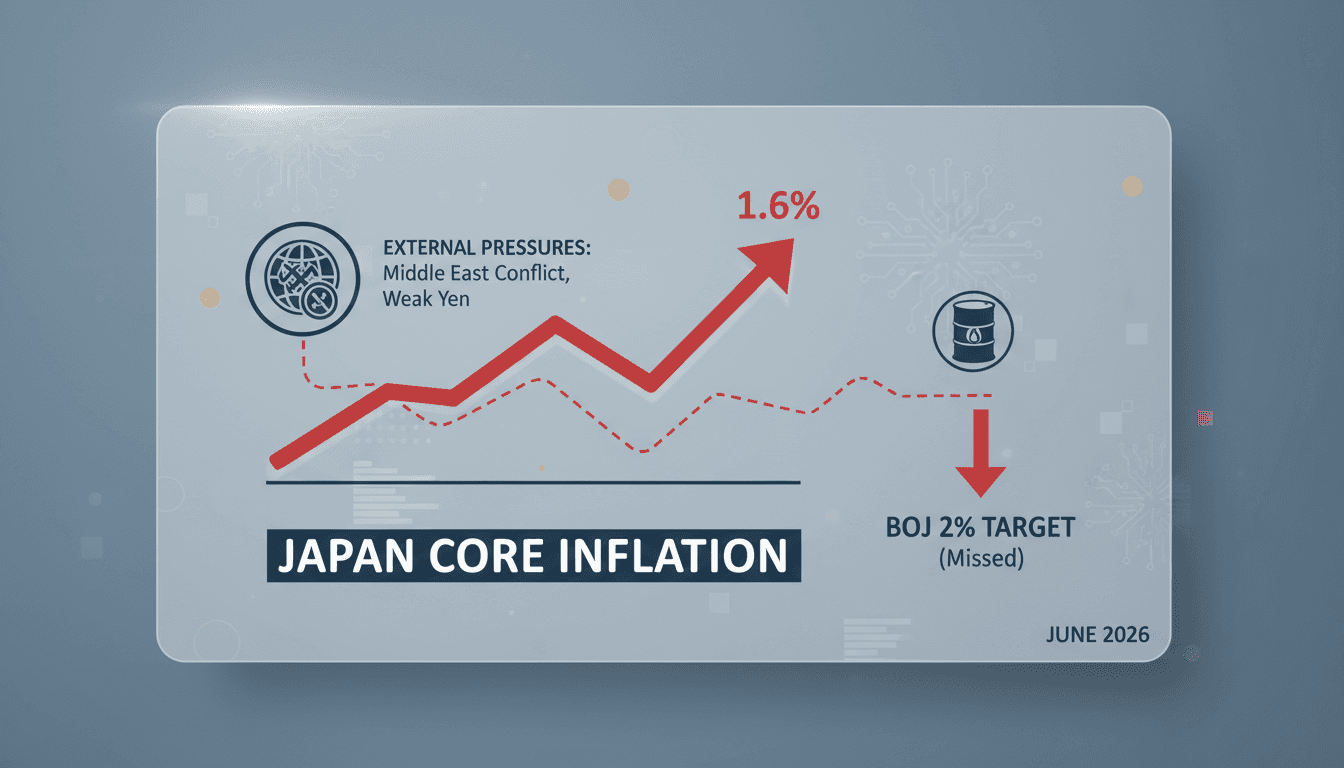
Japan's core inflation rises to 1.6% amid external pressures
Here's what it means for you.
Japan's recent inflation data signals a cautious economic landscape, as the core Consumer Price Index (CPI) has risen to 1.6% year-over-year. This increase, while indicative of some recovery, remains below the Bank of Japan's 2% target, suggesting that the central bank may need to reassess its monetary policy strategies. Stakeholders should remain vigilant as external factors, including geopolitical tensions and currency fluctuations, continue to influence inflation trends. The interplay between domestic inflation and global economic conditions will be crucial for Japan's economic trajectory. As the nation navigates these challenges, the implications for consumer spending and investment could be significant.
What happened
Japan's core CPI has increased by 1.6% year-over-year as of June 2026, reflecting a slight acceleration in consumer inflation. Despite this rise, the figure remains below the Bank of Japan's inflation target of 2%, indicating mixed economic signals. The increase in inflation is influenced by external pressures, including the ongoing conflict in the Middle East and a weak yen.
These factors have contributed to a complex economic environment, raising questions about the sustainability of Japan's recovery. The current inflation dynamics suggest that while there are signs of improvement, significant challenges remain.
The Context
The Bank of Japan has set a 2% inflation target as part of its broader economic strategy. However, the recent rise in core CPI highlights the ongoing struggle to achieve this goal amidst external pressures. Geopolitical tensions and currency fluctuations are key factors that are shaping inflation trends in Japan.
As the nation grapples with these challenges, the uncertainty surrounding its economic recovery trajectory becomes more pronounced. Stakeholders, including policymakers and investors, must consider how these dynamics will influence future economic decisions.
Takeaway
Looking ahead, continued monitoring of inflation trends will be essential as Japan navigates its complex economic landscape. Potential adjustments in monetary policy by the Bank of Japan could be on the horizon, depending on how external factors evolve. The impact of global economic conditions on Japan's inflation rates will also be critical to watch.
As the situation develops, the interplay between domestic inflation and international pressures will shape Japan's economic policies and growth prospects. Stakeholders should prepare for possible shifts in the economic environment as these factors unfold.
Social/economic commentary and analysis relevant to business and markets.
"WSJ blends data-driven economic insight with commentary on policy and society."
— A47 Editor
Japan Consumer Inflation Picks Up, Keeping Rate Increases on Track
Japan's consumer inflation has picked up, with the core Consumer Price Index (CPI) rising by 1.6% year-on-year in June 2026, driven by elevated energy prices. This increase reflects ongoing economic pressures, including the impact of a weak yen and g...
Key macro releases (CPI, jobs, PMIs), surprise indexes, and market implications.
"Great for data-print awareness and instant read-through to rates and risk assets."
— A47 Editor
Japan CPI rises as expected in June, core inflation below BOJ target
Japan's Consumer Price Index (CPI) rose as expected in June, with core inflation recorded at 1.6%, remaining below the Bank of Japan's (BOJ) target. This increase reflects ongoing economic pressures, particularly from elevated energy prices, which ha...
Macro commentary, policy analysis, growth/inflation themes, and global outlooks.
"Contextual macro coverage that complements day-to-day market headlines."
— A47 Editor
Japan June core inflation accelerates, stays below BOJ target
In June 2026, Japan's core inflation accelerated to 1.6%, remaining below the Bank of Japan's (BOJ) target, as rising energy prices continued to exert upward pressure on consumer prices. This marks an increase from the previous month's core inflation...
Key macro releases (CPI, jobs, PMIs), surprise indexes, and market implications.
"Great for data-print awareness and instant read-through to rates and risk assets."
— A47 Editor
Japan June core CPI rises 1.6% yr/yr
Japan's core Consumer Price Index (CPI) rose by 1.6% year-on-year in June 2026, reflecting an increase driven by elevated energy prices. This marks a notable rise from the previous month's core inflation rate of 1.4%, indicating ongoing inflationary ...