
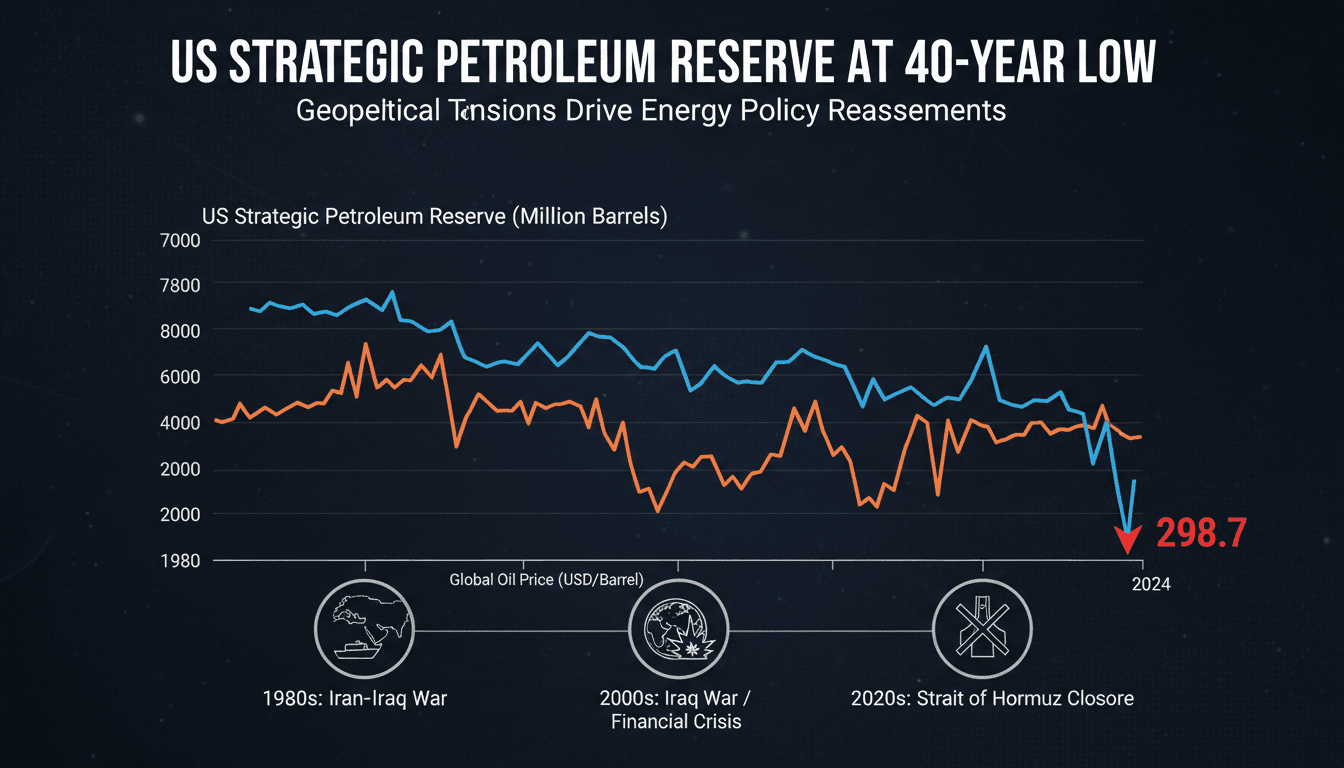
US Strategic Petroleum Reserve falls below 300 million barrels for the first time since the 1980s
Here's what it means for you.
The U.S. Strategic Petroleum Reserve (SPR) has reached a critical low, which could have significant implications for energy policy and market stability. As the reserve dips below 300 million barrels for the first time in over 40 years, concerns about energy security are mounting. This situation may prompt policymakers to reassess strategies for managing oil supply disruptions, particularly in light of ongoing geopolitical tensions. The closure of the Strait of Hormuz, a vital oil transport route, exacerbates these concerns and could lead to increased volatility in global oil prices. Stakeholders across the energy sector will need to monitor developments closely as the U.S. navigates these challenges.
What happened
The U.S. Strategic Petroleum Reserve has fallen to 298.7 million barrels, marking its lowest level since the early 1980s. This decline is significant as it highlights potential vulnerabilities in U.S. energy security amid ongoing geopolitical tensions. The recent drop of approximately 6.1 million barrels raises alarms about the nation's ability to manage oil supply disruptions effectively.
The closure of the Strait of Hormuz has heightened concerns over oil supply stability, further complicating the situation. As the reserve continues to dwindle, the implications for both domestic and global markets become increasingly pronounced.
The Context
The SPR serves as a crucial resource for the U.S. to mitigate the impacts of oil supply disruptions. The last time the reserve was below 300 million barrels was in the early 1980s, a period marked by significant energy crises. The current geopolitical landscape, particularly the closure of the Strait of Hormuz, has intensified worries about the stability of oil supplies.
As the U.S. grapples with these challenges, various stakeholders, including government officials, energy companies, and consumers, will be affected by the evolving situation. The interplay of these factors underscores the importance of reassessing energy policies to enhance national security.
Takeaway
The declining oil reserve may prompt the U.S. to reconsider its energy policies and strategies for managing supply disruptions. As the situation develops, it will be essential to monitor the impact of the Strait of Hormuz closure on global oil prices. Additionally, potential policy responses from the U.S. government regarding energy reserves will be critical to watch.
In the coming months, the focus will likely shift towards enhancing energy security and exploring alternative strategies to stabilize oil supplies amid ongoing geopolitical uncertainties. Stakeholders should remain vigilant as these dynamics unfold.
Global business headlines with AI angles.
"General business outlet that frequently covers AI."
— A47 Editor
U.S. Strategic Petroleum Reserve Falls To Its Lowest Level In More Than Four Decades As Hormuz Strait Remains Closed
The U.S. Strategic Petroleum Reserve has fallen to its lowest level in over 40 years, coinciding with the ongoing closure of the Strait of Hormuz, a critical maritime route for global oil shipments. This depletion raises concerns about the U.S.'s abi...
Capitol Hill news, legislation, and policy insight.
"The Hill specializes in U.S. politics and policy, with a focus on Capitol Hill developments and a reputation for insider reporting."
— A47 Editor
US emergency oil reserve falls below 300M barrels for first time since 1980s
The U.S. emergency oil reserve has fallen below 300 million barrels for the first time since the 1980s, with the latest Energy Department data reporting a level of 298.7 million barrels. This decline marks a significant milestone in the history of th...
Pan-Arab news coverage spanning politics, business, sports, and regional affairs.
"Asharq Al-Awsat reflects a broad Arab editorial perspective with strong attention to regional geopolitics."
— A47 Editor
تراجع احتياطي النفط الاستراتيجي الأميركي لأدنى مستوى منذ 1983
Recent data from the U.S. Department of Energy indicates that the strategic petroleum reserve has decreased by approximately 6.1 million barrels, bringing the total to 298.7 million barrels, marking the lowest level since 1983.