
US Strategic Petroleum Reserve reaches lowest level since 1982
Why it matters
The depletion of the Strategic Petroleum Reserve (SPR) signals heightened geopolitical risks and potential market instability.
What happened (in 30 seconds)
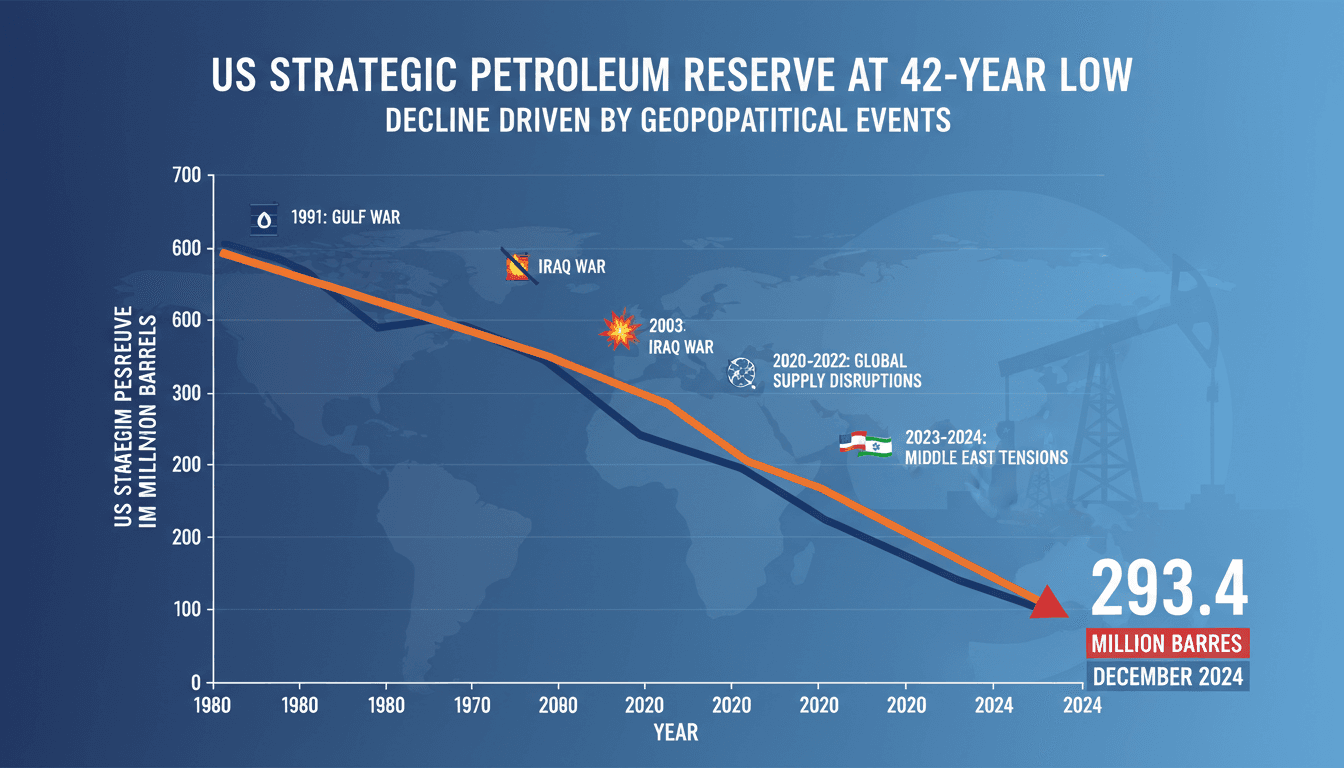
- Emergency crude oil holdings in the US Strategic Petroleum Reserve fell to 293.4 million barrels, the lowest since December 1982.
- Ongoing releases authorized by the US government aim to mitigate supply disruptions from Middle Eastern conflicts, with a commitment to release up to 172 million barrels.
- Commercial inventories have risen to 424.4 million barrels, but oil prices have increased amid ongoing supply concerns.
The context you actually need
- Established in 1975, the SPR was created to buffer against severe petroleum supply disruptions, peaking at 707.21 million barrels in 2008.
- Geopolitical tensions in the Middle East, particularly around the Strait of Hormuz, have prompted accelerated drawdowns from the reserve.
- The International Energy Agency (IEA) coordinated a release of 400 million barrels to address global supply deficits, with projections indicating a 1.27 million barrels per day shortfall in 2026.
What's really happening
The recent drawdown of the US Strategic Petroleum Reserve (SPR) to its lowest level since December 1982 reflects a complex interplay of geopolitical tensions and market dynamics. The SPR, established in the wake of the 1973-1974 Arab oil embargo, was designed to provide a buffer against severe supply disruptions. However, as of August 14, 2026, it has dwindled to 293.4 million barrels, significantly below its peak of 707.21 million barrels in 2008.
The current situation stems from escalating conflicts in the Middle East, particularly involving the US, Israel, and Iran. These tensions have disrupted oil tanker movements through the critical Strait of Hormuz, a vital passage for global oil shipments. In response, the US government authorized the release of up to 172 million barrels from the SPR as part of a broader 400 million barrel coordinated action by the IEA. This decision was made to stabilize the market and mitigate the impact of supply disruptions.
As the SPR levels have declined, commercial inventories have risen to 424.4 million barrels, providing some market cushion. However, the overall sentiment in the oil market remains cautious, with prices rising more than $2 per barrel in response to the drawdown. The US administration has indicated that the exchanged barrels will be returned with premiums, which could help recover some of the lost capacity without necessitating full repurchases.
The implications of this drawdown are significant. The SPR's low levels raise questions about the US's ability to respond to future supply shocks, particularly as geopolitical risks remain elevated. The IEA's projection of a 1.27 million barrels per day global supply deficit in 2026 underscores the urgency of the situation. As the US continues to navigate these challenges, the balance between maintaining adequate emergency capacity and addressing immediate market needs will be critical.
Who feels it first (and how)
- Consumers: Higher energy costs will directly impact household budgets and transportation expenses.
- Businesses: Industries reliant on oil, such as transportation and manufacturing, may face increased operational costs.
- Investors: Fluctuations in oil prices could affect stock market performance, particularly for energy sector stocks.
- Governments: Countries dependent on oil imports may experience economic instability and inflationary pressures.
What to watch next
- Oil price trends: Monitoring fluctuations in oil prices will be crucial, as they can signal broader market reactions to geopolitical events.
- Geopolitical developments: Any escalation in Middle Eastern conflicts could lead to further supply disruptions and impact global oil markets.
- US policy responses: Watch for announcements regarding future SPR releases or changes in energy policy that could affect supply and pricing.
The SPR is at its lowest level since 1982, reflecting significant geopolitical tensions.
Oil prices will remain volatile as markets react to ongoing supply concerns and geopolitical developments.
The long-term strategy for replenishing the SPR and its impact on future energy security remains uncertain.
Frequently Asked Questions
- Why it matters?
- The depletion of the Strategic Petroleum Reserve (SPR) signals heightened geopolitical risks and potential market instability.
- What happened (in 30 seconds)?
- Emergency crude oil holdings in the US Strategic Petroleum Reserve fell to 293.4 million barrels, the lowest since December 1982. Ongoing releases authorized by the US government aim to mitigate supply disruptions from Middle Eastern conflicts, with a commitment to release up to 172 million barrels. Commercial inventories have risen to 424.4 million barrels, but oil prices have increased amid ongoing supply concerns.
- What's really happening?
- The recent drawdown of the US Strategic Petroleum Reserve (SPR) to its lowest level since December 1982 reflects a complex interplay of geopolitical tensions and market dynamics. The SPR, established in the wake of the 1973-1974 Arab oil embargo, was designed to provide a buffer against severe supply disruptions. However, as of August 14, 2026, it has dwindled to 293.4 million barrels, significantly below its peak of 707.21 million barrels in 2008. The current situation stems from escalating co
- Who feels it first (and how)?
- Consumers: Higher energy costs will directly impact household budgets and transportation expenses. Businesses: Industries reliant on oil, such as transportation and manufacturing, may face increased operational costs. Investors: Fluctuations in oil prices could affect stock market performance, particularly for energy sector stocks. Governments: Countries dependent on oil imports may experience economic instability and inflationary pressures.
- What to watch next?
- Oil price trends: Monitoring fluctuations in oil prices will be crucial, as they can signal broader market reactions to geopolitical events. Geopolitical developments: Any escalation in Middle Eastern conflicts could lead to further supply disruptions and impact global oil markets. US policy responses: Watch for announcements regarding future SPR releases or changes in energy policy that could affect supply and pricing.
English-language digital publication covering business, politics, technology, and current affairs.
"The Arabian Post mixes original and syndicated-style coverage with a broad regional and global business-news orientation."
— A47 Editor
US emergency oil reserve sinks to 1982 low
The United States' Strategic Petroleum Reserve has fallen below 300 million barrels for the first time since 1982, with a significant withdrawal of approximately 5.3 million barrels reported for the week ending August 14. This decline reflects ongoin...
Corporate leadership, finance, technology, and market trends.
"Fortune covers financial trends, leadership, and innovation with a pragmatic editorial approach."
— A47 Editor
U.S. strategic reserves are getting so low the drawdown threatens to damage the 60 underground salt caverns storing American oil
The U.S. is facing a critical situation as its strategic petroleum reserves are depleting, raising concerns about the structural integrity of the 60 underground salt caverns that store American oil. A petroleum engineering professor has warned that c...
English-language digital publication covering business, politics, technology, and current affairs.
"The Arabian Post mixes original and syndicated-style coverage with a broad regional and global business-news orientation."
— A47 Editor
US oil reserve sinks towards four-decade low
The US Strategic Petroleum Reserve has dropped below 300 million barrels, reaching its lowest level since 1983, following a significant weekly withdrawal of approximately 6.1 million barrels. This decline raises alarms regarding the adequacy of the n...
Global business headlines with AI angles.
"General business outlet that frequently covers AI."
— A47 Editor
The U.S. Strategic Petroleum Reserve Keeps Dwindling. Experts Are Warning Its Facing Structural Peril.
The U.S. Strategic Petroleum Reserve (SPR) has fallen below 300 million barrels for the first time since its establishment over four decades ago, raising alarms among experts about its structural integrity. This depletion follows significant withdraw...