
Lagarde Warns of Erosion in Europe's Economic Model Due to U.S. Global Retreat
Here's what it means for you.
If you're in Europe, expect potential shifts in job markets and investment opportunities as the economic landscape evolves.
Why it matters
The erosion of Europe's post-war economic model could reshape global trade dynamics and impact economic stability across the continent.
What happened (in 30 seconds)
- Lagarde's warning: On August 19, 2026, ECB President Christine Lagarde highlighted the erosion of Europe's economic model due to U.S. global retreat.
- Trade barriers rising: Over 2,500 trade restrictions were introduced globally in the past year, complicating international trade.
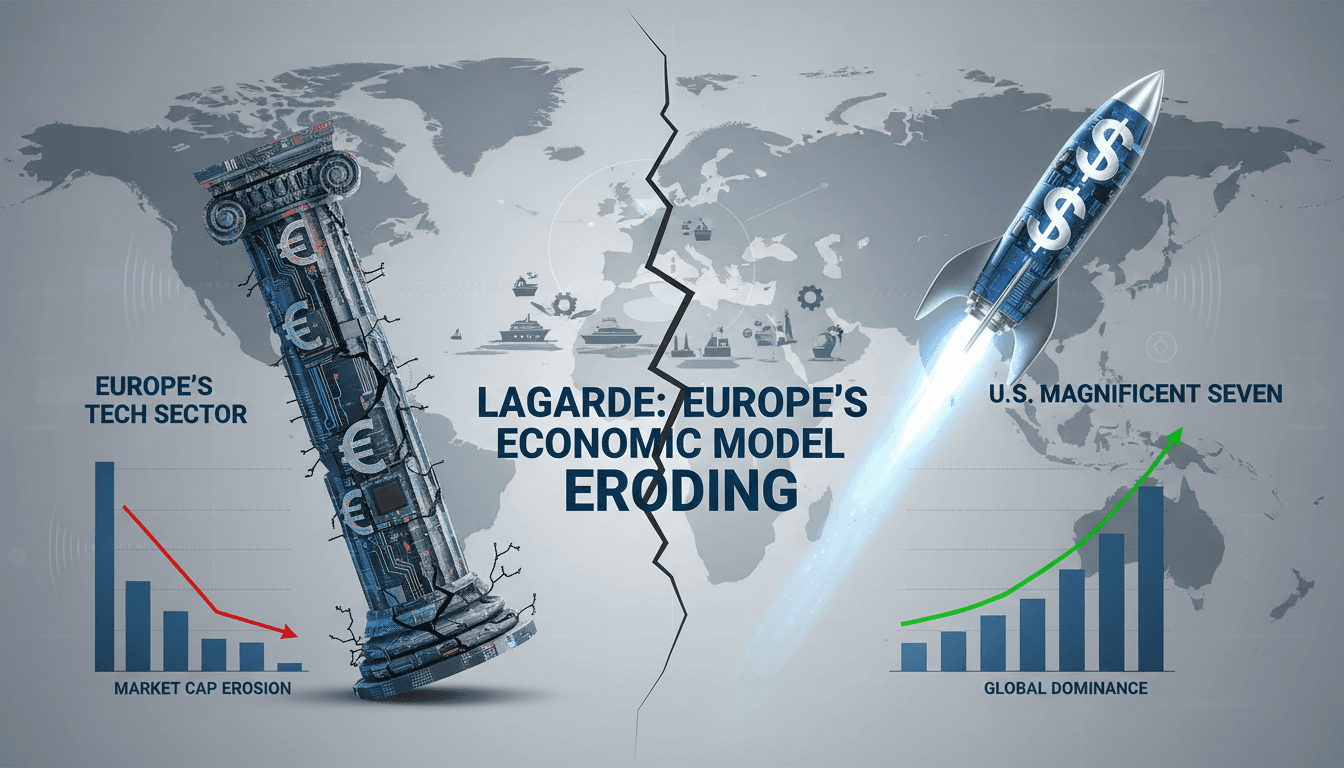
- AI competitiveness lag: Europe's tech market cap stands at €1.37 trillion, significantly lower than the U.S. Magnificent Seven's $23 trillion, raising concerns about future growth.
The context you actually need
- Post-war reliance: Europe's economic growth has historically depended on global trade, affordable energy, and U.S. security guarantees.
- Geopolitical tensions: Rising protectionism and conflicts, including those related to Russia and the Middle East, are straining these foundational pillars.
- Need for integration: Lagarde advocates for deeper EU integration and reforms to enhance resilience and competitiveness in the face of these challenges.
What's really happening
Christine Lagarde's remarks at the World Economic Forum's International Business Council in Geneva signal a critical juncture for Europe's economy. The traditional post-World War II growth model, which relied heavily on expanding global trade, affordable energy for manufacturing, and a stable international order underpinned by U.S. security, is facing unprecedented challenges.
The introduction of over 2,500 trade restrictions globally in the past year illustrates a significant shift towards protectionism, complicating the landscape for European businesses that depend on international markets. The uncertainty surrounding tariff agreements, particularly those influenced by the Trump administration, has further exacerbated this situation. As firms grapple with these new realities, many are prioritizing resilience over efficiency, leading to reduced investment in growth and innovation.
Lagarde's comparison of Europe's €1.37 trillion tech market cap to the staggering $23 trillion valuation of the U.S. Magnificent Seven underscores a critical vulnerability. This disparity highlights Europe's lag in artificial intelligence competitiveness, raising alarms about the continent's ability to capitalize on the next wave of technological advancement. The risk of repeating past mistakes, such as missing out on the digital revolution, looms large.
To counter these challenges, Lagarde has called for initiatives like 'EU Inc.' and capital market reforms aimed at enabling cross-border scaling. These proposals are designed to foster deeper integration within the EU, allowing member states to pool resources and enhance collective bargaining power in the global market. However, the path to achieving these reforms is fraught with political and economic hurdles, as member states grapple with their own domestic priorities and the implications of increased integration.
The geopolitical landscape adds another layer of complexity. With the U.S. retreating from its traditional role as a global leader, Europe faces the daunting task of redefining its security and economic strategies. The ongoing tensions with Russia and instability in the Middle East further complicate this endeavor, necessitating a reevaluation of defense spending and international alliances.
In summary, Lagarde's warning serves as a clarion call for Europe to adapt to a rapidly changing global environment. The erosion of the post-war economic model is not just a theoretical concern; it has tangible implications for businesses, governments, and individuals across the continent.
Who feels it first (and how)
- Businesses: Companies reliant on international trade may face increased costs and uncertainties.
- Tech sector: Startups and established firms in the tech industry could struggle to compete with U.S. counterparts.
- Workers: Job markets may shift as industries adapt to new economic realities, impacting employment opportunities.
What to watch next
- EU integration discussions: Monitor ongoing talks about deeper integration and structural reforms within the EU, as these will shape future economic policies.
- Trade policy changes: Keep an eye on potential shifts in trade agreements and tariffs that could impact European businesses.
- AI investment trends: Watch for developments in AI competitiveness and investment in technology, as these will be crucial for Europe's economic future.
Europe's economic model is under strain due to rising protectionism and geopolitical tensions.
Increased calls for EU integration and reforms to enhance competitiveness will continue.
The specific outcomes of proposed initiatives like 'EU Inc.' and their impact on the economy remain uncertain.
Frequently Asked Questions
- Why it matters?
- The erosion of Europe's post-war economic model could reshape global trade dynamics and impact economic stability across the continent.
- What happened (in 30 seconds)?
- Lagarde's warning: On August 19, 2026, ECB President Christine Lagarde highlighted the erosion of Europe's economic model due to U.S. global retreat. Trade barriers rising: Over 2,500 trade restrictions were introduced globally in the past year, complicating international trade. AI competitiveness lag: Europe's tech market cap stands at €1.37 trillion, significantly lower than the U.S. Magnificent Seven's $23 trillion, raising concerns about future growth.
- What's really happening?
- Christine Lagarde's remarks at the World Economic Forum's International Business Council in Geneva signal a critical juncture for Europe's economy. The traditional post-World War II growth model, which relied heavily on expanding global trade, affordable energy for manufacturing, and a stable international order underpinned by U.S. security, is facing unprecedented challenges. The introduction of over 2,500 trade restrictions globally in the past year illustrates a significant shift towards pr
- Who feels it first (and how)?
- Businesses: Companies reliant on international trade may face increased costs and uncertainties. Tech sector: Startups and established firms in the tech industry could struggle to compete with U.S. counterparts. Workers: Job markets may shift as industries adapt to new economic realities, impacting employment opportunities.
- What to watch next?
- EU integration discussions: Monitor ongoing talks about deeper integration and structural reforms within the EU, as these will shape future economic policies. Trade policy changes: Keep an eye on potential shifts in trade agreements and tariffs that could impact European businesses. AI investment trends: Watch for developments in AI competitiveness and investment in technology, as these will be crucial for Europe's economic future.
Global business headlines with AI angles.
"General business outlet that frequently covers AI."
— A47 Editor
ECB Chief Warns U.S. Retreat Is Making It Harder to Compete, Says Europe's Post-War Economic Model Is 'Eroding'
Christine Lagarde, President of the European Central Bank (ECB), has warned that the retreat of the U.S. from global leadership is complicating Europe's ability to compete economically, suggesting that the region's post-war economic model is under th...
Sports reporting with a focus on Saudi and regional competitions.
"Okaz sports coverage is broad and audience-friendly, with strong attention to Saudi teams and leagues."
— A47 Editor
«الأوروبي» يحذر من تخلف «اليورو» عن الذكاء الاصطناعي
Christine Lagarde, President of the European Central Bank, warned in Geneva that the Eurozone risks falling behind in the global economic shift towards artificial intelligence, emphasizing the need for increased investment in this technology. She not...
Pan-Arab news coverage spanning politics, business, sports, and regional affairs.
"Asharq Al-Awsat reflects a broad Arab editorial perspective with strong attention to regional geopolitics."
— A47 Editor
لاغارد: أوروبا لا تستطيع تفويت ثورة الذكاء الاصطناعي
Christine Lagarde, President of the European Central Bank, warned that Europe cannot afford to fall behind as artificial intelligence transforms the global economy. She emphasized the urgency for Europe to embrace this technological revolution to rem...