
ECB President Christine Lagarde Highlights Erosion of Europe's Economic Model Amid U.S. Global Retreat
Here's what it means for you.
If you're in a sector reliant on European markets, prepare for potential shifts in investment and competitiveness.
Why it matters
The erosion of Europe's economic model could reshape global trade dynamics and impact investment flows.
What happened (in 30 seconds)
- Christine Lagarde, President of the European Central Bank, warned that Europe's post-war economic model is eroding due to U.S. global retreat.
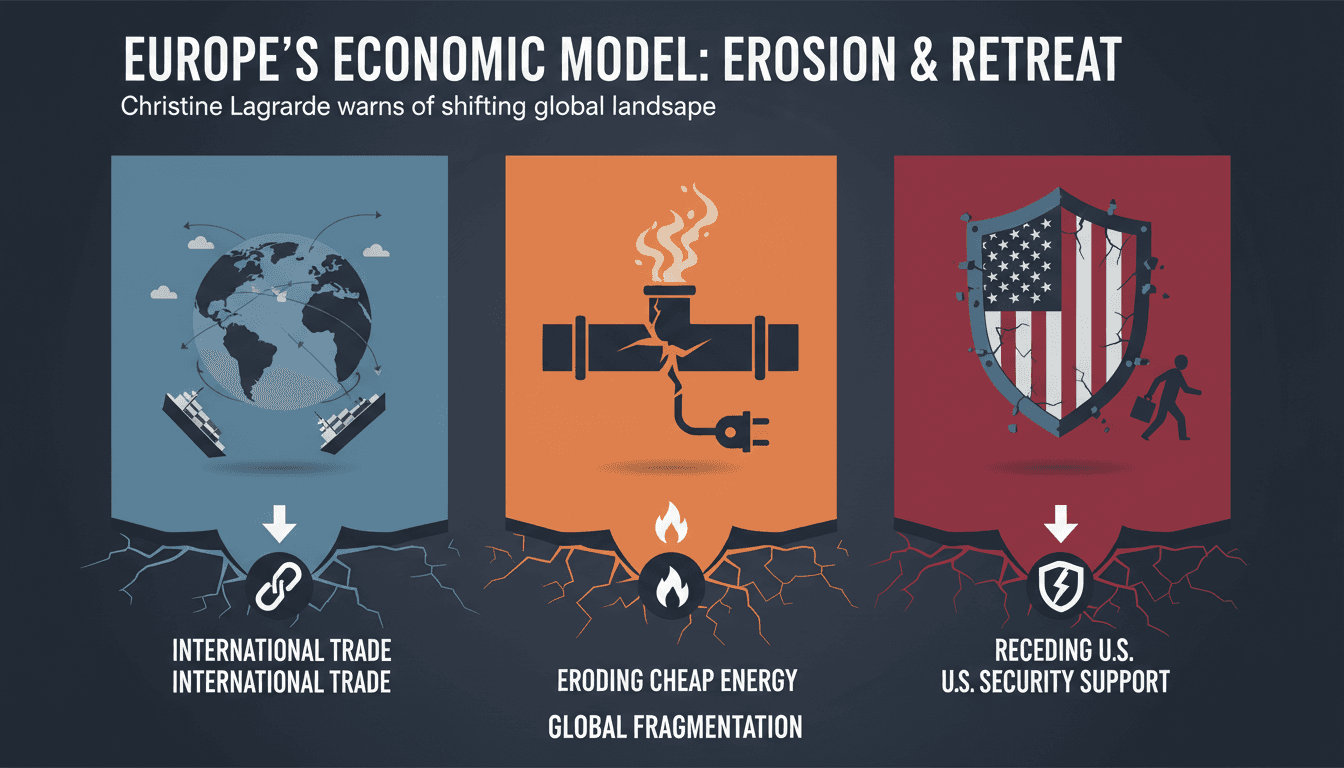
- Three pillars of European growth—international trade, cheap energy, and a stable global order—are weakening simultaneously.
- Over 2,500 global trade restrictions were implemented in the past year, complicating Europe's competitive landscape.
The context you actually need
- Europe's growth model has historically depended on globalization, affordable energy, and U.S. security, which are now under threat.
- Rising global trade barriers and U.S. tariffs have created uncertainty in market access for European goods.
- Competition from China in key sectors and Europe's lag in digital and AI technologies are further complicating the economic landscape.
What's really happening
Christine Lagarde's remarks on August 19, 2026, at the World Economic Forum highlight a critical juncture for Europe. The three foundational pillars of the continent's economic growth—international trade, affordable energy, and a stable global order—are simultaneously weakening. This convergence of challenges is forcing Europe to reassess its competitiveness in a fragmented global economy.
The backdrop to Lagarde's warning includes over 2,500 global trade restrictions imposed in the past year alone, which have created a more complex and less predictable trading environment. The U.S. has shifted its policy stance under President Trump, implementing tariffs on EU goods that have further strained transatlantic trade relations. This has led to a significant increase in uncertainty regarding market access for European products, which could stifle growth and investment.
Energy costs are another critical factor. Lagarde pointed out that electricity prices for energy-intensive industries in the EU are more than double those in the U.S. This disparity not only affects manufacturing competitiveness but also raises questions about the sustainability of Europe's energy model, especially in light of the ongoing energy crisis exacerbated by geopolitical tensions, particularly following Russia's actions in Ukraine.
Moreover, the competitive landscape is shifting as Europe faces increasing pressure from China, which is rapidly advancing in key sectors such as technology and manufacturing. The combined market capitalization of Europe's 34 most valuable publicly traded technology companies stands at €1.37 trillion ($1.59 trillion), a stark contrast to the over $23 trillion market cap of the U.S. Magnificent Seven. This gap underscores Europe's lag in digital and AI technologies, which are crucial for future economic growth.
In response to these challenges, Lagarde proposed reforms aimed at enhancing Europe's competitiveness. These include the introduction of an optional 'EU Inc.' corporate structure and capital market integration to enable greater scale and efficiency. Such reforms could help European companies adapt to the new economic realities and foster innovation.
Who feels it first (and how)
- Manufacturers: Facing higher energy costs and tariffs, they may struggle to compete globally.
- Tech companies: Lagging in market capitalization and innovation compared to U.S. counterparts.
- Investors: Uncertainty in market access and regulatory changes may affect investment decisions.
- Expatriate professionals: Shifts in capital flows and investment may impact job opportunities in Europe.
What to watch next
- EU corporate reforms: Monitor discussions on the proposed 'EU Inc.' structure and capital market integration, as these could reshape the business landscape.
- Trade negotiations: Keep an eye on ongoing U.S.-EU trade negotiations, which may influence tariffs and market access.
- Energy policy shifts: Watch for changes in energy policy that could affect costs and competitiveness in European industries.
Europe's economic model is under significant pressure from multiple fronts.
Continued discussions on corporate reforms and competitiveness measures within the EU.
The long-term impact of these shifts on global trade dynamics and investment flows.
Frequently Asked Questions
- Why it matters?
- The erosion of Europe's economic model could reshape global trade dynamics and impact investment flows.
- What happened (in 30 seconds)?
- Christine Lagarde, President of the European Central Bank, warned that Europe's post-war economic model is eroding due to U.S. global retreat. Three pillars of European growth—international trade, cheap energy, and a stable global order—are weakening simultaneously. Over 2,500 global trade restrictions were implemented in the past year, complicating Europe's competitive landscape.
- What's really happening?
- Christine Lagarde's remarks on August 19, 2026, at the World Economic Forum highlight a critical juncture for Europe. The three foundational pillars of the continent's economic growth—international trade, affordable energy, and a stable global order—are simultaneously weakening. This convergence of challenges is forcing Europe to reassess its competitiveness in a fragmented global economy. The backdrop to Lagarde's warning includes over 2,500 global trade restrictions imposed in the past year a
- Who feels it first (and how)?
- Manufacturers: Facing higher energy costs and tariffs, they may struggle to compete globally. Tech companies: Lagging in market capitalization and innovation compared to U.S. counterparts. Investors: Uncertainty in market access and regulatory changes may affect investment decisions. Expatriate professionals: Shifts in capital flows and investment may impact job opportunities in Europe.
- What to watch next?
- EU corporate reforms: Monitor discussions on the proposed 'EU Inc.' structure and capital market integration, as these could reshape the business landscape. Trade negotiations: Keep an eye on ongoing U.S.-EU trade negotiations, which may influence tariffs and market access. Energy policy shifts: Watch for changes in energy policy that could affect costs and competitiveness in European industries.
Global business headlines with AI angles.
"General business outlet that frequently covers AI."
— A47 Editor
ECB Chief Warns U.S. Retreat Is Making It Harder to Compete, Says Europe's Post-War Economic Model Is 'Eroding'
Christine Lagarde, President of the European Central Bank (ECB), has warned that the retreat of the U.S. from global leadership is complicating Europe's ability to compete economically, suggesting that the region's post-war economic model is under th...
Sports reporting with a focus on Saudi and regional competitions.
"Okaz sports coverage is broad and audience-friendly, with strong attention to Saudi teams and leagues."
— A47 Editor
«الأوروبي» يحذر من تخلف «اليورو» عن الذكاء الاصطناعي
Christine Lagarde, President of the European Central Bank, warned in Geneva that the Eurozone risks falling behind in the global economic shift towards artificial intelligence, emphasizing the need for increased investment in this technology. She not...
Pan-Arab news coverage spanning politics, business, sports, and regional affairs.
"Asharq Al-Awsat reflects a broad Arab editorial perspective with strong attention to regional geopolitics."
— A47 Editor
لاغارد: أوروبا لا تستطيع تفويت ثورة الذكاء الاصطناعي
Christine Lagarde, President of the European Central Bank, warned that Europe cannot afford to fall behind as artificial intelligence transforms the global economy. She emphasized the urgency for Europe to embrace this technological revolution to rem...