
China Implements $54 Billion Capital Injection into State-Owned Financial Institutions
Here's what it means for you.
If you’re involved in global trade or finance, this move could influence market stability and lending conditions.
Why it matters
This capital injection aims to stabilize China's financial system amid economic challenges, impacting global markets and trade dynamics.
What happened (in 30 seconds)
- China announced a 360 billion yuan ($53.6-54 billion) capital injection into eight state-owned banks and insurers on September 6-7, 2026.
- The Ministry of Finance is leading this initiative to strengthen capital buffers and support lending to the real economy.
- Market reactions were muted, with analysts noting the package was smaller than expected relative to the scale of China's banking system.
The context you actually need
- China's GDP growth slowed to 4.3% in Q2 2026, falling below the annual target range of 4.5-5%, highlighting economic fragility.
- Previous recapitalization efforts included a 520 billion yuan boost in 2025, indicating ongoing government intervention in the banking sector.
- Current challenges include weak domestic demand, a prolonged property market slump, and external pressures from trade tensions and geopolitical conflicts.
What's really happening
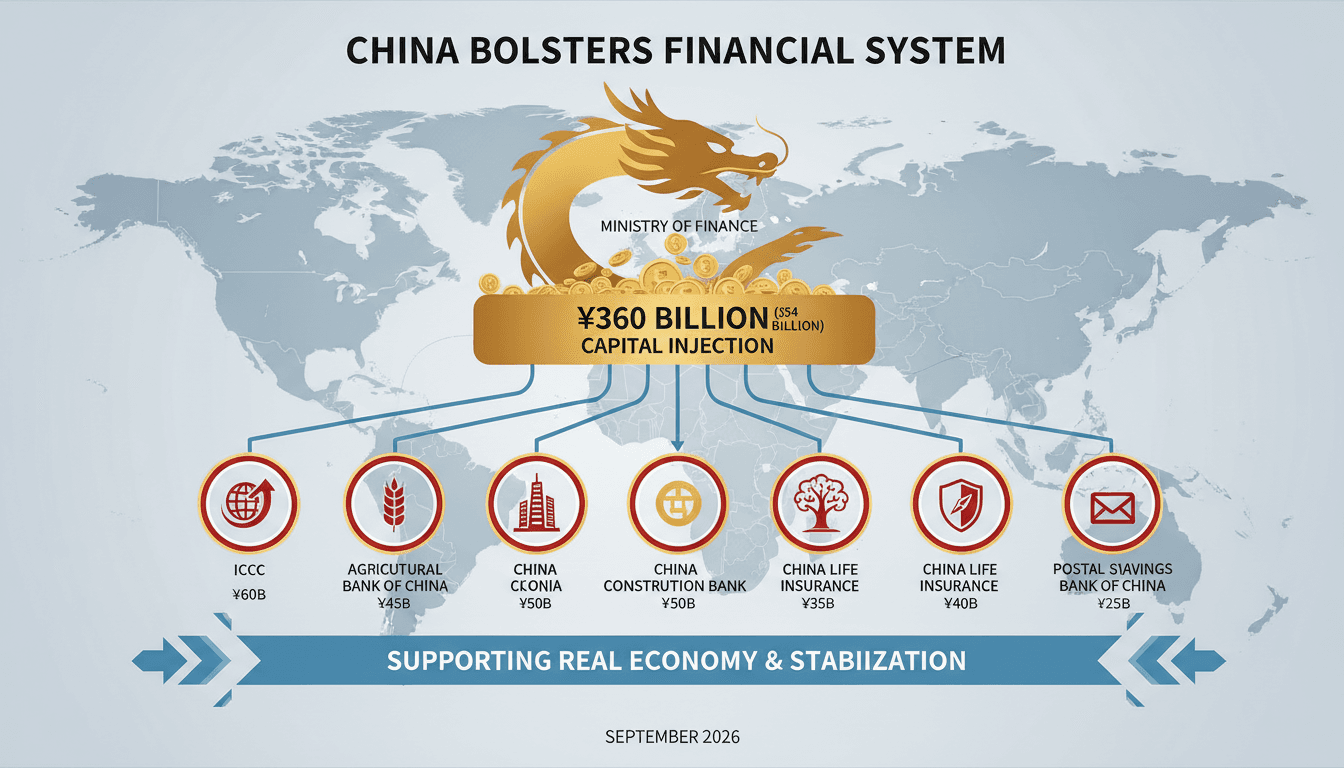
On September 6-7, 2026, China’s Ministry of Finance announced a significant capital injection of 360 billion yuan ($53.6-54 billion) into eight major state-owned banks and insurers. This strategic move is designed to bolster the financial stability of these institutions, which are critical to the Chinese economy. The recipients include prominent entities such as the Industrial and Commercial Bank of China (ICBC), Agricultural Bank of China (ABC), and China Life Insurance, among others.
The impetus for this capital injection stems from a confluence of economic pressures. China's economy has been grappling with a slowdown, evidenced by a GDP growth rate of just 4.3% in the second quarter of 2026, which is below the government's target range. This slowdown is attributed to several factors, including a multi-year downturn in the property sector, weak consumer spending, and ongoing trade tensions with the United States. Additionally, the geopolitical landscape, particularly the impact of the Iran war on oil prices, has further complicated economic recovery efforts.
The capital injection is structured through direct allocations and private A-share placements, with significant amounts earmarked for specific institutions: up to 160 billion yuan for ABC, 100 billion yuan for ICBC, and smaller amounts for others. This marks a notable shift as it extends previous bank-focused efforts to include insurers for the first time in two decades, reflecting a broader strategy to enhance the resilience of the financial sector.
Despite the scale of the injection, market reactions were mixed. Analysts described the package as underwhelming compared to the vast size of China's $74 trillion banking system. While the government emphasizes the importance of this move for credit provision and economic stability, the muted market response suggests skepticism about its sufficiency to address the underlying economic challenges.
In summary, this capital injection is a critical step in China's ongoing efforts to stabilize its financial system and support economic growth. However, the effectiveness of this measure will depend on its implementation and the broader economic context in which it operates.
Who feels it first (and how)
- Banking sector employees: Potential job security concerns if the capital injection does not lead to improved financial health.
- Consumers: Changes in lending conditions could affect access to credit for personal and business loans.
- Investors: Market volatility may impact investment strategies, particularly in sectors tied to Chinese economic performance.
- Global trade partners: Countries engaged in trade with China may experience shifts in demand based on the stability of Chinese financial institutions.
What to watch next
- Economic indicators: Monitor China's GDP growth rates and consumer spending patterns to gauge the effectiveness of the capital injection.
- Market reactions: Watch for fluctuations in bank stock prices and overall market sentiment in response to this financial maneuver.
- Geopolitical developments: Keep an eye on trade relations with the U.S. and the impact of global events, such as the Iran war, on China's economic stability.
The capital injection amount is 360 billion yuan ($53.6-54 billion).
The move aims to stabilize the financial system and support lending to the real economy.
The long-term effectiveness of this capital injection in addressing systemic economic challenges remains uncertain.
Frequently Asked Questions
- Why it matters?
- This capital injection aims to stabilize China's financial system amid economic challenges, impacting global markets and trade dynamics.
- What happened (in 30 seconds)?
- China announced a 360 billion yuan ($53.6-54 billion) capital injection into eight state-owned banks and insurers on September 6-7, 2026. The Ministry of Finance is leading this initiative to strengthen capital buffers and support lending to the real economy. Market reactions were muted, with analysts noting the package was smaller than expected relative to the scale of China's banking system.
- What's really happening?
- On September 6-7, 2026, China’s Ministry of Finance announced a significant capital injection of 360 billion yuan ($53.6-54 billion) into eight major state-owned banks and insurers. This strategic move is designed to bolster the financial stability of these institutions, which are critical to the Chinese economy. The recipients include prominent entities such as the Industrial and Commercial Bank of China (ICBC), Agricultural Bank of China (ABC), and China Life Insurance, among others. The impe
- Who feels it first (and how)?
- Banking sector employees: Potential job security concerns if the capital injection does not lead to improved financial health. Consumers: Changes in lending conditions could affect access to credit for personal and business loans. Investors: Market volatility may impact investment strategies, particularly in sectors tied to Chinese economic performance. Global trade partners: Countries engaged in trade with China may experience shifts in demand based on the stability of Chinese financial institu
- What to watch next?
- Economic indicators: Monitor China's GDP growth rates and consumer spending patterns to gauge the effectiveness of the capital injection. Market reactions: Watch for fluctuations in bank stock prices and overall market sentiment in response to this financial maneuver. Geopolitical developments: Keep an eye on trade relations with the U.S. and the impact of global events, such as the Iran war, on China's economic stability.
Corporate news, economic trends, and markets with UK and global scope.
"BBC News is widely regarded as reputable and impartial, with a public service mandate."
— A47 Editor
China to pump $54bn into state banks and insurers to boost economy
China is set to inject $54 billion into its state banks and insurers as part of a strategy to bolster its economy amid ongoing challenges, including a slowdown in growth. This significant capital infusion aims to strengthen the financial sector and s...
Global political, business, and cultural coverage from WSJ international desks.
"The Wall Street Journal offers extensive international reporting with a reputation for financial insight and a center-right editorial stance."
— A47 Editor
Beijing to Inject More Than $50 Billion Into Banks, Insurers to Boost Growth
Beijing is set to inject over $50 billion into its banking and insurance sectors to stimulate economic growth, marking the second capital infusion in less than two years as China's growth momentum falters.
Global markets, investing, and macroeconomics from a premier financial newsroom.
"Bloomberg is respected for in-depth financial reporting and data-driven analysis."
— A47 Editor
China Injects Billions of Capital Into Banks, Insurers
China is injecting billions of capital into its largest banks and insurers to strengthen their balance sheets and support economic growth amid a slowing economy, as reported by Bloomberg's Sunny Bangia.
UK and international business news, economics, and corporate coverage.
"The Guardian’s business section covers finance and markets with a progressive editorial tone."
— A47 Editor
China prepares £40bn stimulus for financial sector amid fears over sluggish growth
China is set to inject $54 billion (£40 billion) into its financial sector, aiming to support banks and insurers amid concerns over slowing economic growth. This move comes as the country's economic growth rate has dropped to 4.3%, the slowest since ...
International coverage from The Guardian's global desks.
"The Guardian is known for its progressive editorial stance and in-depth analysis."
— A47 Editor
China prepares £40bn stimulus for financial sector amid fears over sluggish growth
China is set to inject $54 billion (£40 billion) into its financial sector, aiming to support banks and insurers amid concerns over slowing economic growth. This move comes as the country's economic growth rate has dropped to 4.3%, the slowest since ...