
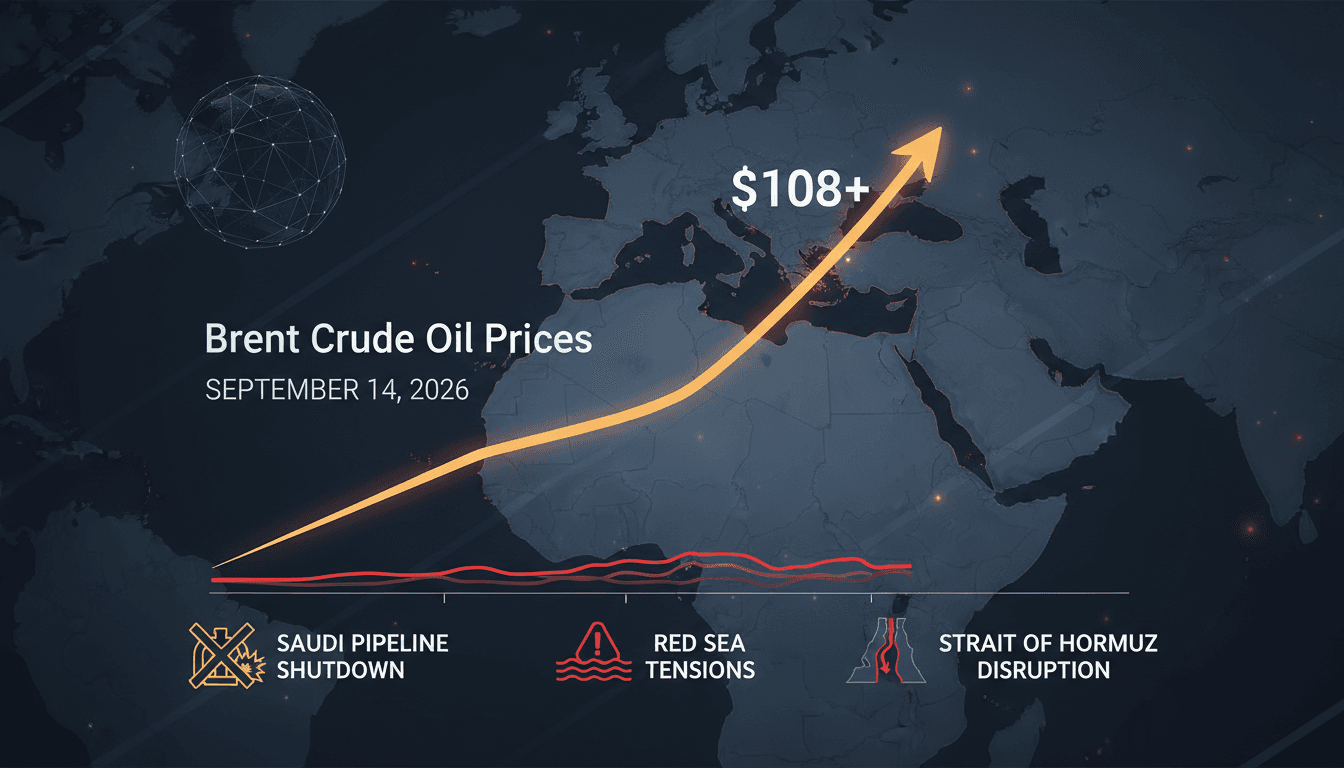
Brent Crude Oil Prices Exceed $108 Amid Middle East Supply Disruptions
Here's what it means for you.
Rising oil prices could lead to increased costs for transportation and consumer goods, impacting your budget.
Why it matters
The surge in Brent crude prices reflects escalating geopolitical tensions that can disrupt global supply chains and economic stability.
What happened (in 30 seconds)
- Brent crude oil prices exceeded $108 per barrel on September 14, 2026, marking a significant increase.
- Supply disruptions stemmed from the ongoing shutdown of Saudi Arabia's East-West pipeline and heightened regional tensions.
- Market reactions included a 3.47% rise in Brent and a 3.26% increase in WTI, as traders adjusted to new risks.
The context you actually need
- Geopolitical tensions in the Middle East have intensified, particularly involving Iran and Saudi Arabia, affecting oil supply stability.
- Saudi Arabia's East-West pipeline, crucial for transporting oil, has been offline due to attacks, limiting output capacity.
- Global demand for oil, especially from China, is rising, further straining an already tight market and pushing prices higher.
What's really happening
On September 14, 2026, Brent crude oil prices surged to $108.24 per barrel, driven by a combination of geopolitical instability and supply chain disruptions. The immediate catalyst was the prolonged shutdown of Saudi Arabia's East-West pipeline, which has a capacity of 4-5 million barrels per day. This pipeline is critical for transporting oil from the eastern oil fields to the Red Sea, and its closure has compounded existing supply concerns in a market already facing tight conditions.
The backdrop to this price spike includes months of escalating conflict involving Iran, the United States, and Iran-aligned groups like the Houthis. Recent drone attacks on Saudi energy infrastructure and repeated strikes on commercial vessels in the Persian Gulf and Red Sea have heightened fears of further disruptions. Additionally, navigation through the Strait of Hormuz, a vital shipping route for oil, has been restricted, adding to the uncertainty.
As traders opened the markets on Monday, they quickly priced in the risks associated with disrupted shipping routes through Hormuz and Bab al-Mandab, alongside increased insurance and shipping costs. The market's reaction was swift, with Brent rising 3.47% and WTI gaining 3.26%. This reflects a broader trend where geopolitical risks are increasingly influencing oil prices, making them more volatile.
The implications of this price surge extend beyond immediate market reactions. Higher oil prices can lead to increased costs for transportation and logistics, which can trickle down to consumers in the form of higher prices for goods and services. Businesses that rely heavily on oil, such as transportation and manufacturing, may face squeezed margins, leading to potential layoffs or reduced investment.
Moreover, regional governments are closely monitoring the situation. Saudi authorities are assessing the damage to the pipeline and considering repair timelines, while diplomatic efforts to ease tensions in the region remain stalled. The ongoing volatility in oil prices could lead to a renewed focus on alternative energy sources and supply routes, as countries seek to mitigate their dependence on Middle Eastern oil.
Who feels it first (and how)
- Consumers: Higher fuel prices will increase transportation costs, affecting everyday expenses.
- Logistics companies: Increased shipping costs will squeeze margins and may lead to higher service fees.
- Energy-dependent industries: Sectors like manufacturing and transportation may face rising operational costs.
- Investors: Volatility in oil prices can impact stock markets, particularly energy stocks and related sectors.
What to watch next
- Pipeline repairs: Monitor updates on the Saudi East-West pipeline's status, as repairs could stabilize supply and prices.
- Geopolitical developments: Keep an eye on diplomatic efforts between Iran and Gulf states, as successful negotiations could ease tensions.
- Global demand trends: Watch for shifts in oil demand, particularly from China, which could further influence pricing dynamics.
Brent crude prices have surpassed $108 per barrel due to supply disruptions.
Continued volatility in oil prices as geopolitical tensions persist.
The timeline for pipeline repairs and their impact on global supply.
Frequently Asked Questions
- Why it matters?
- The surge in Brent crude prices reflects escalating geopolitical tensions that can disrupt global supply chains and economic stability.
- What happened (in 30 seconds)?
- Brent crude oil prices exceeded $108 per barrel on September 14, 2026, marking a significant increase. Supply disruptions stemmed from the ongoing shutdown of Saudi Arabia's East-West pipeline and heightened regional tensions. Market reactions included a 3.47% rise in Brent and a 3.26% increase in WTI, as traders adjusted to new risks.
- What's really happening?
- On September 14, 2026, Brent crude oil prices surged to $108.24 per barrel, driven by a combination of geopolitical instability and supply chain disruptions. The immediate catalyst was the prolonged shutdown of Saudi Arabia's East-West pipeline, which has a capacity of 4-5 million barrels per day. This pipeline is critical for transporting oil from the eastern oil fields to the Red Sea, and its closure has compounded existing supply concerns in a market already facing tight conditions. The back
- Who feels it first (and how)?
- Consumers: Higher fuel prices will increase transportation costs, affecting everyday expenses. Logistics companies: Increased shipping costs will squeeze margins and may lead to higher service fees. Energy-dependent industries: Sectors like manufacturing and transportation may face rising operational costs. Investors: Volatility in oil prices can impact stock markets, particularly energy stocks and related sectors.
- What to watch next?
- Pipeline repairs: Monitor updates on the Saudi East-West pipeline's status, as repairs could stabilize supply and prices. Geopolitical developments: Keep an eye on diplomatic efforts between Iran and Gulf states, as successful negotiations could ease tensions. Global demand trends: Watch for shifts in oil demand, particularly from China, which could further influence pricing dynamics.
Arabic-language coverage of international news and geopolitics.
"RT Arabic is a Russian state-funded outlet often criticized for promoting Kremlin-aligned narratives."
— A47 Editor
قفزة في أسعار النفط مع افتتاح الأسواق.. برنت يتجاوز 108 دولارات
Oil prices surged sharply as global markets reopened on Monday, with Brent crude surpassing $108 per barrel, driven by the rapid developments in the Middle East over the weekend.
Jordanian news and regional updates.
"Roya News is a Jordanian outlet focused on breaking news and local affairs."
— A47 Editor
ارتفاع أسعار النفط بنحو 3% مع افتتاح التداولات وخام برنت يسجل 107 دولارات
Oil prices increased by approximately 3% at the start of the week's trading, with Brent crude reaching $107 per barrel. This rise reflects a positive trend in the oil market, indicating potential recovery and increased demand.
Sports reporting with a focus on Saudi and regional competitions.
"Okaz sports coverage is broad and audience-friendly, with strong attention to Saudi teams and leagues."
— A47 Editor
للمرة الأولى منذ 4 أشهر.. النفط يتجه لإنهاء الأسبوع فوق 100 دولار
Oil prices have risen today, heading towards closing the week above the $100 per barrel mark for the first time since mid-May. Brent crude futures increased by $1.05, or 1%, reaching $108.68 per barrel, while West Texas Intermediate crude rose by 1%,...