
China Injects $54 Billion into State-Owned Banks and Insurers to Boost Financial Stability
Here's what it means for you.
If you’re involved in global finance or trade, this move could influence market stability and lending conditions.
Why it matters
This capital injection aims to bolster the financial system amid economic challenges, impacting global market confidence.
What happened (in 30 seconds)
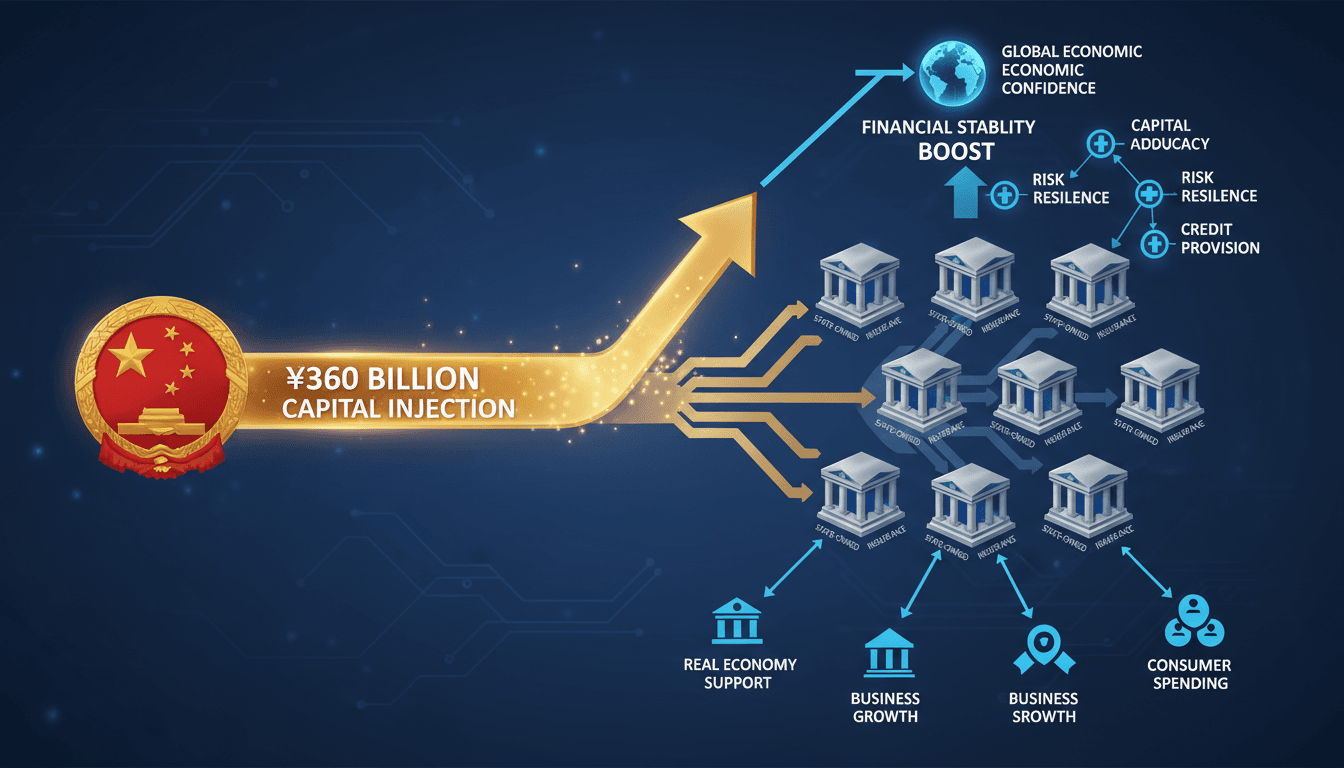
- On September 7, 2026, China announced a 360 billion yuan ($54 billion) capital injection into eight state-owned banks and insurers.
- Key institutions targeted include the Industrial and Commercial Bank of China and Agricultural Bank of China, among others.
- The move is part of broader efforts to support the real economy facing domestic demand weakness and external trade frictions.
The context you actually need
- China's economy is grappling with a multi-year property market slump and weak domestic consumption, leading to a GDP growth slowdown to 4.3% in Q2 2026.
- Prior recapitalization efforts in 2025 set the stage for this latest injection, which aims to enhance capital adequacy and risk resilience.
- The funding structure includes 300 billion yuan from the Ministry of Finance via special treasury bonds and 60 billion yuan from the China National Tobacco Corporation.
What's really happening
China's recent capital injection of 360 billion yuan ($54 billion) into state-owned banks and insurers is a strategic maneuver to fortify the financial sector amid persistent economic headwinds. The Chinese economy is currently facing a confluence of challenges: a prolonged slump in the property market, weak domestic consumption, and demographic pressures from an aging population. These factors have collectively contributed to a slowdown in GDP growth, which fell to 4.3% in the second quarter of 2026, below the government's target range of 4.5-5%.
The capital injection is designed to enhance the capital adequacy ratios of major financial institutions, thereby improving their ability to absorb shocks and maintain lending capacity. This is particularly crucial as low interest rates have constrained organic capital generation, necessitating external support to bolster financial stability. The targeted institutions, including the Industrial and Commercial Bank of China and Agricultural Bank of China, will receive significant allocations to replenish their core Tier-1 capital through private A-share placements. This mechanism is intended to enable these banks to provide greater credit to the economy, which is essential for stimulating growth.
However, the announcement has not been without its challenges. Following the news, shares of Chinese banks and insurers declined by 1.5-2.5%, reflecting investor concerns over potential dilution from new share issuances. Analysts have pointed out that while this capital injection strengthens solvency buffers, it is not a panacea for the underlying issues plaguing the economy. There is a consensus that additional fiscal stimulus will be necessary to revive credit demand and support economic recovery.
Moreover, the capital injection is part of a broader strategy by Beijing to support the real economy, which is currently facing significant domestic demand weakness and external trade frictions, particularly with the United States. As China navigates these complex challenges, the effectiveness of this capital infusion will be closely monitored by both domestic and international stakeholders.
Who feels it first (and how)
- Banking sector employees may see changes in job security and performance expectations as banks adjust to new capital requirements.
- Investors in Chinese financial markets could experience volatility as share prices react to dilution concerns and market sentiment.
- Businesses reliant on credit may face altered lending conditions, impacting their operational capabilities and growth prospects.
What to watch next
- Market reactions: Monitor how shares of the involved banks and insurers perform in the weeks following the announcement, as this will indicate investor confidence.
- Credit demand trends: Watch for changes in lending patterns and credit availability, which will signal the effectiveness of the capital injection in stimulating the economy.
- Government fiscal policies: Keep an eye on any additional fiscal measures that may be introduced to complement this capital injection and support economic recovery.
The capital injection amount is 360 billion yuan ($54 billion).
There will be increased scrutiny on the effectiveness of this measure in stimulating credit demand.
The long-term impact on the stability of the Chinese financial system and its global implications remains to be seen.
Frequently Asked Questions
- Why it matters?
- This capital injection aims to bolster the financial system amid economic challenges, impacting global market confidence.
- What happened (in 30 seconds)?
- On September 7, 2026, China announced a 360 billion yuan ($54 billion) capital injection into eight state-owned banks and insurers. Key institutions targeted include the Industrial and Commercial Bank of China and Agricultural Bank of China, among others. The move is part of broader efforts to support the real economy facing domestic demand weakness and external trade frictions.
- What's really happening?
- China's recent capital injection of 360 billion yuan ($54 billion) into state-owned banks and insurers is a strategic maneuver to fortify the financial sector amid persistent economic headwinds. The Chinese economy is currently facing a confluence of challenges: a prolonged slump in the property market, weak domestic consumption, and demographic pressures from an aging population. These factors have collectively contributed to a slowdown in GDP growth, which fell to 4.3% in the second quarter of
- Who feels it first (and how)?
- Banking sector employees may see changes in job security and performance expectations as banks adjust to new capital requirements. Investors in Chinese financial markets could experience volatility as share prices react to dilution concerns and market sentiment. Businesses reliant on credit may face altered lending conditions, impacting their operational capabilities and growth prospects.
- What to watch next?
- Market reactions: Monitor how shares of the involved banks and insurers perform in the weeks following the announcement, as this will indicate investor confidence. Credit demand trends: Watch for changes in lending patterns and credit availability, which will signal the effectiveness of the capital injection in stimulating the economy. Government fiscal policies: Keep an eye on any additional fiscal measures that may be introduced to complement this capital injection and support economic recover
Corporate news, economic trends, and markets with UK and global scope.
"BBC News is widely regarded as reputable and impartial, with a public service mandate."
— A47 Editor
China to pump $54bn into state banks and insurers to boost economy
China is set to inject $54 billion into its state banks and insurers as part of a strategy to bolster its economy amid ongoing challenges, including a slowdown in growth. This significant capital infusion aims to strengthen the financial sector and s...
Global political, business, and cultural coverage from WSJ international desks.
"The Wall Street Journal offers extensive international reporting with a reputation for financial insight and a center-right editorial stance."
— A47 Editor
Beijing to Inject More Than $50 Billion Into Banks, Insurers to Boost Growth
Beijing is set to inject over $50 billion into its banking and insurance sectors to stimulate economic growth, marking the second capital infusion in less than two years as China's growth momentum falters.
Global markets, investing, and macroeconomics from a premier financial newsroom.
"Bloomberg is respected for in-depth financial reporting and data-driven analysis."
— A47 Editor
China Injects Billions of Capital Into Banks, Insurers
China is injecting billions of capital into its largest banks and insurers to strengthen their balance sheets and support economic growth amid a slowing economy, as reported by Bloomberg's Sunny Bangia.
UK and international business news, economics, and corporate coverage.
"The Guardian’s business section covers finance and markets with a progressive editorial tone."
— A47 Editor
China prepares £40bn stimulus for financial sector amid fears over sluggish growth
China is set to inject $54 billion (£40 billion) into its financial sector, aiming to support banks and insurers amid concerns over slowing economic growth. This move comes as the country's economic growth rate has dropped to 4.3%, the slowest since ...
International coverage from The Guardian's global desks.
"The Guardian is known for its progressive editorial stance and in-depth analysis."
— A47 Editor
China prepares £40bn stimulus for financial sector amid fears over sluggish growth
China is set to inject $54 billion (£40 billion) into its financial sector, aiming to support banks and insurers amid concerns over slowing economic growth. This move comes as the country's economic growth rate has dropped to 4.3%, the slowest since ...