
U.S. 30-Year Fixed Mortgage Rates Exceed 7% for First Time Since January 2025
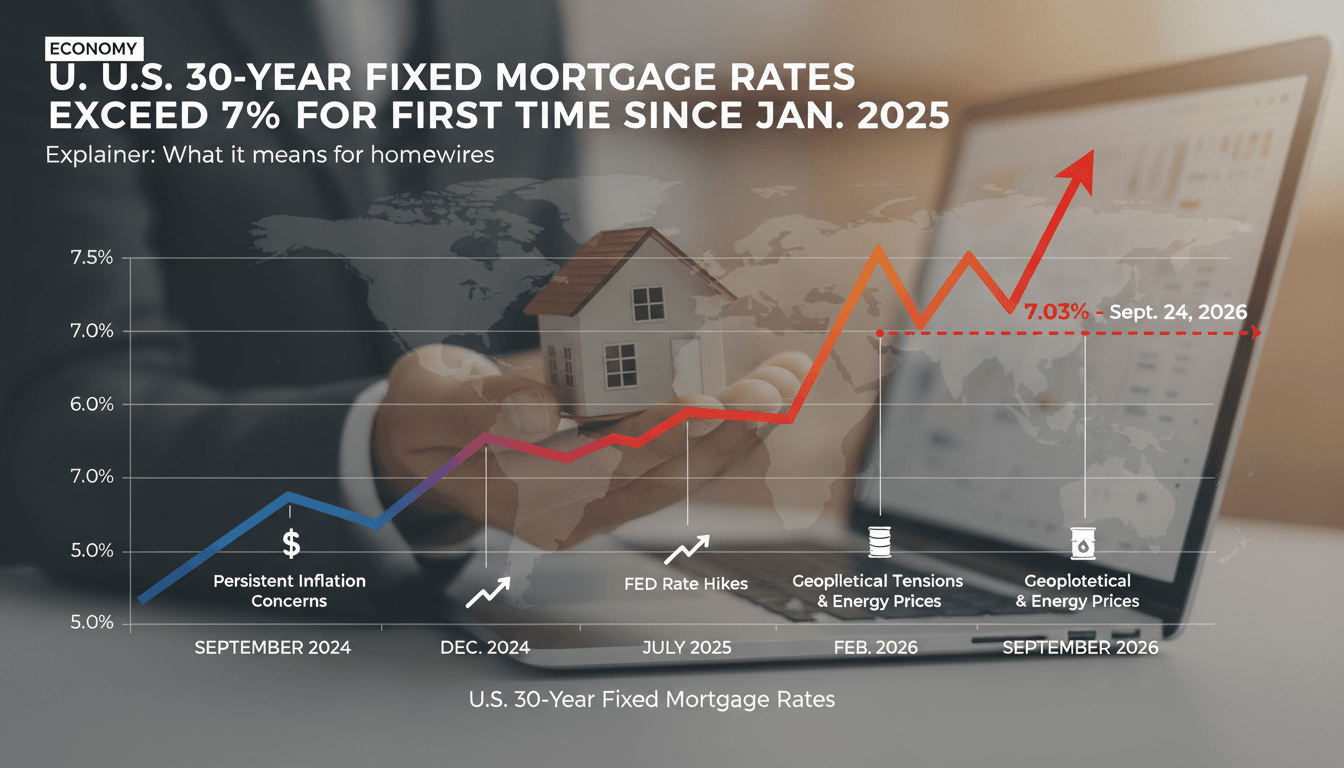
Rising mortgage rates could significantly impact your home-buying plans and financial strategies.
Why it matters
Higher mortgage rates can lead to decreased affordability for homebuyers, affecting the overall housing market.
What happened (in 30 seconds)
- U.S. mortgage rates crossed above 7% for the first time since January 2025, reaching 7.03% on September 24, 2026.
- Borrowing costs are rising due to persistent inflation, Federal Reserve policy actions, and geopolitical tensions affecting energy prices.
- Mortgage applications have begun to decline as affordability pressures mount, signaling potential slowdowns in home sales.
The context you actually need
- Historical fluctuations: Mortgage rates have seen significant changes since the pandemic, with lows below 3% followed by sharp increases in 2022-2023.
- Recent trends: The current rise in rates began in late August 2026, accelerating after the Federal Reserve's rate hike on September 16.
- Economic indicators: The 10-year Treasury yield is also near 5%, reflecting inflation expectations and energy price volatility.
What's really happening
The recent surge in U.S. 30-year fixed mortgage rates to 7.03% is a culmination of various economic factors that have converged over the past months. The Federal Reserve's aggressive monetary policy, aimed at curbing inflation, has played a pivotal role. Following a rate hike on September 16, 2026, the market reacted swiftly, pushing mortgage rates higher. This increase is not just a standalone event; it is closely tied to the broader economic landscape, including rising energy prices due to geopolitical conflicts, particularly the ongoing tensions in the Middle East.
As inflation remains persistent, the Fed's actions are designed to stabilize the economy, but they come with trade-offs. Higher borrowing costs mean that prospective homebuyers face increased monthly payments, which can deter many from entering the housing market. This is particularly concerning as the housing market typically sees a slowdown in sales during the fall and winter months. The Mortgage Bankers Association reported a 1.5% decline in mortgage applications in the week ending September 18, indicating that potential buyers are already feeling the pinch.
Moreover, the correlation between mortgage rates and the 10-year Treasury yield cannot be overlooked. As the yield approaches 5.1%, it reflects market expectations of future inflation and economic growth. Investors are demanding higher returns on bonds, which translates into higher mortgage rates for consumers. This dynamic creates a feedback loop where rising rates lead to decreased affordability, which in turn can slow down home sales and potentially lead to a cooling housing market.
The implications extend beyond just homebuyers. Real estate investors, builders, and related sectors may also feel the impact as financing becomes more expensive. The overall sentiment in the housing market could shift, leading to a more cautious approach from both buyers and sellers. As affordability pressures mount, the risk of a slowdown in home price appreciation increases, which could have broader implications for the economy.
Who feels it first (and how)
- Prospective homebuyers: Facing higher monthly payments, many may delay or abandon their home-buying plans.
- Real estate investors: Increased borrowing costs could deter investment in new properties or renovations.
- Mortgage lenders: A decline in applications may lead to reduced revenues and potential layoffs in the sector.
- Homebuilders: Higher rates could slow down new construction projects as demand wanes.
What to watch next
- Mortgage application trends: Continued declines in applications could signal a broader slowdown in the housing market.
- Federal Reserve policy announcements: Future rate hikes or changes in monetary policy will directly impact mortgage rates and market sentiment.
- Inflation data: Monitoring inflation trends will be crucial, as persistent inflation could lead to further rate increases.
Mortgage rates have surpassed 7% for the first time since January 2025.
Continued pressure on home sales and mortgage applications as affordability decreases.
The long-term impact on home prices and the overall housing market remains uncertain.
Frequently Asked Questions
- Why it matters?
- Higher mortgage rates can lead to decreased affordability for homebuyers, affecting the overall housing market.
- What happened (in 30 seconds)?
- U.S. mortgage rates crossed above 7% for the first time since January 2025, reaching 7.03% on September 24, 2026. Borrowing costs are rising due to persistent inflation, Federal Reserve policy actions, and geopolitical tensions affecting energy prices. Mortgage applications have begun to decline as affordability pressures mount, signaling potential slowdowns in home sales.
- What's really happening?
- The recent surge in U.S. 30-year fixed mortgage rates to 7.03% is a culmination of various economic factors that have converged over the past months. The Federal Reserve's aggressive monetary policy, aimed at curbing inflation, has played a pivotal role. Following a rate hike on September 16, 2026, the market reacted swiftly, pushing mortgage rates higher. This increase is not just a standalone event; it is closely tied to the broader economic landscape, including rising energy prices due to geo
- Who feels it first (and how)?
- Prospective homebuyers: Facing higher monthly payments, many may delay or abandon their home-buying plans. Real estate investors: Increased borrowing costs could deter investment in new properties or renovations. Mortgage lenders: A decline in applications may lead to reduced revenues and potential layoffs in the sector. Homebuilders: Higher rates could slow down new construction projects as demand wanes.
- What to watch next?
- Mortgage application trends: Continued declines in applications could signal a broader slowdown in the housing market. Federal Reserve policy announcements: Future rate hikes or changes in monetary policy will directly impact mortgage rates and market sentiment. Inflation data: Monitoring inflation trends will be crucial, as persistent inflation could lead to further rate increases.
Stock market news, investing ideas, and trading analysis.
"TheStreet provides market news and retail-investor-focused analysis."
— A47 Editor
Mortgage rates just crossed a key threshold. Here’s why
The 30-year mortgage rate has surpassed a significant threshold, now standing at 7.03%, attributed to rising Treasury yields. This increase marks a pivotal moment in the mortgage market, reflecting broader economic trends.
Social/economic commentary and analysis relevant to business and markets.
"WSJ blends data-driven economic insight with commentary on policy and society."
— A47 Editor
Average 30-year mortgage rates hit 7.03% this week, the first time they have surpassed 7% since the beginning of last year
Average 30-year mortgage rates have reached 7.03% this week, marking the first time they have exceeded the 7% threshold since early last year. This increase is significant as it reflects a shift in the housing market dynamics, impacting buyers, selle...
Key macro releases (CPI, jobs, PMIs), surprise indexes, and market implications.
"Great for data-print awareness and instant read-through to rates and risk assets."
— A47 Editor
US fixed 30-year mortgage rate jumps to 7.12%, MBA says
The US fixed 30-year mortgage rate has surged to 7.12%, according to the Mortgage Bankers Association (MBA), marking a significant increase that reflects ongoing trends in the housing market and economic conditions.