
Middle East crude oil exports exceed pre-war levels amid ongoing regional conflict
Why it matters
This rebound in oil exports signals resilience in the face of geopolitical tensions, impacting global energy markets and economic conditions.
What happened (in 30 seconds)
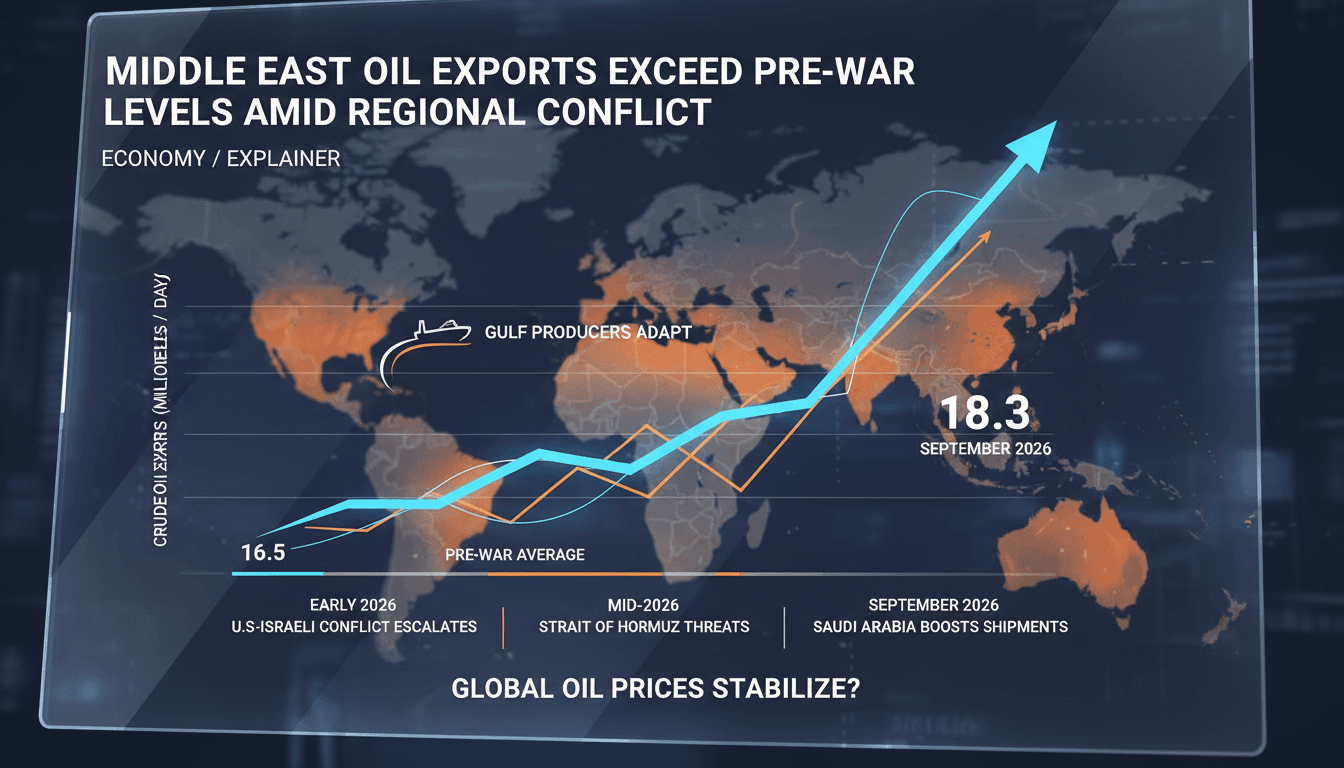
- Middle East crude oil exports exceeded pre-war levels on multiple days in September 2026, reaching a seven-day moving average of 18.3 million barrels per day.
- Saudi Arabia increased shipments via Gulf and Red Sea routes, adapting to ongoing security threats from the U.S.-Israeli conflict with Iran.
- Despite persistent tanker attacks, the overall export volume averaged 22.4 million barrels per day, indicating a significant recovery in regional oil flows.
The context you actually need
- The U.S.-Israeli conflict with Iran, which began in February 2026, initially disrupted oil transit through the Strait of Hormuz, a critical chokepoint for global oil supply.
- Pre-war export averages stood at approximately 18 million barrels per day, highlighting the significance of the recent recovery.
- Producers have explored alternative routes and strategies, such as bypassing the Strait of Hormuz and utilizing ship-to-ship transfers, to maintain export levels amid ongoing threats.
What's really happening
In September 2026, Middle East crude oil exports saw a notable rebound, primarily driven by Saudi Arabia's strategic increase in loadings from both Red Sea and Gulf terminals. This uptick followed the partial restoration of the East-West pipeline after a September 10 attack, which had previously hampered export capabilities. Data from Kpler indicated that exports surpassed pre-war levels on 14 days during the month, with a seven-day moving average reaching 18.3 million barrels per day by September 30. Vortexa corroborated this recovery, reporting a 14-day average of 18.6 million barrels per day.
The surge in exports reflects the adaptive strategies employed by Gulf producers to navigate logistical and geopolitical constraints. Despite the ongoing U.S.-Israeli conflict with Iran, which has led to heightened security threats and attacks on maritime infrastructure, Saudi Arabia and its regional partners have managed to sustain and even increase their oil flows. This includes Iraqi crude exports via the Strait of Hormuz, facilitated by Iranian permissions, and a rise in liquefied natural gas (LNG) cargoes.
However, the situation remains precarious. Reports of tanker attacks, such as those on the VLCC Kazimah III and Aframax Lipsi, have raised alarms about the unpredictability of maritime security in the region. These incidents prompted warnings from maritime agencies like Marisks, emphasizing the ongoing risks that could disrupt oil supply chains.
The overall export tally for crude, products, and other liquids averaged 22.4 million barrels per day in the week leading up to September 30, showcasing the resilience of Middle Eastern oil producers. This recovery has contributed to easing oil market tightness, with Brent crude prices showing declines as supply from the region increases. Saudi Arabia's ramp-up in exports aims to regain market share, particularly benefiting Asian refiners who rely heavily on Middle Eastern crude.
Despite these positive developments, analysts caution that full normalization of oil exports remains elusive due to the persistent risks associated with the ongoing conflict. The geopolitical landscape continues to evolve, and while the rebound in exports is a remarkable adaptation, the future of Middle Eastern oil flows remains uncertain.
Who feels it first (and how)
- Energy traders: They will experience immediate impacts on pricing and trading strategies due to fluctuating supply levels.
- Asian refiners: Increased access to Middle Eastern crude could lower costs and enhance refining margins.
- Consumers in Dubai: Residents may benefit from stabilized fuel supplies and potentially lower energy costs, supporting local economic activity.
What to watch next
- Tanker security incidents: Continued attacks could disrupt oil flows and impact global prices, making maritime security a critical focus.
- Geopolitical developments: Any shifts in the U.S.-Israeli-Iranian conflict could alter export dynamics and market stability.
- Market responses: Watch for changes in Brent crude prices as supply levels fluctuate, influencing global energy costs.
Middle East crude oil exports have rebounded above pre-war levels on multiple occasions.
Continued adaptation by Gulf producers will shape future export strategies amid ongoing geopolitical tensions.
The long-term stability of oil flows through the Strait of Hormuz remains uncertain due to security threats.
Frequently Asked Questions
- Why it matters?
- This rebound in oil exports signals resilience in the face of geopolitical tensions, impacting global energy markets and economic conditions.
- What happened (in 30 seconds)?
- Middle East crude oil exports exceeded pre-war levels on multiple days in September 2026, reaching a seven-day moving average of 18.3 million barrels per day. Saudi Arabia increased shipments via Gulf and Red Sea routes, adapting to ongoing security threats from the U.S.-Israeli conflict with Iran. Despite persistent tanker attacks, the overall export volume averaged 22.4 million barrels per day, indicating a significant recovery in regional oil flows.
- What's really happening?
- In September 2026, Middle East crude oil exports saw a notable rebound, primarily driven by Saudi Arabia's strategic increase in loadings from both Red Sea and Gulf terminals. This uptick followed the partial restoration of the East-West pipeline after a September 10 attack, which had previously hampered export capabilities. Data from Kpler indicated that exports surpassed pre-war levels on 14 days during the month, with a seven-day moving average reaching 18.3 million barrels per day by Septemb
- Who feels it first (and how)?
- Energy traders: They will experience immediate impacts on pricing and trading strategies due to fluctuating supply levels. Asian refiners: Increased access to Middle Eastern crude could lower costs and enhance refining margins. Consumers in Dubai: Residents may benefit from stabilized fuel supplies and potentially lower energy costs, supporting local economic activity.
- What to watch next?
- Tanker security incidents: Continued attacks could disrupt oil flows and impact global prices, making maritime security a critical focus. Geopolitical developments: Any shifts in the U.S.-Israeli-Iranian conflict could alter export dynamics and market stability. Market responses: Watch for changes in Brent crude prices as supply levels fluctuate, influencing global energy costs.
International coverage of politics, security, and social issues.
"Global News is a mainstream Canadian outlet with a centrist editorial stance, focusing on factual reporting."
— A47 Editor
Middle East oil exports reportedly topped pre-war levels last month: data
Persian Gulf oil exports reportedly exceeded pre-war levels for about half of September, according to recent shipping data, despite ongoing attacks on tankers that continue to create uncertainty in the region.
Sports reporting with a focus on Saudi and regional competitions.
"Okaz sports coverage is broad and audience-friendly, with strong attention to Saudi teams and leagues."
— A47 Editor
رغم هجمات هرمز.. صادرات نفط الشرق الأوسط تتجاوز مستويات ما قبل الحرب
Despite ongoing military tensions and attacks on vessels in the Strait of Hormuz, crude oil exports from the Middle East surpassed pre-war levels during the last week of September. Initial data from the ship tracking company Kepler indicated that cru...
English-language digital publication covering business, politics, technology, and current affairs.
"The Arabian Post mixes original and syndicated-style coverage with a broad regional and global business-news orientation."
— A47 Editor
Middle East crude exports regain pre-war pace
Crude oil exports from the Middle East have surpassed pre-war levels on several occasions during the last week of September, indicating a recovery in energy flows despite ongoing attacks on commercial shipping in the Strait of Hormuz. Provisional dat...
Corporate leadership, finance, technology, and market trends.
"Fortune covers financial trends, leadership, and innovation with a pragmatic editorial approach."
— A47 Editor
Persian Gulf oil flows return to prewar levels, but Iran could resort to a ‘scorched earth campaign’ as U.S. deploys more ships and Marines to Mideast
Oil flows from the Persian Gulf have returned to prewar levels, yet concerns persist as Iran may resort to aggressive tactics amid increased U.S. military presence in the region. The U.S. has deployed additional ships and Marines, raising fears of es...