
Saudi Arabia Specifies Five Worker Categories Covered by Nitaqat Minimum Wage Threshold Rise to SR6,000
Why it matters
The revision forces private firms to choose between increasing baseline compensation for national talent or hiring more headcount to fulfill statutory Saudization quotas.
What happened (in 30 seconds)
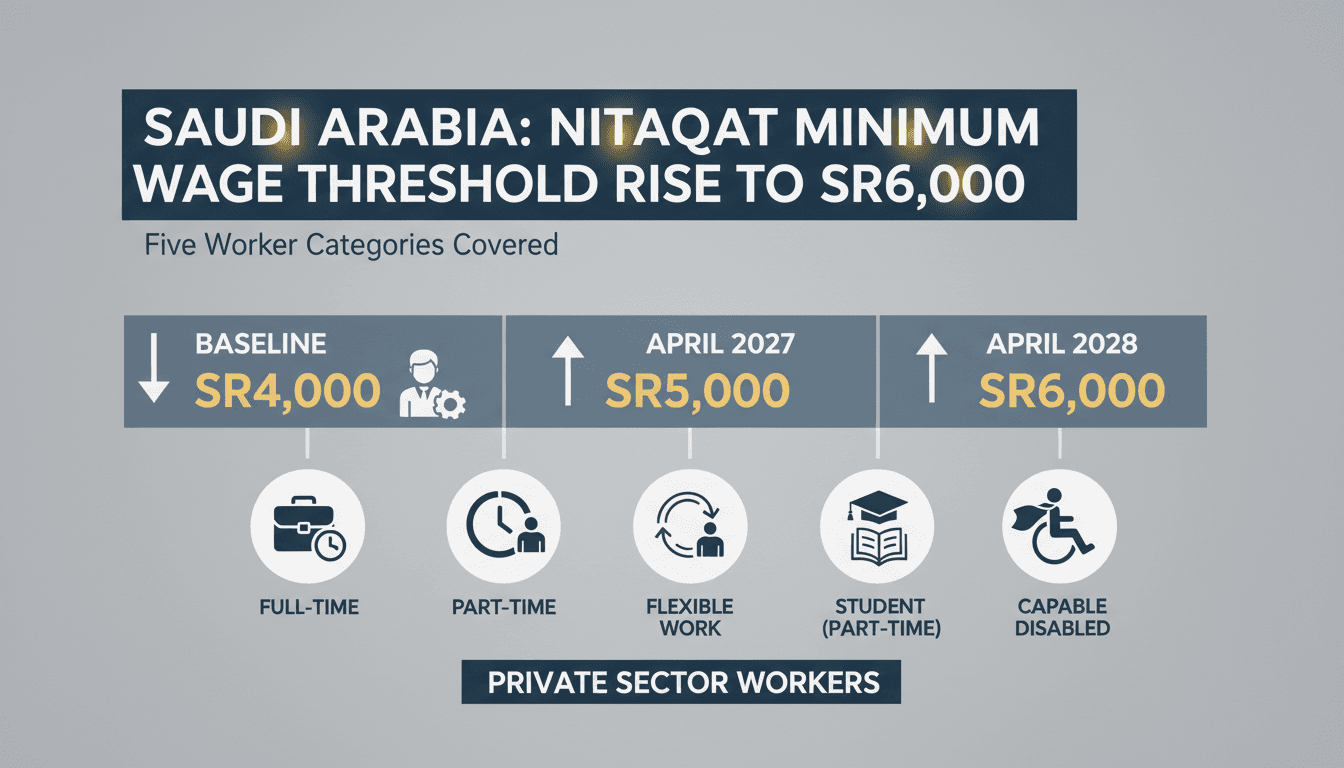
- The policy update: Saudi Arabia’s Ministry of Human Resources and Social Development detailed that five private-sector worker categories are subject to an elevated Nitaqat minimum wage threshold, rising from SR4,000 to SR6,000 monthly.
- The phased timeline: The adjustment rolls out across two clear stages, moving first to SR5,000 on April 25, 2027, before reaching the final SR6,000 baseline on April 25, 2028.
- The covered roles: Deputy Minister Dr. Abdullah Abuthnain confirmed the rule covers full-time staff, part-time employees, flexible-work personnel, part-time students, and people with disabilities who are capable of working.
The context you actually need
- The baseline baseline: Under previous Nitaqat regulations, a Saudi employee had to earn at least SR4,000 per month to be counted as one full worker toward an enterprise's mandatory localization quota.
- The broader economic package: Ordered by King Salman upon the Crown Prince's proposal, the labor adjustment coordinates with utility tariff revisions starting in January 2027 alongside a SR500 monthly household allowance for eligible citizens.
- The regulatory architecture: The policy modifies quota-counting formulas inside systems like Qiwa rather than legally forcing private employers to lift existing contract salaries across the board.
What's really happening
The mechanics of the Nitaqat system rely on mathematical credits rather than simple headcount mandates. For an enterprise operating in Saudi Arabia, maintaining a compliant operational tier—green or platinum—determines basic corporate functioning, including the ability to issue and renew work visas for expatriate staff. Under the existing framework, paying a Saudi national SR4,000 monthly satisfies the requirement for a single full credit. By adjusting this floor to SR5,000 in April 2027 and SR6,000 in April 2028, the Ministry of Human Resources and Social Development is recalibrating the economic value of private-sector employment.
The incentive structure operates through compliance calculus. An employer is not legally mandated to immediately raise an employee's salary from SR4,000 to SR6,000. However, if that employer chooses not to adjust the contract, that worker no longer provides full credit toward the company’s Saudization ratio. To maintain the exact same operational compliance score, the firm faces a clear trade-off: either increase existing wages to hit the new threshold or recruit additional headcount to offset fractional counting. For high-volume, low-margin sectors that rely on entry-level national roles, the cost-to-compliance balance changes immediately.
Covering five distinct worker categories—full-time, part-time, flexible arrangements, student workers, and persons with disabilities capable of working—prevents operational leakage. In prior iterations of labor market reforms, companies could adjust employment classifications or rely on non-standard contracts to meet quotas without committing full-time capital. Bringing flexible-work and part-time staff under proportional thresholds ensures that the cost of compliance remains standardized regardless of contract type.
This policy coordinates directly with household economics. With domestic utility tariff adjustments scheduled for January 2027, the state is structuring private-sector wage floors to absorb utility overhead alongside a SR500 monthly citizen support allowance. For regional corporate leaders, the structural implication is clear: the era of meeting compliance metrics via entry-level, minimum-floor wages is shrinking, pushing enterprise talent strategies toward retention, job quality, and higher operational output to justify rising wage bases.
Who feels it first (and how)
- Corporate HR and payroll directors: Must audit Qiwa-registered employment agreements across all five worker categories before the April 2027 grace period concludes.
- Low-margin private-sector operators: Retail, facility management, and hospitality businesses with large entry-level workforces will see baseline compliance labor costs rise from SR4,000 to SR6,000 per full-quota Saudi worker by 2028.
- Saudi national entry-level staff: Individuals in full-time, part-time, flexible, and student roles will see upward wage pressure as employers update contracts to retain full Nitaqat credit.
- Regional corporate planners in Dubai and the wider GCC: Multi-market enterprises must factor distinct localization cost differentials into cross-border resource planning between Saudi operations and other Gulf hubs.
What to watch next
- Qiwa platform formula updates: Monitoring how fractional counting ratios are technically applied to salaries falling between SR4,000 and SR5,000 during the first transition phase will determine exact compliance exposure.
- Contract restructuring volume: Tracking private-sector contract renegotiations through late 2026 and early 2027 will show whether firms choose wage raises or headcount expansion.
- January 2027 utility tariff implementation: The rollout of revised utility tariffs and citizen allowances will test household balance sheets three months before the first labor threshold activates on April 25, 2027.
The Nitaqat wage threshold increases to SR5,000 on April 25, 2027, and to SR6,000 on April 25, 2028, covering five specified worker categories across the private sector.
Employers with lean margin profiles will compress wage bands near the lower threshold, consolidating entry-level roles into higher-output positions to justify the SR2,000 per-worker monthly increase.
The exact mathematical weight granted to workers whose salaries remain between SR4,000 and the new floors once the grace periods expire.
Frequently Asked Questions
- Why it matters?
- The revision forces private firms to choose between increasing baseline compensation for national talent or hiring more headcount to fulfill statutory Saudization quotas.
- What happened (in 30 seconds)?
- The policy update: Saudi Arabia’s Ministry of Human Resources and Social Development detailed that five private-sector worker categories are subject to an elevated Nitaqat minimum wage threshold, rising from SR4,000 to SR6,000 monthly. The phased timeline: The adjustment rolls out across two clear stages, moving first to SR5,000 on April 25, 2027, before reaching the final SR6,000 baseline on April 25, 2028. The covered roles: Deputy Minister Dr. Abdullah Abuthnain confirmed the rule covers full
- What's really happening?
- The mechanics of the Nitaqat system rely on mathematical credits rather than simple headcount mandates. For an enterprise operating in Saudi Arabia, maintaining a compliant operational tier—green or platinum—determines basic corporate functioning, including the ability to issue and renew work visas for expatriate staff. Under the existing framework, paying a Saudi national SR4,000 monthly satisfies the requirement for a single full credit. By adjusting this floor to SR5,000 in April 2027 and SR6
- Who feels it first (and how)?
- Corporate HR and payroll directors: Must audit Qiwa-registered employment agreements across all five worker categories before the April 2027 grace period concludes. Low-margin private-sector operators: Retail, facility management, and hospitality businesses with large entry-level workforces will see baseline compliance labor costs rise from SR4,000 to SR6,000 per full-quota Saudi worker by 2028. Saudi national entry-level staff: Individuals in full-time, part-time, flexible, and student roles wi
- What to watch next?
- Qiwa platform formula updates: Monitoring how fractional counting ratios are technically applied to salaries falling between SR4,000 and SR5,000 during the first transition phase will determine exact compliance exposure. Contract restructuring volume: Tracking private-sector contract renegotiations through late 2026 and early 2027 will show whether firms choose wage raises or headcount expansion. January 2027 utility tariff implementation: The rollout of revised utility tariffs and citizen allow
English-language reporting on Saudi politics, policy, and society.
"Saudi Gazette reflects mainstream Saudi institutional perspectives."
— A47 Editor
HR Ministry: Five worker categories are covered by Nitaqat wage hike to SR6,000
The Deputy Minister of Human Resources and Social Development for Labor Affairs, Dr. Abdullah Abuthnain, said the decision raising the minimum Saudi wage for full Nitaqat Saudization credit covers five worker categories in private sector establishmen...
English-language reporting focused on Saudi Arabia and regional affairs.
"Saudi Gazette provides English-language coverage that often aligns with mainstream Saudi news priorities."
— A47 Editor
HR Ministry: Five worker categories are covered by Nitaqat wage hike to SR6,000
The Deputy Minister of Human Resources and Social Development for Labor Affairs, Dr. Abdullah Abuthnain, said the decision raising the minimum Saudi wage for full Nitaqat Saudization credit covers five worker categories in private sector establishmen...
A curated Gulf News feed featuring major stories across news, business, opinion, and lifestyle.
"Gulf News is a major UAE newspaper whose featured stories feed reflects a broad editorial mix shaped for a Gulf audience."
— A47 Editor
Saudi Arabia raises minimum wage thresholds to SR5,000 in 2027 and SR6,000 in 2028
Saudi Arabia's Ministry of Human Resources and Social Development announced that the minimum monthly wage for Saudi private-sector employees counting as full-time under the Nitaqat Saudization program will rise to SR5,000 from April 25, 2027, and to ...
UAE-based newspaper covering Gulf politics, society, and international developments.
"Gulf News is one of the UAE’s most prominent English-language publications."
— A47 Editor
Saudi Arabia raises minimum wage thresholds to SR5,000 in 2027 and SR6,000 in 2028
Saudi Arabia's Ministry of Human Resources and Social Development announced that the minimum monthly wage for Saudi private-sector employees counting as full-time under the Nitaqat Saudization program will rise to SR5,000 from April 25, 2027, and to ...
Sports reporting with a focus on Saudi and regional competitions.
"Okaz sports coverage is broad and audience-friendly, with strong attention to Saudi teams and leagues."
— A47 Editor
«الموارد البشرية»: 5 فئات يشملها رفع حد «نطاقات» إلى 6 آلاف ريال
The Deputy Minister of Human Resources and Social Development for Labor Affairs, Dr. Abdullah Abu Athnain, announced that the decision to raise the minimum wage required for a Saudi worker to be counted in full toward nationalization ratios under the...
English-language reporting focused on Saudi Arabia and regional affairs.
"Saudi Gazette provides English-language coverage that often aligns with mainstream Saudi news priorities."
— A47 Editor
Saudi Arabia to raise minimum wage threshold to SR5,000 in April 2027, and SR6,000 in April, 2028
Saudi Arabia's Ministry of Human Resources and Social Development announced that the minimum monthly wage for Saudi private-sector employees to count as full-time under the Nitaqat Saudization program will rise to SR5,000 from April 25, 2027, and to ...
English-language reporting on Saudi politics, policy, and society.
"Saudi Gazette reflects mainstream Saudi institutional perspectives."
— A47 Editor
Saudi Arabia to raise minimum wage threshold to SR5,000 in April 2027, and SR6,000 in April, 2028
Saudi Arabia's Ministry of Human Resources and Social Development announced that the minimum monthly wage for Saudi private-sector employees to count as full-time under the Nitaqat Saudization program will rise to SR5,000 from April 25, 2027, and to ...
Arabic-language coverage of Saudi, regional, and international affairs.
"Al Bilad offers mainstream Saudi newspaper coverage across domestic and broader Arab topics."
— A47 Editor
“المواردالبشرية” توضح تفاصيل زيادة دعم مستفيدي الضمان وموظفي القطاع العام والخاص
The Saudi Ministry of Human Resources and Social Development, announcing on Sunday in Riyadh, detailed a royal directive to increase support for Social Security beneficiaries, including a 500 riyal monthly increase in pension for beneficiary families...