
Oil Prices Fall Over 8% as Democratic Midterm Sweep Lowers Odds of Escalation in US-Iran War
Why it matters
The sudden pricing-out of military escalation risk removes an 8-month geopolitical premium from global commodity benchmarks, directly easing downstream inflationary pressures on commercial operations.
What happened (in 30 seconds)
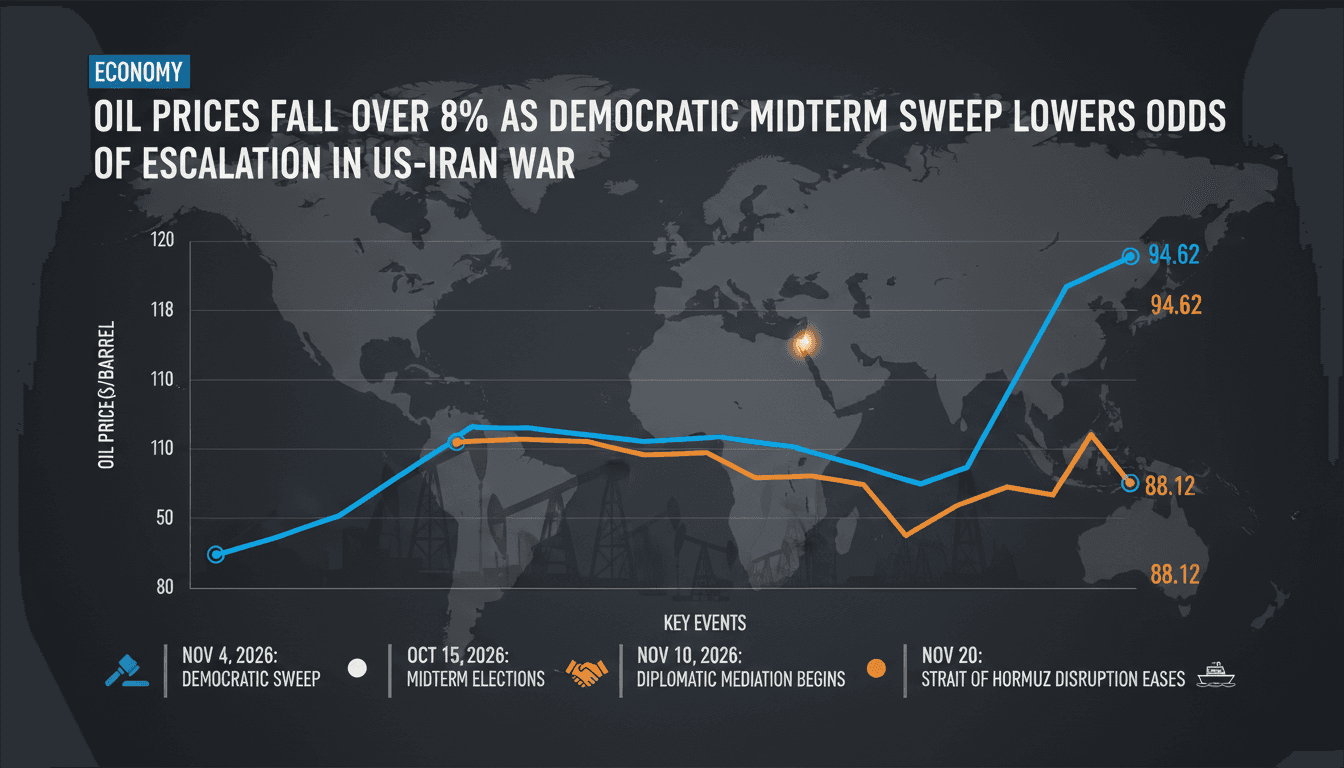
- Crude benchmarks dropped over 8% in a single session: Brent settled at $94.62 per barrel (down 8.7%) and WTI fell to $88.12 per barrel on November 4, 2026, marking their lowest settlement levels since August 31.
- U.S. midterm elections shifted congressional control: The Democratic Party secured majorities in both the Senate and the House of Representatives, altering the legislative framework governing foreign military appropriations.
- Leadership signaled an operational pivot: Following public statements from Vice President JD Vance linking legislative losses to fuel price pressure, President Donald Trump stated there are no immediate plans for further strikes on Iran.
The context you actually need
- Eight months of conflict had established elevated price baselines: Since February 2026, U.S.-Iran hostilities had disrupted commercial shipping through the Strait of Hormuz, pushing crude benchmarks to highs near $118 per barrel.
- Diplomatic mediation channels remained open throughout the escalation: Intermediaries, including the government of Qatar, had sustained parallel backchannel talks, but market pricing had prioritized military escalation risk over diplomatic progress.
- Trend-following systematic strategies amplified the downward trajectory: Once initial election returns confirmed the shift in legislative power, automated commodity trading funds executed programmatic sell orders that accelerated the intraday drop.
What's really happening
Commodity markets are recalibrating around structural incentives rather than rhetoric. For eight months, crude carried a persistent risk premium reflecting the possibility that active hostilities between the United States and Iran would completely close or structurally throttle the Strait of Hormuz. Benchmarks traded as high as $118 per barrel because traders had to price in supply disruption risks across major Persian Gulf export routes.
The transfer of both congressional chambers to Democratic control reconfigures the mechanical leverage points of U.S. foreign policy. In practical terms, legislative majorities hold authority over discretionary appropriations, supplementary military funding packages, and statutory war powers authorizations. For market participants, a divided executive-legislative balance creates an operational ceiling on sustained overseas military expenditures.
Simultaneously, executive incentives shifted within hours of the poll results. The explicit acknowledgment by Vice President JD Vance that electoral losses were driven by public dissatisfaction with the conflict and domestic fuel costs reflects a direct domestic political constraint. President Donald Trump's subsequent confirmation that no immediate military strikes on Iran are planned provided traders with the precise catalyst needed to unwind the remaining escalation trade.
This is not a development driven by sentiment; it is a mechanical reassessment of political capacity. When the executive branch publicly ties electoral performance to energy-driven inflation, the strategic utility of prolonged conflict declines. Concurrently, diplomatic mediation efforts conducted via regional interlocutors such as Qatar gain increased traction.
The resulting 8.7% drop in Brent to $94.62 per barrel represents the rapid evaporation of the war premium rather than an immediate change in physical supply balances. Gulf financial assets reacted immediately: regional equity benchmarks such as Saudi Arabia's TASI advanced as institutional investors calculated that lower input and logistical costs would offset energy sector valuation adjustments. When geopolitical tail-risk dissipates, capital reallocates from protective commodity hedges into regional equities, consumer businesses, and transport logistics.
Who feels it first (and how)
- Global logistics and shipping operators: Maritime carriers and air freight providers experience an immediate easing of bunker and fuel surcharges, alongside anticipated reductions in commercial war-risk insurance premiums for Persian Gulf transit.
- Energy-sector institutional investors: Funds overweight upstream oil equities and long-crude futures face swift mark-to-market drawdowns as systematic algorithms exit long commodity momentum positions.
- Regional commercial enterprises in the Gulf: Importers and non-oil commercial operators in hubs like Dubai and Riyadh see cost-of-goods pressures ease, supported by advancing domestic equity indices such as the TASI.
- Corporate procurement directors: Supply chain managers locked into elevated third-quarter fuel escalation contracts gain leverage to renegotiate upcoming distribution agreements at lower benchmark baselines.
What to watch next
- Congressional committee movements on appropriations: Track whether newly installed congressional leadership introduces legislation restricting executive funding for Middle East naval operations, which will determine if the de-escalation trend is structurally permanent.
- Strait of Hormuz tanker transit volumes: Monitor weekly commercial vessel transit frequencies and maritime insurance rates through the strait to see if physical maritime activity confirms the reduction in risk premiums.
- Qatari diplomatic briefing releases: Follow official updates from mediation sessions in Doha to identify whether preliminary frameworks for formal talks between Washington and Tehran yield verifiable security commitments.
The Democratic Party secured control of both chambers of the U.S. Congress in the November 2026 midterms; Brent crude settled at $94.62 per barrel and WTI settled at $88.12 per barrel on November 4; U.S. leadership confirmed no immediate strikes are scheduled.
Lower baseline fuel costs will ease near-term transport inflation across major international trade corridors, while programmatic hedge fund selling will keep energy price volatility elevated in the short term.
Whether intermediate diplomatic engagement involving regional mediators will convert into an enduring, formal security resolution, or if non-state actions in regional waterways will spark renewed spikes in risk premiums.
Frequently Asked Questions
- Why it matters?
- The sudden pricing-out of military escalation risk removes an 8-month geopolitical premium from global commodity benchmarks, directly easing downstream inflationary pressures on commercial operations.
- What happened (in 30 seconds)?
- Crude benchmarks dropped over 8% in a single session: Brent settled at $94.62 per barrel (down 8.7%) and WTI fell to $88.12 per barrel on November 4, 2026, marking their lowest settlement levels since August 31. U.S. midterm elections shifted congressional control: The Democratic Party secured majorities in both the Senate and the House of Representatives, altering the legislative framework governing foreign military appropriations. Leadership signaled an operational pivot: Following public stat
- What's really happening?
- Commodity markets are recalibrating around structural incentives rather than rhetoric. For eight months, crude carried a persistent risk premium reflecting the possibility that active hostilities between the United States and Iran would completely close or structurally throttle the Strait of Hormuz. Benchmarks traded as high as $118 per barrel because traders had to price in supply disruption risks across major Persian Gulf export routes. The transfer of both congressional chambers to Democrati
- Who feels it first (and how)?
- Global logistics and shipping operators: Maritime carriers and air freight providers experience an immediate easing of bunker and fuel surcharges, alongside anticipated reductions in commercial war-risk insurance premiums for Persian Gulf transit. Energy-sector institutional investors: Funds overweight upstream oil equities and long-crude futures face swift mark-to-market drawdowns as systematic algorithms exit long commodity momentum positions. Regional commercial enterprises in the Gulf: Impor
- What to watch next?
- Congressional committee movements on appropriations: Track whether newly installed congressional leadership introduces legislation restricting executive funding for Middle East naval operations, which will determine if the de-escalation trend is structurally permanent. Strait of Hormuz tanker transit volumes: Monitor weekly commercial vessel transit frequencies and maritime insurance rates through the strait to see if physical maritime activity confirms the reduction in risk premiums. Qatari dip
Oil, metals, and agriculture: supply/demand headlines, OPEC chatter, inventories, and price action.
"Solid tape for energy and metals traders tracking macro and micro catalysts."
— A47 Editor
Oil falls over 8% as traders weigh impact on Iran war of Democratic midterms sweep
Oil prices fell more than 8% as traders weighed the impact of the Iran conflict and the Democratic Party's sweep in the US midterm elections, reflecting negative market sentiment tied to shifting geopolitical expectations in the Middle East.
U.S. business news, corporate developments, and economy.
"The Wall Street Journal is respected for deep financial and economic reporting with a center-right editorial perspective."
— A47 Editor
Oil Prices Sink as U.S. Midterms Raise Market Hopes for Middle East Solution
Oil futures fell to two-month lows after Democrats swept Congress in the U.S. midterm elections, as investors read the result as raising the prospect of a quick resolution to the Middle East conflict and easing fears of possible U.S. military escalat...
Global markets, investing, and macroeconomics from a premier financial newsroom.
"Bloomberg is respected for in-depth financial reporting and data-driven analysis."
— A47 Editor
Latest Oil Market News and Analysis for Nov. 4
Oil prices fluctuated after a two-day decline as traders weighed conflicting signals on the trajectory of US-Iran peace talks, according to Bloomberg's markets coverage for Nov. 4. The move followed a sharp slump earlier in the week, when prices fell...
Global political, business, and cultural coverage from WSJ international desks.
"The Wall Street Journal offers extensive international reporting with a reputation for financial insight and a center-right editorial stance."
— A47 Editor
Oil Futures Turn Lower as Market Holds Out Hope for Middle East Diplomacy
Oil futures settled lower in a choppy session as concerns over limited U.S. strikes on Iranian targets, including Qeshm Island in the Strait of Hormuz, were offset by ongoing diplomatic efforts to settle the U.S.-Iran conflict.