
US Treasury Sanctions Dozens of Iranian Shadow Banking Entities Across Iran UAE Turkey and Hong Kong
Why it matters
By targeting trade-based intermediaries across commercial nodes in the United Arab Emirates, Turkey, and Hong Kong, US enforcement is actively shrinking the offshore clearing mechanisms that bridge frontier economies with global trade.
What happened (in 30 seconds)
- The US Treasury designated over two dozen entities: On November 23, 2026, the Office of Foreign Assets Control (OFAC) rolled out sanctions targeting Iranian exchange houses, front companies, and key operators across Iran, the UAE, Turkey, and Hong Kong under Operation Economic Outcast.
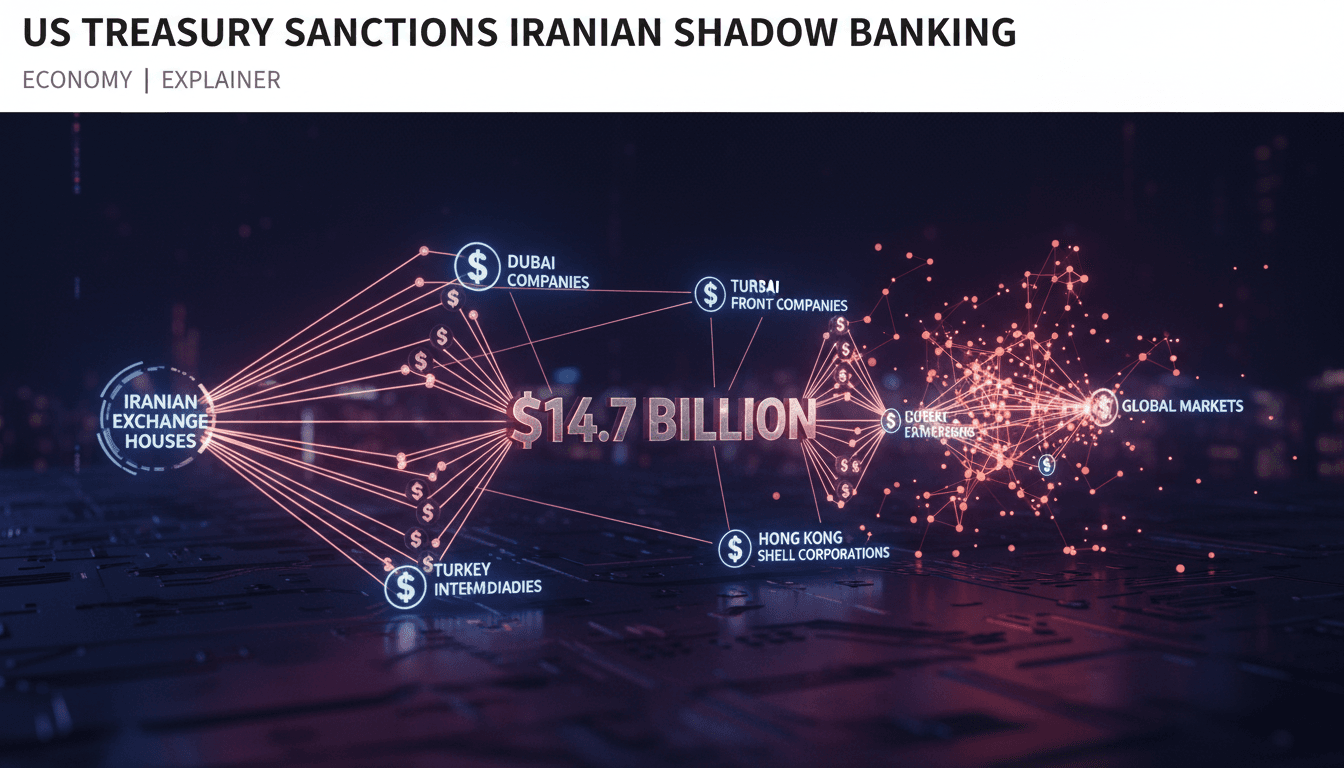
- FinCEN flagged $14.7 billion in activity: The Financial Crimes Enforcement Network published findings detailing approximately $14.7 billion in financial flows tied to Iranian shadow banking networks between January 2025 and August 2026.
- Dubai trading houses faced specific designations: At least eight commercial companies based in Dubai—including Recaz Star General Trading LLC and Grand Target Heavy Equipment and Machinery Spare Parts Trading L.L.C.—were listed for allegedly routing thousands of transactions worth millions of dollars for Iranian exchange operators.
The context you actually need
- Maximum pressure enforcement is intensifying: Following the re-election of President Donald Trump, the US administration has focused enforcement directly on intermediate financial networks, following an earlier round on November 20, 2026, aimed at oil revenue facilitators.
- Shadow banking serves as an alternative trade infrastructure: Overseen by the Central Bank of Iran, this architecture relies on exchange houses and intermediary "rahbar" companies to clear accounts for oil, petrochemicals, and manufactured goods outside the Western banking system using non-dollar currencies.
- Global commercial hubs are prime operational territory: Intermediaries set up commercial presence in international free zones and trade centers to obscure the provenance of funds before they re-enter mainstream supply chains.
What's really happening
The mechanics of modern economic sanctions have shifted from freezing central state reserves to dismantling decentralized ledger-clearing systems. Iran’s conventional banking infrastructure was detached from the global cross-border payments grid years ago. To maintain trade, market participants constructed a parallel architecture: shadow banking networks coordinated through exchange houses, such as Mellat Exchange Company and Mina Fashki and Partners Exchange Company, alongside operational firms like Rahbar Bazargani Nesim Baharan Qeshm Company.
This system functions through mutual netting and offset accounting. When an overseas buyer purchases oil, petrochemicals, or other Iranian commodities, the payment rarely crosses into an Iranian territory bank account in US dollars. Instead, the funds are routed to overseas trading firms—frequently established in high-volume jurisdictions like Dubai, Istanbul, or Hong Kong. These entities operate accounts in regional commercial banks, invoicing for heavy equipment parts, consumer items, or general trading goods. The capital accumulated abroad is then reallocated to pay third-party suppliers delivering imports into Iran. The physical cargo moves in one direction, while the offsetting capital balance clears through hundreds of distributed commercial accounts.
Treasury Secretary Scott Bessent labeled these networks the regime's last financial lifeline precisely because they keep basic cross-border trade liquid. However, these systems face a structural vulnerability: they rely on legitimate trade hubs to maintain friction-free commerce.
When OFAC designates specific nodes—such as Recaz Star General Trading LLC or Grand Target Heavy Equipment and Machinery Spare Parts Trading L.L.C.—it severs their access to international banking rails. Regional banks holding accounts for designated entities must freeze those assets or risk secondary sanctions that would cut off their own dollar-clearing arrangements.
This enforcement model changes the risk-reward calculation for intermediary hubs. Operating a front entity requires local company registration, commercial bank accounts, and trade licenses within free zones. As compliance scrutiny heightens, the cost of operating these intermediaries rises, transaction fees jump, and counterparties face disruption. While the Treasury noted a partial decline in shadow banking volume as an early signal of disruption, the underlying economic incentives to move trade through non-traditional rails remain active as long as commodity buyers require alternative payment clearing.
Who feels it first (and how)
- Trade compliance officers in UAE free zones: Corporate teams must immediately screen tier-one and tier-two trade registries to verify that local counterparties, machinery suppliers, and logistics partners share no ownership, directorships, or shared addresses with the newly designated firms.
- Middle Eastern commercial banks: Compliance and legal departments must rapidly isolate customer accounts tied to targeted firms and audit correspondent transactional logs from the January 2025 to August 2026 window highlighted by FinCEN.
- Regional machinery and general trading operators: Legitimate businesses operating in identical market segments—such as spare parts and industrial hardware—face longer settlement delays as international clearing banks apply heightened scrutiny to payments originating from regional commercial centers.
- Iranian import-export managers: Importers procuring industrial inputs, consumer products, and manufactured parts inside Iran will experience wider spreads on foreign exchange conversion and delayed settlement cycles as local exchange houses search for alternative offshore clearing routes.
What to watch next
- Regional bank de-risking cycles: Watch whether Tier-1 UAE and Turkish financial institutions execute wholesale account reviews or closures within general trading and spare parts categories to reduce secondary sanctions exposure.
- Iranian retaliatory and commercial measures: Track formal countermeasures reviewed by Tehran, following statements from Foreign Ministry officials and Parliament Speaker Mohammad Bagher Ghalibaf regarding responses to US financial measures and trade restrictions.
- Network migration to alternative jurisdictions: Look for capital and invoicing flows to shift toward emerging non-dollar trade corridors as operators attempt to rebuild clearing mechanisms outside recently audited trade nodes.
The US Treasury sanctioned approximately 24 entities and individuals across four jurisdictions on November 23, 2026, backed by FinCEN documentation tracing $14.7 billion in linked financial movements.
Corporate service providers and free zone authorities will step up Know-Your-Customer (KYC) requirements, increasing administrative timelines for establishing new trading companies in affected commercial zones.
It remains uncertain whether these targeted designations will permanently reduce overall trade volumes, or simply force exchange networks to disperse their clearing volume across a larger number of smaller, short-lived shell operations.
Frequently Asked Questions
- Why it matters?
- By targeting trade-based intermediaries across commercial nodes in the United Arab Emirates, Turkey, and Hong Kong, US enforcement is actively shrinking the offshore clearing mechanisms that bridge frontier economies with global trade.
- What happened (in 30 seconds)?
- The US Treasury designated over two dozen entities: On November 23, 2026, the Office of Foreign Assets Control (OFAC) rolled out sanctions targeting Iranian exchange houses, front companies, and key operators across Iran, the UAE, Turkey, and Hong Kong under Operation Economic Outcast. FinCEN flagged $14.7 billion in activity: The Financial Crimes Enforcement Network published findings detailing approximately $14.7 billion in financial flows tied to Iranian shadow banking networks between Januar
- What's really happening?
- The mechanics of modern economic sanctions have shifted from freezing central state reserves to dismantling decentralized ledger-clearing systems. Iran’s conventional banking infrastructure was detached from the global cross-border payments grid years ago. To maintain trade, market participants constructed a parallel architecture: shadow banking networks coordinated through exchange houses, such as Mellat Exchange Company and Mina Fashki and Partners Exchange Company, alongside operational firms
- Who feels it first (and how)?
- Trade compliance officers in UAE free zones: Corporate teams must immediately screen tier-one and tier-two trade registries to verify that local counterparties, machinery suppliers, and logistics partners share no ownership, directorships, or shared addresses with the newly designated firms. Middle Eastern commercial banks: Compliance and legal departments must rapidly isolate customer accounts tied to targeted firms and audit correspondent transactional logs from the January 2025 to August 2026
- What to watch next?
- Regional bank de-risking cycles: Watch whether Tier-1 UAE and Turkish financial institutions execute wholesale account reviews or closures within general trading and spare parts categories to reduce secondary sanctions exposure. Iranian retaliatory and commercial measures: Track formal countermeasures reviewed by Tehran, following statements from Foreign Ministry officials and Parliament Speaker Mohammad Bagher Ghalibaf regarding responses to US financial measures and trade restrictions. Network
Arabic-language coverage of international news and geopolitics.
"RT Arabic is a Russian state-funded outlet often criticized for promoting Kremlin-aligned narratives."
— A47 Editor
عقوبات أمريكية تستهدف عشرات المرتبطين بشبكات مالية إيرانية
The United States Department of the Treasury announced on Monday the imposition of sanctions on dozens of individuals and entities linked to Iran, as part of efforts to disrupt its informal banking networks and isolate them from the global economy.
Global news coverage with extensive reporting on Middle Eastern conflicts and geopolitics.
"Al Jazeera is a Qatar-based broadcaster known for wide regional coverage and alternative perspectives."
— A47 Editor
US escalates sanctions on Iran, targets ‘shadow banking’ networks
The US Treasury has escalated sanctions against Iran, targeting over two dozen Iranian entities and what it describes as 'shadow banking' networks used to support Tehran's global financial activities. The measures are presented as an effort to disrup...
Comprehensive coverage of Middle Eastern and global issues.
"Al Jazeera is a prominent voice from the Global South, especially the Middle East, with an emphasis on underreported stories."
— A47 Editor
US escalates sanctions on Iran, targets ‘shadow banking’ networks
The US Treasury has escalated sanctions against Iran, targeting over two dozen Iranian entities and what it describes as 'shadow banking' networks used to support Tehran's global financial activities. The measures are presented as an effort to disrup...
Regional coverage and analysis focused on politics, diplomacy, and business across the Middle East.
"Al-Monitor is known for analytical reporting on Middle East politics and policy developments."
— A47 Editor
US imposes sanctions on dozens linked to Iran's shadow banking networks
On Monday, November 23, the US Treasury Department issued new Iran-related sanctions targeting dozens of people and entities, aimed at isolating Iran from the global economy and disrupting its shadow banking networks. The Financial Crimes Enforcement...
Market-moving headlines impacting equities, bonds, and related risk assets.
"Real-time catalysts and volatility drivers across indices and sectors."
— A47 Editor
US imposes sanctions on dozens linked to Iran’s shadow banking networks
The United States has imposed sanctions on dozens of individuals and entities linked to Iran's shadow banking networks, according to a markets report published by Investing.com. The measures target financial channels that Washington alleges are used ...
English-language reporting on Saudi politics, policy, and society.
"Saudi Gazette reflects mainstream Saudi institutional perspectives."
— A47 Editor
US imposes new sanctions on Iranian oil traders and government-linked facilitators
The US Treasury Department imposed new sanctions on Friday targeting Iranian oil traders and government-linked facilitators accused of helping Tehran sell oil abroad and misappropriating the proceeds. The measures were issued as part of Operation Eco...