
Asian Regulators Deploy Emergency Market Support as AI Chip Selloff Pushes Regional Indices Into Bear Territory
Why it matters
Coordinated regulatory actions across three major economies demonstrate how deeply linked global equity valuations have become to tech infrastructure spending.
What happened (in 30 seconds)
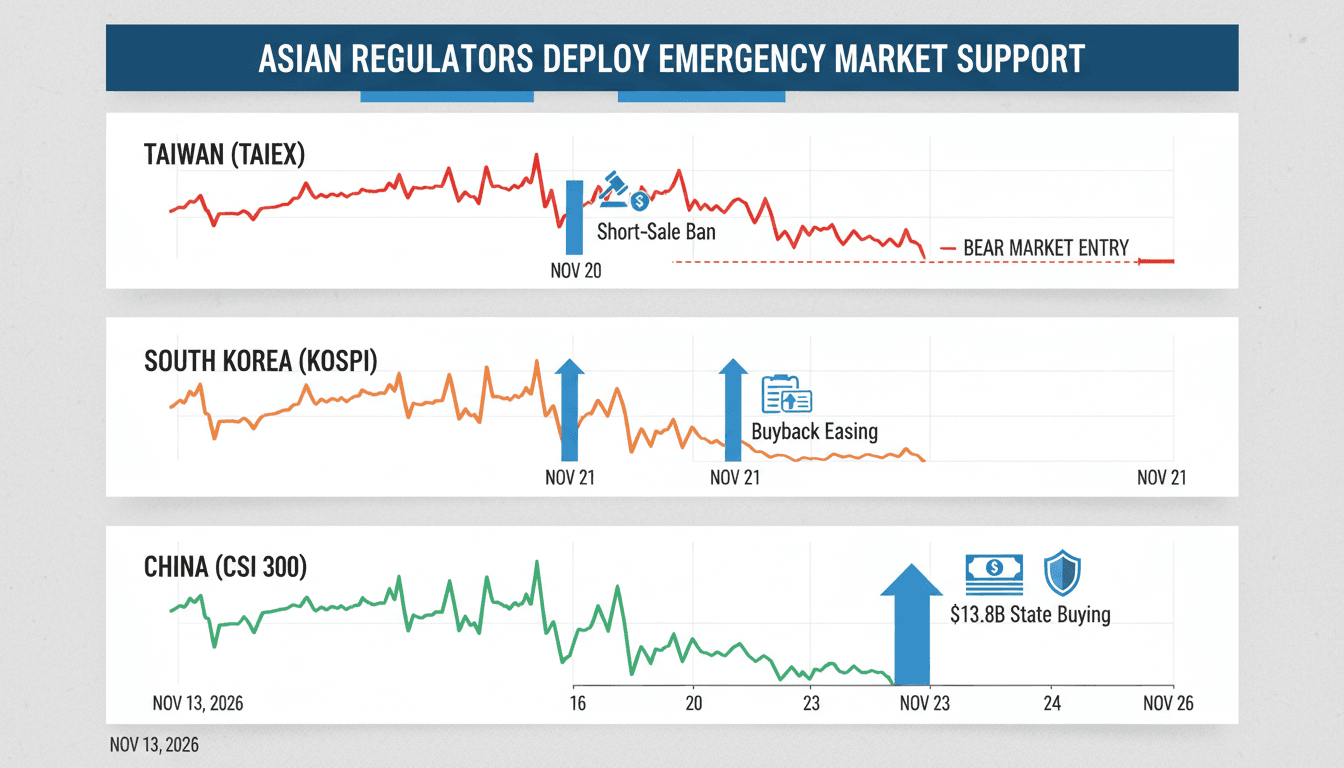
- Regional sell-off crosses the threshold: On November 22-23, 2026, indices including Taiwan's Taiex, South Korea's Kospi, China's CSI 300, and Hong Kong's Hang Seng entered technical bear markets after sliding more than 20% from recent peaks.
- State actors execute direct liquidity backstops: China’s state-backed funds deployed $13.8 billion in targeted equity purchases, while authorities announced reductions in securities purchase margin requirements taking effect November 30.
- Circuit breakers and curbs deploy: Taiwan restricted short selling below prior-day closing prices and engaged its National Financial Stabilisation Fund, while South Korea prepared a stabilization fund and relaxed corporate share buyback constraints.
The context you actually need
- Hardware suppliers absorbed the brunt: East Asian exchanges maintain heavy structural weightings in the chipmakers, packagers, and hardware exporters that construct physical data centers for global tech enterprises.
- U.S. balance sheets triggered the shift: Recent earnings reports from American technology firms reflected elevated infrastructure outlays, sparking market skepticism over whether elevated capital expenditure yields durable near-term returns.
- Trillions in equity eroded: South Korea's Kospi alone relinquished $1.8 trillion in market capitalization between its June peak and the November intervention, demonstrating the scale of the exposure.
What's really happening
The sharp decline across East Asian equity benchmarks marks an analytical turning point: market pricing has shifted from projecting uninterrupted physical expansion to stress-testing capital allocation. For two years, Asian semiconductor hubs operated as primary equity beneficiaries of the worldwide rush toward high-performance computing clusters. Taiwan’s precision chip fabricators, South Korea’s memory giants, and mainland component manufacturers priced in sustained, multi-year purchase orders from overseas buyers.
That incentive structure met friction when major U.S. cloud providers and technology firms released financial reports illustrating that infrastructure costs are outpacing direct revenue capture. Simultaneously, political outcomes in the United States injected uncertainty into prospective data center zoning, energy procurement, and cross-border tech regulations. The market reassessed not whether computing demand exists, but whether current capital expenditure trajectories are sustainable in the medium term.
Because regional indexes maintain concentrated exposure to semiconductor ecosystems, the repricing cascaded rapidly. When index drops exceeded 20%, technical sell triggers activated systemic volatility mechanisms. This dynamic explains the speed and scope of the response across Beijing, Seoul, and Taipei on November 22-23. Regulators acted not to influence global enterprise spending, but to prevent liquidity squeezes within their domestic capital markets.
In China, where authorities intervened with $13.8 billion through national team funds and moved to lower margin requirements, the policy goal is capping structural domestic financial spillover. In South Korea, where the Finance Ministry and central bank coordinated alongside market watchdogs, the objective is preserving liquidity by allowing corporations to repurchase their own equity without friction. In Taiwan, where trading volatility produced the sharpest weekly decline since 1991, curbs on short selling serve as a legal barrier against speculative momentum trading.
These state-directed tools can establish a price floor in local currency trading, but they cannot manufacture commercial orders for server components. Global hardware suppliers face an altered operating climate: high physical plant costs, heightened investor scrutiny on return on investment, and state-backed circuit breakers operating at full capacity.
Who feels it first (and how)
- Global asset allocators and portfolio managers: Investment strategies weighted toward East Asian tech equities face abrupt administrative rules, such as revised margin parameters in China and short-sale restrictions in Taiwan.
- Semiconductor and hardware procurement executives: Corporate treasuries and supply chain heads navigating component pricing must factor in market pressure on supplier valuations and potential capacity adjustments.
- Regional financial hubs including Dubai: International wealth management channels and cross-border capital desks observe shifting portfolio allocations as institutional capital rebalances away from high-beta technology corridors.
What to watch next
- The November 30 margin implementation date: Monitor whether reduced margin requirements in China generate measurable domestic retail and institutional buying volume or merely slow net outflows.
- Corporate buyback volume in South Korea: Track whether domestic industrial giants utilize the relaxed share repurchase limits to establish institutional price support on the Kospi.
- Stabilization fund liquidation schedules: Assess how and when Taiwan's National Financial Stabilisation Fund and regional counterparts plan to exit accumulated market positions without triggering secondary sell-offs.
Major equity indices in China, Taiwan, and South Korea entered technical bear markets exceeding 20% drops; Chinese state funds deployed $13.8 billion; Taiwan restricted short sales below prior-day closes; South Korea lifted buyback restrictions.
Market volatility in regional semiconductor equities will persist until U.S. hyperscalers present definitive guidance on their capital spending timelines for upcoming quarters.
Whether regulatory liquidity injections can successfully decouple Asian manufacturing equities from broader global tech reassessments without ongoing sovereign intervention.
Frequently Asked Questions
- Why it matters?
- Coordinated regulatory actions across three major economies demonstrate how deeply linked global equity valuations have become to tech infrastructure spending.
- What happened (in 30 seconds)?
- Regional sell-off crosses the threshold: On November 22-23, 2026, indices including Taiwan's Taiex, South Korea's Kospi, China's CSI 300, and Hong Kong's Hang Seng entered technical bear markets after sliding more than 20% from recent peaks. State actors execute direct liquidity backstops: China’s state-backed funds deployed $13.8 billion in targeted equity purchases, while authorities announced reductions in securities purchase margin requirements taking effect November 30. Circuit breakers and
- What's really happening?
- The sharp decline across East Asian equity benchmarks marks an analytical turning point: market pricing has shifted from projecting uninterrupted physical expansion to stress-testing capital allocation. For two years, Asian semiconductor hubs operated as primary equity beneficiaries of the worldwide rush toward high-performance computing clusters. Taiwan’s precision chip fabricators, South Korea’s memory giants, and mainland component manufacturers priced in sustained, multi-year purchase orders
- Who feels it first (and how)?
- Global asset allocators and portfolio managers: Investment strategies weighted toward East Asian tech equities face abrupt administrative rules, such as revised margin parameters in China and short-sale restrictions in Taiwan. Semiconductor and hardware procurement executives: Corporate treasuries and supply chain heads navigating component pricing must factor in market pressure on supplier valuations and potential capacity adjustments. Regional financial hubs including Dubai: International weal
- What to watch next?
- The November 30 margin implementation date: Monitor whether reduced margin requirements in China generate measurable domestic retail and institutional buying volume or merely slow net outflows. Corporate buyback volume in South Korea: Track whether domestic industrial giants utilize the relaxed share repurchase limits to establish institutional price support on the Kospi. Stabilization fund liquidation schedules: Assess how and when Taiwan's National Financial Stabilisation Fund and regional cou
Editor-curated FT homepage stories spanning markets, business, world, and opinion.
"The Financial Times is a globally respected business publication with a centrist/center-left tone and strong markets focus."
— A47 Editor
Asian regulators rush to support sagging markets as AI trade falters
Asian regulators have moved to support sagging equity markets across the region as the rally in artificial intelligence-linked stocks falters, according to a Financial Times report. The base article focuses on chipmakers and hardware suppliers, whose...
Global markets, investing, and macroeconomics from a premier financial newsroom.
"Bloomberg is respected for in-depth financial reporting and data-driven analysis."
— A47 Editor
'Risk Is Still Here': How Asia Was Hit By Market Rout
Asian stocks were hit hard by fallout from last week's rout in the artificial intelligence trade, with markets across the region falling sharply. Policymakers in China, South Korea and Taiwan have introduced support measures, and analysts say further...
Global political, business, and cultural coverage from WSJ international desks.
"The Wall Street Journal offers extensive international reporting with a reputation for financial insight and a center-right editorial stance."
— A47 Editor
Asian Regulators Step Up Efforts to Calm AI-Driven Market Turmoil
Regulators and market operators in China, South Korea and Taiwan have rolled out emergency measures to arrest market turmoil sparked by a global rout in artificial-intelligence stocks, as sharp sell-offs hit regional exchanges.
Market-moving headlines impacting equities, bonds, and related risk assets.
"Real-time catalysts and volatility drivers across indices and sectors."
— A47 Editor
Asian countries take steps to aid stock markets after AI rout
Asian governments are taking steps to support their stock markets following a sharp rout in AI-linked shares, as investors react to fears over artificial intelligence and a broader tech-led selloff across global equities.