
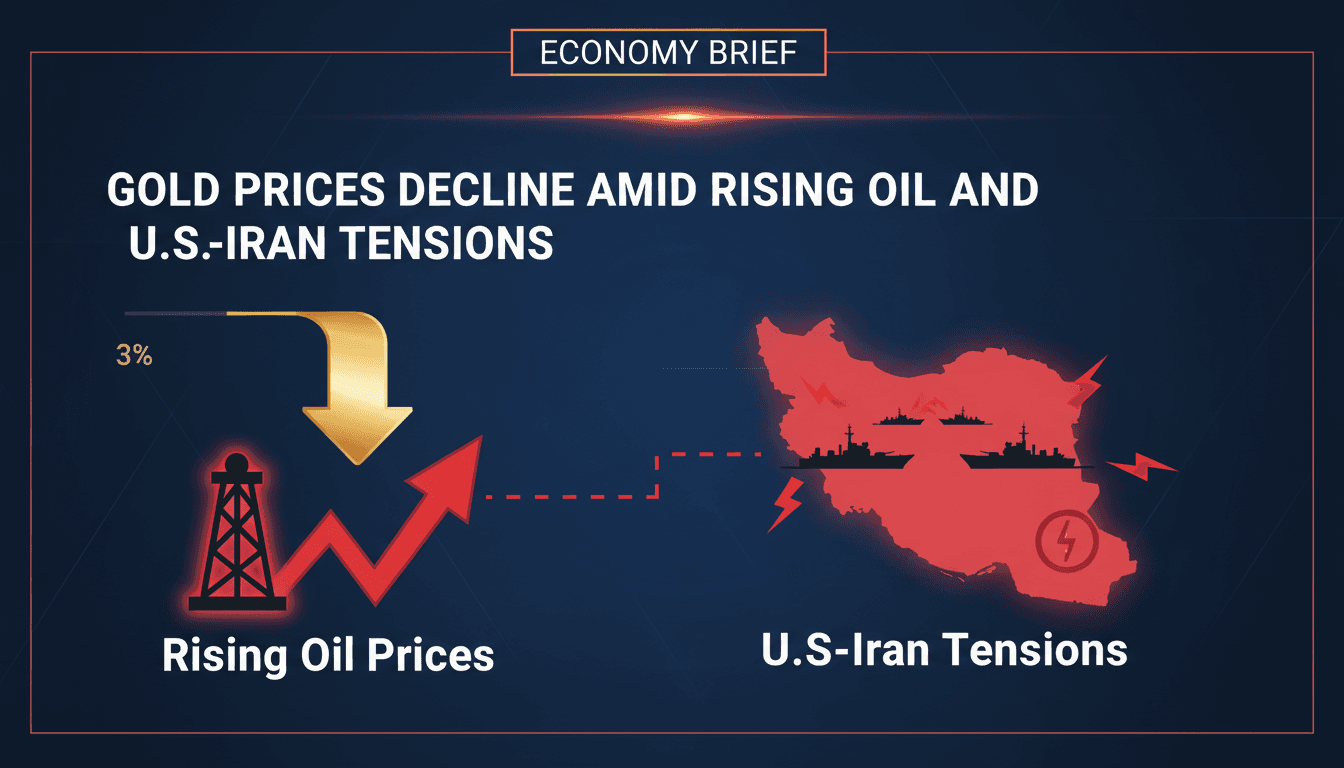
Gold prices decline amid rising oil prices and U.S.-Iran tensions
Here's what it means for you.
The recent decline in gold prices signals a shift in market dynamics influenced by geopolitical tensions and inflation concerns. As oil prices rise due to the reimposition of a naval blockade on Iranian ports, traders are recalibrating their expectations regarding Federal Reserve interest rate hikes. This environment may diminish gold's appeal as a safe haven asset, prompting investors to reconsider their strategies. Market participants should remain vigilant as inflation data and Federal Reserve signals will play crucial roles in shaping future investment decisions. The interplay between these factors could lead to continued volatility in gold prices.
What happened
Gold prices have fallen approximately 3% in the last 48 hours, marking their lowest level in two weeks. This decline is attributed to rising oil prices and escalating tensions between the U.S. and Iran. Spot gold was reported down 0.6% at $4,028.43 per ounce, while U.S. gold futures for August delivery eased 0.8% to $4,035.50.
The recent price drop follows a peak of $4,100.49 per ounce on July 12, 2026. The reimposition of a naval blockade on Iranian ports has contributed to the increase in oil prices, prompting traders to adjust their expectations for Federal Reserve interest rate hikes based on inflation data.
The Context
The backdrop of this decline involves significant geopolitical tensions between the U.S. and Iran, which have historically influenced market stability. The naval blockade has raised concerns about oil supply, leading to increased prices that affect inflation expectations. As inflation concerns grow, the attractiveness of gold as a non-yielding asset may diminish, particularly in a high-interest-rate environment.
Traders are currently assessing a 58% chance of a rate increase at the Federal Reserve's September meeting, which adds another layer of uncertainty to the market. The evolving situation underscores the interconnectedness of geopolitical events and financial markets, making it essential for investors to stay informed.
Takeaway
Looking ahead, the ongoing geopolitical tensions and inflation concerns will likely continue to influence gold prices in the near future. Upcoming Producer Price Index data may provide further insights into inflation trends, which could impact market sentiment. Additionally, market reactions to potential Federal Reserve interest rate changes will be closely monitored.
As these factors unfold, gold prices may remain volatile, prompting shifts in investment strategies. Investors should prepare for potential fluctuations as they navigate this complex landscape.
Business, markets, economy, and corporate news with strong UAE and regional relevance.
"Emirates 24|7 business coverage tends to center UAE markets, property, regulation, and regional economic developments."
— A47 Editor
Gold slips as oil rally keeps inflation, rate outlook on investors' radar
Gold prices declined by 0.6% to $4,028.43 per ounce as rising oil prices heightened inflation concerns and uncertainty regarding the U.S. interest rate outlook. This drop follows a previous increase of over 2% after U.S. consumer inflation data showe...
Markets desk coverage, trading insights, and investor updates.
"WSJ’s markets reporting provides in-depth analysis and context for investors."
— A47 Editor
Gold’s Faithful Think Twice as Prices Slide From Record Highs
Gold prices have continued to decline, falling below $4,000 per ounce for the second consecutive day, as renewed military tensions between the U.S. and Iran have dampened market sentiment. This drop follows a series of attacks that have escalated geo...
Pan-Arab news coverage spanning politics, business, sports, and regional affairs.
"Asharq Al-Awsat reflects a broad Arab editorial perspective with strong attention to regional geopolitics."
— A47 Editor
الذهب يهوي لأدنى مستوياته في أسبوعين مع تصاعد التوترات الأميركية - الإيرانية
Gold prices fell by approximately 3% on Monday, reaching their lowest levels since July 1, amid escalating tensions between the United States and Iran, coupled with rising oil prices.