
IAEA Confirms Syria's Undeclared Nuclear Reactor Near Completion Under Assad Regime
Why it matters
The revelation of Syria's nearly completed nuclear reactor poses significant proliferation risks, potentially destabilizing the geopolitical landscape in the Middle East.
What happened (in 30 seconds)
- IAEA Director General Rafael Grossi announced in September 2026 that Syria's undeclared nuclear reactor at Deir ez-Zor was nearly complete and designed for fissile material production.
- The reactor, originally destroyed by Israeli airstrikes in 2007, was confirmed to be part of an extensive undeclared nuclear program built with North Korean assistance.
- The new Syrian government has cooperated with the IAEA, revealing 73 tonnes of natural uranium metal and confirming the reactor's weapons-potential design.
The context you actually need
- Suspicion of a nuclear program in Syria began after the 2007 Israeli strike on the Al Kibar site, which Syria initially denied was a nuclear facility.
- The IAEA's 2011 assessment indicated that the site was likely a nuclear reactor, raising concerns similar to those surrounding Iraq's Osirak reactor.
- Following the fall of the Assad regime in late 2024, the new Syrian authorities have begun cooperating with international inspectors, revealing previously undeclared nuclear activities.
What's really happening
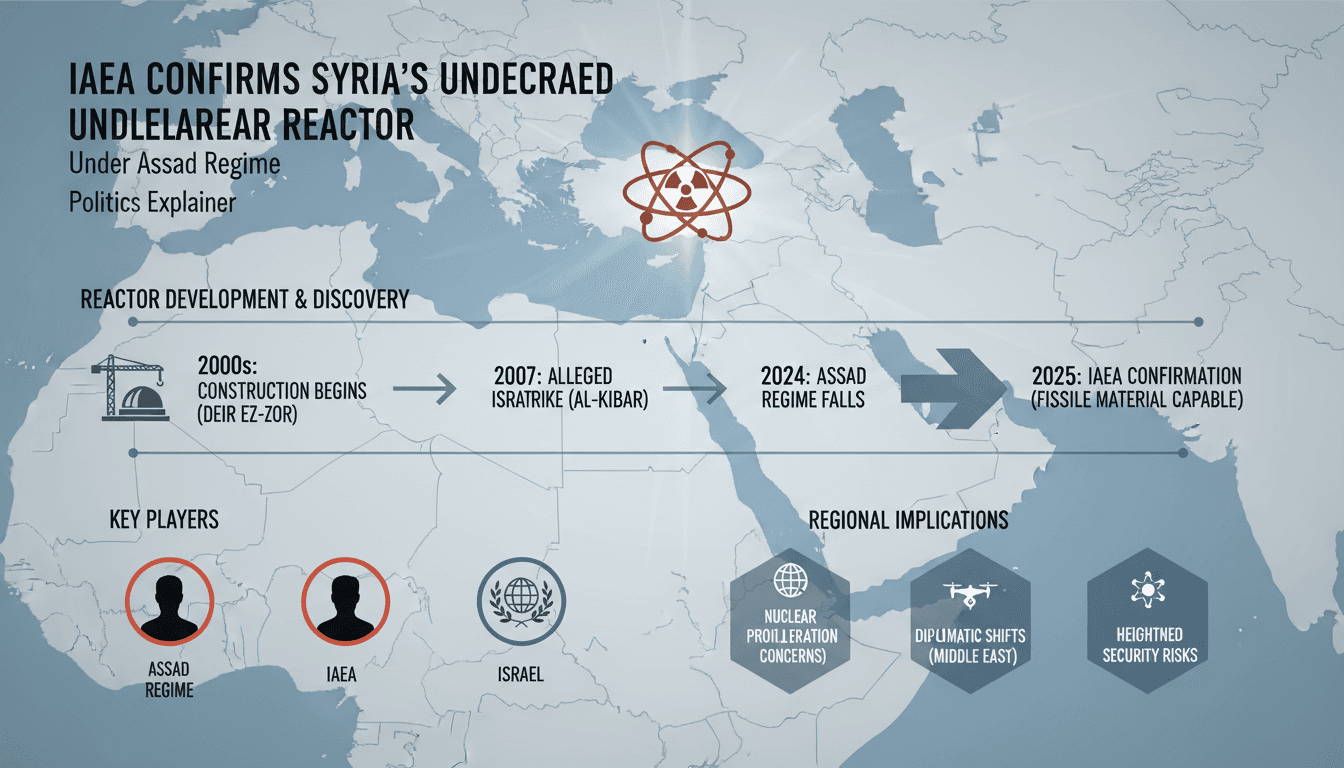
The International Atomic Energy Agency (IAEA) has confirmed that Syria's undeclared nuclear reactor at Deir ez-Zor was nearly complete and capable of producing fissile material for nuclear weapons. This reactor, which was destroyed by Israeli airstrikes in 2007, was built with assistance from North Korea, raising alarms about nuclear proliferation in a region already fraught with geopolitical tensions. The IAEA's findings come after a significant shift in Syria's political landscape, following the ousting of Bashar al-Assad in December 2024. The new transitional government has opted for transparency, cooperating with the IAEA and allowing inspections of previously hidden nuclear sites.
The IAEA's verification process revealed that the Al Kibar facility was not only designed for weapons production but also included a fuel fabrication plant and storage sites for 73 tonnes of natural uranium metal. This uranium, which includes 55 tonnes designated as fuel rods, is now under IAEA safeguards, indicating a commitment to prevent further nuclear proliferation. The implications of these findings are profound, as they suggest that Syria was on the brink of developing a nuclear weapons capability, which could have destabilized the already volatile Middle East.
Israel's 2007 airstrike, which was initially shrouded in secrecy, is now viewed as a critical deterrent against nuclear proliferation in the region. The Israeli government has previously highlighted this strike as a precedent for future military actions against perceived nuclear threats. The current situation underscores the importance of ongoing IAEA monitoring and excavation efforts to ensure that any remnants of Syria's nuclear ambitions are contained and that the new government remains committed to transparency.
As the geopolitical landscape shifts, the Gulf states, including the UAE, may feel the ripple effects of Syria's nuclear activities. Heightened security concerns could influence energy security, diplomatic stability, and non-proliferation norms, all of which are crucial for Dubai's role as a regional hub. While no immediate economic impacts have been reported, the potential for increased tensions in the region could affect investor confidence and market stability.
Who feels it first (and how)
- Gulf States: Heightened security concerns may lead to increased military spending and shifts in diplomatic relations.
- Energy Sector: Potential instability could impact oil and gas markets, affecting prices and supply chains.
- International Investors: Increased geopolitical risks may deter investment in the region, particularly in infrastructure and energy projects.
What to watch next
- IAEA Monitoring: Continued inspections and reports from the IAEA will be crucial in assessing Syria's nuclear intentions and compliance with international norms.
- Regional Military Movements: Watch for any changes in military posturing from Israel and neighboring countries in response to the confirmed nuclear capabilities.
- Diplomatic Engagements: Increased dialogue or tensions between Gulf states and international powers regarding nuclear non-proliferation efforts in the region.
Syria had an undeclared nuclear reactor designed for weapons production, confirmed by the IAEA.
Regional tensions will escalate as countries reassess their security strategies in light of Syria's nuclear capabilities.
The long-term impact on energy markets and investor confidence in the region remains uncertain.
Frequently Asked Questions
- Why it matters?
- The revelation of Syria's nearly completed nuclear reactor poses significant proliferation risks, potentially destabilizing the geopolitical landscape in the Middle East.
- What happened (in 30 seconds)?
- IAEA Director General Rafael Grossi announced in September 2026 that Syria's undeclared nuclear reactor at Deir ez-Zor was nearly complete and designed for fissile material production. The reactor, originally destroyed by Israeli airstrikes in 2007, was confirmed to be part of an extensive undeclared nuclear program built with North Korean assistance. The new Syrian government has cooperated with the IAEA, revealing 73 tonnes of natural uranium metal and confirming the reactor's weapons-pote
- What's really happening?
- The International Atomic Energy Agency (IAEA) has confirmed that Syria's undeclared nuclear reactor at Deir ez-Zor was nearly complete and capable of producing fissile material for nuclear weapons. This reactor, which was destroyed by Israeli airstrikes in 2007, was built with assistance from North Korea, raising alarms about nuclear proliferation in a region already fraught with geopolitical tensions. The IAEA's findings come after a significant shift in Syria's political landscape, following t
- Who feels it first (and how)?
- Gulf States: Heightened security concerns may lead to increased military spending and shifts in diplomatic relations. Energy Sector: Potential instability could impact oil and gas markets, affecting prices and supply chains. International Investors: Increased geopolitical risks may deter investment in the region, particularly in infrastructure and energy projects.
- What to watch next?
- IAEA Monitoring: Continued inspections and reports from the IAEA will be crucial in assessing Syria's nuclear intentions and compliance with international norms. Regional Military Movements: Watch for any changes in military posturing from Israel and neighboring countries in response to the confirmed nuclear capabilities. Diplomatic Engagements: Increased dialogue or tensions between Gulf states and international powers regarding nuclear non-proliferation efforts in the region.
Arabic-language reporting on global and regional news.
"BBC Arabic is part of the BBC, generally regarded for editorial standards and broad international coverage."
— A47 Editor
هل كانت سوريا قريبة من بناء مفاعل نووي في عهد الأسد؟
The International Atomic Energy Agency reported the discovery of a site in Syria for nuclear fuel production, which included 73 tons of natural uranium, comprising 55 tons of fuel rods and the remainder as waste. This finding raises questions about S...
International coverage from The Guardian's global desks.
"The Guardian is known for its progressive editorial stance and in-depth analysis."
— A47 Editor
Syrian reactor could have been used for nuclear weapons if completed, UN says
The chief of the UN nuclear watchdog, the International Atomic Energy Agency (IAEA), has revealed that a nearly completed nuclear reactor built in Syria during Bashar al-Assad's regime could have produced fissile material for nuclear weapons. Inspect...
Regional coverage and analysis focused on politics, diplomacy, and business across the Middle East.
"Al-Monitor is known for analytical reporting on Middle East politics and policy developments."
— A47 Editor
Secret Assad-era Syrian nuclear reactor was almost complete: UN
The International Atomic Energy Agency (IAEA) reported that a nearly complete nuclear reactor, built secretly during Bashar al-Assad's regime in Syria, was capable of producing nuclear weapons material. Recent inspections in Deir Ezzor and another un...