
Algerian Upper House Unanimously Approves Overseas Military Deployment to Niger to Protect Sonatrach Oil Projects
Why it matters
The move creates an operational framework for North African state energy assets operating in volatile frontier basins, directly influencing regional stability dynamics and energy supply chain reliability.
What happened (in 30 seconds)
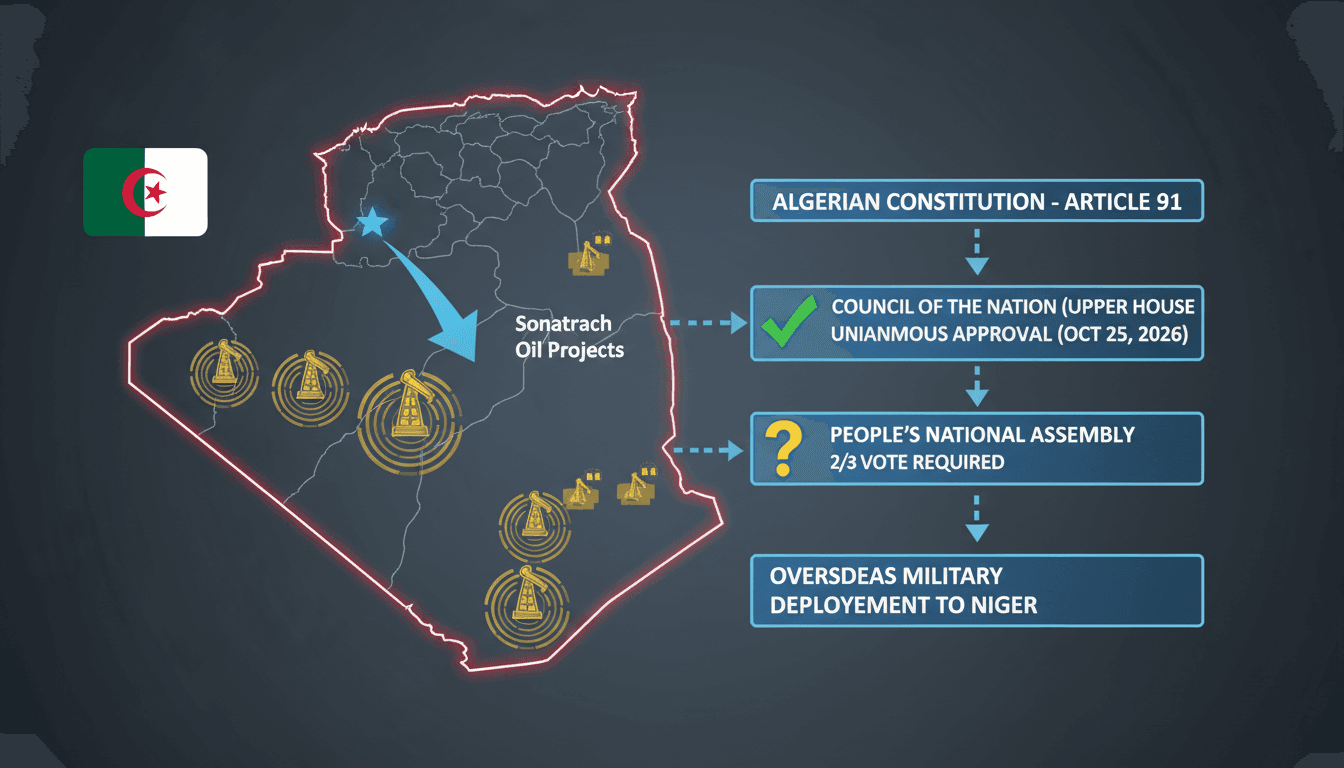
- The upper chamber voted: On October 25, 2026, Algeria's Council of the Nation voted unanimously to approve a presidential decree deploying People's National Army units to neighboring Niger.
- The mandate is focused: The prospective deployment is designed specifically to secure oil extraction and exploration facilities operated by state-owned energy firm Sonatrach near the mutual border.
- The process is pending: Under Article 91 of the Algerian Constitution, the deployment requires a two-thirds majority in both chambers of parliament before President Abdelmadjid Tebboune can execute the order.
The context you actually need
- A 53-year precedent: If approved by the People's National Assembly, this deployment marks Algeria's first overseas military operation since the 1973 Arab-Israeli War.
- Bilateral military coordination: The parliamentary vote follows mid-October 2026 negotiations in Algiers between Niger's Defence Minister General Salifou Modi, President Tebboune, and army Chief of Staff General Said Chanegriha.
- Commercial asset exposure: State-run Sonatrach holds upstream exploration concessions and infrastructure interests in Niger, situated directly across the border amid broader Sahel security challenges.
What's really happening
The unanimous decision by Algeria's Council of the Nation reflects a functional realignment of how regional energy infrastructure is secured in the Sahel corridor. Rather than leaving cross-border capital expenditures vulnerable to local security gaps, Algiers is testing a constitutional mechanism to project state protection over sovereign commercial assets abroad.
The legal baseline centers on Article 91 of the Algerian Constitution. This framework demands a supermajority—specifically two-thirds concurrence from both the upper house and the lower People's National Assembly—to deploy armed forces beyond national borders. The unanimous upper house vote demonstrates total institutional alignment around the economic imperative: protecting Sonatrach's investments. Sonatrach functions as the primary revenue engine for the Algerian state; safeguarding its foreign exploratory assets directly impacts long-term reserve replacement and fiscal stability.
The operational backdrop involves bilateral negotiations finalized earlier in October 2026. General Salifou Modi’s official mission to Algiers established a formal military cooperation protocol prioritizing border security, counter-terrorism operations, and energy asset integrity. This protocol signals an incentive match: Niger requires stabilized operational environments to extract hydrocarbon value and generate state revenue, while Algeria requires physical security guarantees to justify capital allocation by Sonatrach in adjacent border blocks.
This operational shift replaces passive perimeter defense with an active, expeditionary protection mandate. Historically, Algerian foreign policy maintained a strict posture of non-intervention abroad. By focusing the mandate narrowly on defined energy installations rather than broad combat operations, the executive branch maintains compliance with constitutional limits while mitigating downside risk for state-owned industrial investments.
For global commodity markets and infrastructure operators, this structural evolution illustrates how national oil companies operating in fragile zones are integrating sovereign military backstops into their capital risk calculus. While no direct disruptions have hit broader trading hubs, the formal deployment of regular military units to defend oil concessions changes the operational baseline for energy transport, asset appraisal, and regional joint ventures across the Central Sahel.
Who feels it first (and how)
- Energy Infrastructure Developers: Teams evaluating cross-border pipeline and exploration projects in the Sahel gain a visible reference point for sovereign military risk mitigation.
- Sovereign Risk Analysts: Portfolio managers covering North African and frontier market debt must price the institutional precedent of external troop deployments under constitutional mandates.
- Regional Logistics Operators: Supply chain networks moving material across the Algeria-Niger transit corridor will encounter altered security postures and checkpoints tied to army-secured perimeters.
- Global Energy Markets: Traders monitoring broader African crude supply track the protection of upstream volume as Sonatrach works to secure foreign extraction facilities.
What to watch next
- The People's National Assembly vote: Passage requires a two-thirds majority in the lower house to satisfy Article 91 requirements before any deployment occurs.
- Operational deployment orders: Presidential execution directives will define the precise size, rules of engagement, and geographic distribution of the army detachment.
- Sonatrach field operational updates: Announcements regarding restarted, maintained, or expanded drilling schedules within Niger's border concessions indicate operational success.
The Council of the Nation unanimously backed the deployment on October 25, 2026, following a signed military cooperation protocol with Niger's Defence Minister.
The People's National Assembly will face strong institutional alignment to meet the two-thirds threshold required under Article 91.
The exact operational footprint, logistics timetables, and rules of engagement governing the People's National Army units once stationed inside Niger's borders.
Frequently Asked Questions
- Why it matters?
- The move creates an operational framework for North African state energy assets operating in volatile frontier basins, directly influencing regional stability dynamics and energy supply chain reliability.
- What happened (in 30 seconds)?
- The upper chamber voted: On October 25, 2026, Algeria's Council of the Nation voted unanimously to approve a presidential decree deploying People's National Army units to neighboring Niger. The mandate is focused: The prospective deployment is designed specifically to secure oil extraction and exploration facilities operated by state-owned energy firm Sonatrach near the mutual border. The process is pending: Under Article 91 of the Algerian Constitution, the deployment requires a two-thirds majo
- What's really happening?
- The unanimous decision by Algeria's Council of the Nation reflects a functional realignment of how regional energy infrastructure is secured in the Sahel corridor. Rather than leaving cross-border capital expenditures vulnerable to local security gaps, Algiers is testing a constitutional mechanism to project state protection over sovereign commercial assets abroad. The legal baseline centers on Article 91 of the Algerian Constitution. This framework demands a supermajority—specifically two-thir
- Who feels it first (and how)?
- Energy Infrastructure Developers: Teams evaluating cross-border pipeline and exploration projects in the Sahel gain a visible reference point for sovereign military risk mitigation. Sovereign Risk Analysts: Portfolio managers covering North African and frontier market debt must price the institutional precedent of external troop deployments under constitutional mandates. Regional Logistics Operators: Supply chain networks moving material across the Algeria-Niger transit corridor will encounter a
- What to watch next?
- The People's National Assembly vote: Passage requires a two-thirds majority in the lower house to satisfy Article 91 requirements before any deployment occurs. Operational deployment orders: Presidential execution directives will define the precise size, rules of engagement, and geographic distribution of the army detachment. Sonatrach field operational updates: Announcements regarding restarted, maintained, or expanded drilling schedules within Niger's border concessions indicate operational su
English-language reporting on Saudi politics, policy, and society.
"Saudi Gazette reflects mainstream Saudi institutional perspectives."
— A47 Editor
Algeria's upper house approves military deployment to Niger
Algeria's Council of the Nation, the upper house of parliament, voted unanimously on Sunday to approve a presidential decision to deploy military forces to neighboring Niger to protect oil projects operated by state-owned energy company Sonatrach, ac...
Pan-Arab political news and analysis.
"Al-Quds Al-Arabi is a London-based Arabic newspaper known for political coverage."
— A47 Editor
لحماية المنشآت النفطية… مجلس الأمة الجزائري يصادق بالإجماع على إرسال وحدات من الجيش إلى النيجر
The Algerian Council of the Nation, the upper chamber of parliament, unanimously approved in a closed session on Sunday President Abdelmadjid Tebboune's decision to send a unit of the Algerian army to Niger, amid accelerated diplomatic and military m...
Arabic-language coverage of international news and geopolitics.
"RT Arabic is a Russian state-funded outlet often criticized for promoting Kremlin-aligned narratives."
— A47 Editor
مجلس الأمة الجزائري يوافق بالإجماع على إرسال وحدة عسكرية إلى النيجر
The Algerian Council of the Nation unanimously approved on Sunday the dispatch of a military unit from the Algerian People's National Army to Niger, according to a report by RT Arabic.
Comprehensive coverage of Middle Eastern and global issues.
"Al Jazeera is a prominent voice from the Global South, especially the Middle East, with an emphasis on underreported stories."
— A47 Editor
Algerian parliament’s upper house approves troop deployment to Niger
Algeria's upper house of parliament has approved the deployment of Algerian troops to Niger, following a defence pact signed between the two neighbouring countries. The vote comes after Algerian President Abdelmadjid Tebboune previously announced the...
Global news coverage with extensive reporting on Middle Eastern conflicts and geopolitics.
"Al Jazeera is a Qatar-based broadcaster known for wide regional coverage and alternative perspectives."
— A47 Editor
Algerian parliament’s upper house approves troop deployment to Niger
Algeria's upper house of parliament has approved the deployment of Algerian troops to Niger, following a defence pact signed between the two neighbouring countries. The vote comes after Algerian President Abdelmadjid Tebboune previously announced the...
Algerian and regional news coverage.
"Echorouk is a major Algerian outlet with broad national reporting."
— A47 Editor
مجلس الأمة يُصوت بالإجماع على قرار إرسال وحدات من الجيش إلى النيجر
The Algerian Council of the Nation voted unanimously on Sunday to notify the President of the Republic of a decision to send a unit from the National Popular Army to the Republic of Niger. The measure aims to protect investment projects of the Sonatr...
Arabic-language coverage of political affairs and current events.
"Okaz political coverage typically follows mainstream Saudi framing on national and regional affairs."
— A47 Editor
بالإجماع.. «الأمة الجزائري» يصادق على إرسال قوات إلى النيجر
The Algerian Council of the Nation, the upper house of parliament, unanimously approved on Sunday a decision to deploy units of the People's National Army to Niger, a first for the Algerian military beyond its borders since the October 1973 war. The ...