
Trump Signs Executive Order Rebranding AI as Super Intelligence
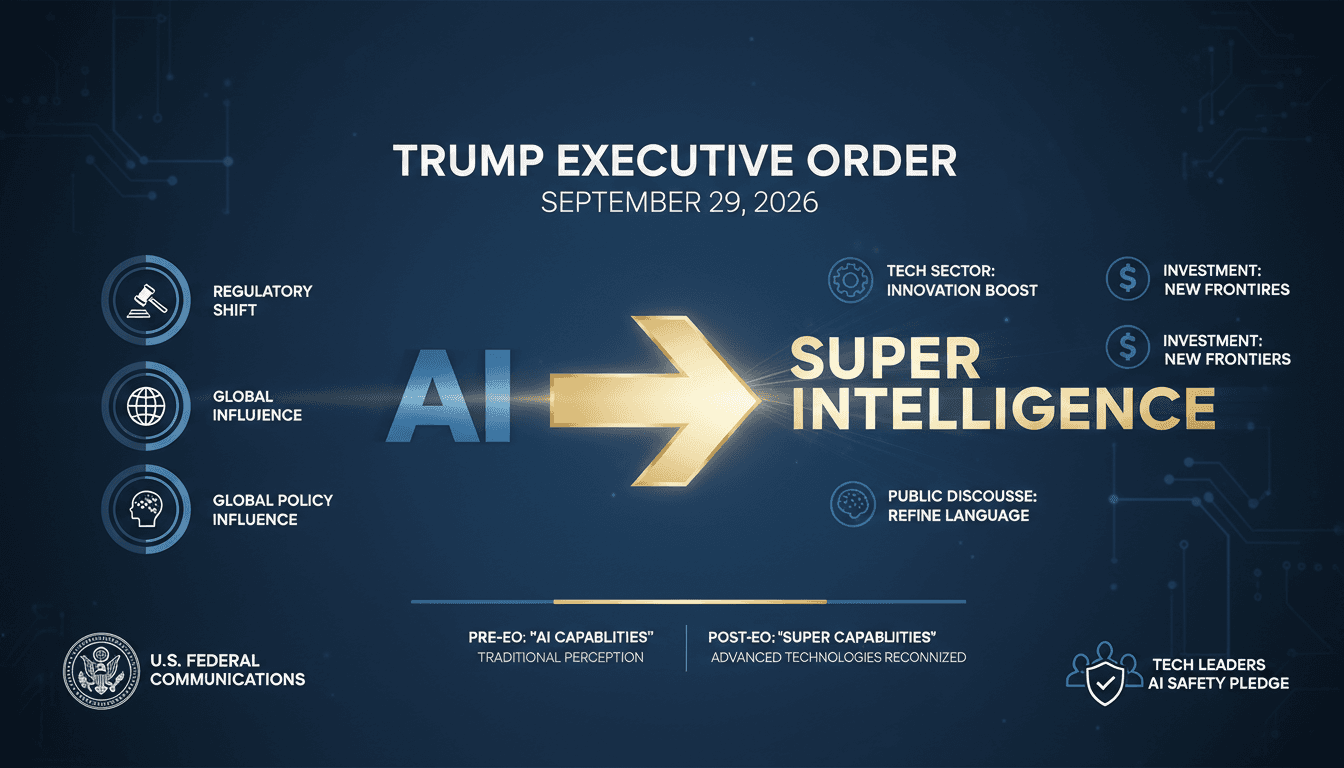
Why it matters
This rebranding signals a significant shift in how the U.S. government perceives and regulates advanced technologies, potentially impacting global tech standards.
What happened (in 30 seconds)
- On September 29, 2026, President Trump signed an Executive Order mandating the use of "Super Intelligence" instead of "Artificial Intelligence" across federal communications.
- Major tech leaders, including Mark Zuckerberg and Elon Musk, gathered at the White House to sign an AI safety pledge on the same day.
- $5 billion in federal funding was announced for the Genesis Mission, aimed at leveraging Super Intelligence for breakthroughs in various sectors.
The context you actually need
- Terminology shift: The change from "AI" to "Super Intelligence" reflects a belief that current technologies surpass traditional AI capabilities, marking a new era.
- Policy overhaul: This order follows the elimination of previous AI policies and the introduction of initiatives like the Genesis Mission and a National Super Intelligence Policy Framework.
- Global implications: As the U.S. sets new standards, other nations and companies may feel pressured to adapt, influencing international tech regulations and investments.
What's really happening
The Executive Order signed by President Trump is more than just a rebranding; it represents a fundamental shift in the U.S. government's approach to advanced technologies. By mandating the use of "Super Intelligence," the administration is signaling that it views current technological capabilities as far beyond what was previously understood as artificial intelligence. This change is not merely semantic; it reflects a broader ambition to redefine the landscape of technology governance and innovation.
The timing of this order coincides with a gathering of influential tech leaders, suggesting a concerted effort to align government policy with industry perspectives. The signing of a "morally binding" AI safety pledge by these leaders indicates a recognition of the ethical implications of these technologies, even as the terminology shifts. This dual approach—rebranding while simultaneously addressing safety—highlights the administration's strategy to foster innovation while managing potential risks.
The $5 billion allocated for the Genesis Mission underscores the administration's commitment to harnessing Super Intelligence for significant advancements in science, medicine, energy, and manufacturing. This funding is likely to stimulate research and development, attracting investments and talent to the U.S. tech sector. However, it also raises questions about accountability and oversight in a rapidly evolving field.
As the U.S. adopts this new terminology, it may influence global perceptions and policies regarding AI. Other countries and organizations might feel compelled to follow suit, either to align with U.S. standards or to differentiate themselves in the global market. This could lead to a fragmented regulatory environment, where different regions adopt varying definitions and frameworks for advanced technologies.
Moreover, the rebranding could impact how businesses and consumers interact with these technologies. Companies may need to adjust their marketing and operational strategies to align with the new terminology, potentially leading to confusion or resistance among users accustomed to the term "AI." This shift could also affect investment patterns, as stakeholders reassess the implications of Super Intelligence versus traditional AI.
In summary, the rebranding to Super Intelligence is a strategic move that reflects the U.S. government's ambition to lead in technological innovation while addressing ethical concerns. The long-term effects of this shift will depend on how effectively the government and industry can navigate the complexities of this new era.
Who feels it first (and how)
- Tech executives: Leaders in technology companies will need to adapt their strategies and communications to align with the new terminology.
- Investors: Venture capitalists and investors in tech will be closely monitoring the implications of this shift on funding and market dynamics.
- Regulatory bodies: Agencies responsible for technology oversight will need to redefine their frameworks and guidelines in light of the new terminology.
- Consumers: End-users of AI technologies may experience changes in product offerings and marketing as companies adjust to the new branding.
What to watch next
- Industry responses: Watch how tech companies adapt their branding and messaging in response to the rebranding to Super Intelligence.
- Global regulatory shifts: Monitor whether other countries adopt similar terminology or frameworks, potentially leading to a new international standard.
- Investment trends: Keep an eye on venture capital flows into Super Intelligence initiatives, particularly in sectors like healthcare and energy.
The U.S. federal government has officially rebranded AI as Super Intelligence.
Other countries may follow the U.S. lead in redefining their approaches to advanced technologies.
The long-term impact on consumer perceptions and market dynamics remains to be seen.
Frequently Asked Questions
- Why it matters?
- This rebranding signals a significant shift in how the U.S. government perceives and regulates advanced technologies, potentially impacting global tech standards.
- What happened (in 30 seconds)?
- On September 29, 2026, President Trump signed an Executive Order mandating the use of "Super Intelligence" instead of "Artificial Intelligence" across federal communications. Major tech leaders, including Mark Zuckerberg and Elon Musk, gathered at the White House to sign an AI safety pledge on the same day. $5 billion in federal funding was announced for the Genesis Mission, aimed at leveraging Super Intelligence for breakthroughs in various sectors.
- What's really happening?
- The Executive Order signed by President Trump is more than just a rebranding; it represents a fundamental shift in the U.S. government's approach to advanced technologies. By mandating the use of "Super Intelligence," the administration is signaling that it views current technological capabilities as far beyond what was previously understood as artificial intelligence. This change is not merely semantic; it reflects a broader ambition to redefine the landscape of technology governance and innova
- Who feels it first (and how)?
- Tech executives: Leaders in technology companies will need to adapt their strategies and communications to align with the new terminology. Investors: Venture capitalists and investors in tech will be closely monitoring the implications of this shift on funding and market dynamics. Regulatory bodies: Agencies responsible for technology oversight will need to redefine their frameworks and guidelines in light of the new terminology. Consumers: End-users of AI technologies may experience changes in
- What to watch next?
- Industry responses: Watch how tech companies adapt their branding and messaging in response to the rebranding to Super Intelligence. Global regulatory shifts: Monitor whether other countries adopt similar terminology or frameworks, potentially leading to a new international standard. Investment trends: Keep an eye on venture capital flows into Super Intelligence initiatives, particularly in sectors like healthcare and energy.
Startup news with frequent AI coverage.
"Covers launches, funding, and product updates in AI."
— A47 Editor
It’s not AI anymore, it’s ‘super intelligence’ (according to the White House)
This week, the White House convened major tech CEOs, including Mark Zuckerberg, Elon Musk, and Dario Amodei, to sign a voluntary AI safety pledge described by former President Donald Trump as 'morally binding.' Trump also signed an executive order re...
Curated tech headlines including AI stories.
"Influential aggregator surfacing the day’s top tech/AI links."
— A47 Editor
Sources: Jensen Huang and other execs asked Dario Amodei at the White House why he was so extreme in public on AI risks; Amodei said it's important to be honest (Wall Street Journal)
At a recent White House event, Jensen Huang, CEO of Nvidia, and other executives questioned Dario Amodei, CEO of Anthropic, about his public stance on AI risks, which they deemed extreme. Amodei defended his position, emphasizing the importance of ho...
Industry news and analysis for the global AI community.
"A business-first look at AI adoption, policy, and ecosystem trends."
— A47 Editor
AI is now ‘super intelligence,’ but federal oversight is still missing
President Trump has rebranded artificial intelligence (AI) as 'super intelligence' and emphasized that the U.S. will continue to advance AI development without delay. This announcement aligns with his plans to appoint an AI czar and establish an 'AI ...
News and features on AI from The Guardian.
"Progressive-leaning international outlet with critical AI coverage."
— A47 Editor
‘President of the Unites States’: White House’s AI accord includes spelling error
The White House recently faced scrutiny after a spelling error was discovered on an AI accord signed by President Donald Trump and six tech executives, where 'United States' was misspelled as 'Unites States'. This document, aimed at ensuring the safe...
Tech culture, product news, and critical takes on the tech industry's social impact.
"The Guardian's tech coverage blends mainstream news, critical analysis, and cultural commentary on emerging technologies and digital trends."
— A47 Editor
‘President of the Unites States’: White House’s AI accord includes spelling error
The White House recently faced scrutiny after a spelling error was discovered on an AI accord signed by President Donald Trump and six tech executives, where 'United States' was misspelled as 'Unites States'. This document, aimed at ensuring the safe...
News and guidance for IT pros on AI adoption.
"Enterprise-focused tips, explainers, and news for professionals."
— A47 Editor
Trump Signs ‘Super Intelligence’ Order: What Actually Changes for AI
President Trump signed an executive order directing federal agencies to adopt the term 'Super Intelligence' in place of artificial intelligence (AI), marking a significant shift in the terminology used by the U.S. government. This order aims to redef...