
Pentagon Establishes Autonomous Warfare Command Targeting 2027 Activation
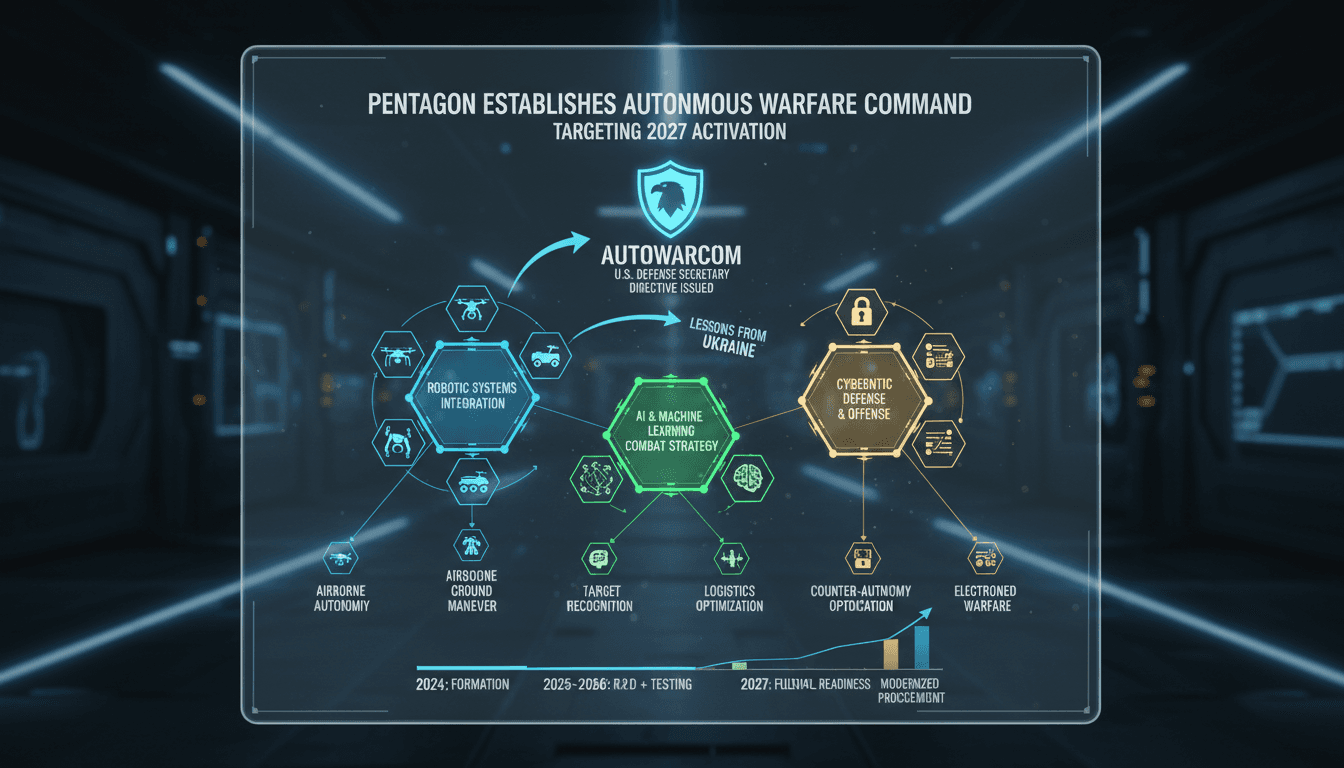
Why it matters
This initiative reflects a broader trend towards automation in military operations, impacting defense contractors and technology sectors.
What happened (in 30 seconds)
- On September 30, 2026, U.S. Defense Secretary Pete Hegseth announced the creation of the Autonomous Warfare Command (AUTOWARCOM) at Marine Corps Base Quantico.
- Project Agincourt was launched to develop acquisition pathways for unmanned systems, while Project Meridian will conduct a 120-day external study on future warfare capabilities.
- Full command activation is targeted for October 1, 2027, pending congressional legislation, with a planned 20% reduction in general and flag officers.
The context you actually need
- Geopolitical pressures have intensified the U.S. military's focus on unmanned systems, particularly in light of drone-centric operations observed in Ukraine.
- Previous initiatives included the Direct Reporting Portfolio Manager for Unmanned Systems, highlighting a sustained commitment to integrating robotic capabilities.
- Supply-chain vulnerabilities and technological advancements by adversaries have prompted calls for structural reforms to expedite military procurement processes.
What's really happening
The Pentagon's announcement of AUTOWARCOM marks a significant pivot in U.S. military strategy, driven by the need to adapt to rapidly evolving technological landscapes and the lessons learned from recent conflicts. The establishment of this four-star combatant command is not merely an organizational change; it represents a fundamental shift in how the U.S. approaches warfare.
The command is designed to integrate autonomous systems into military operations more effectively, addressing the increasing reliance on unmanned technologies. This is particularly relevant in the context of great-power competition, where adversaries are also advancing their capabilities in drone warfare and autonomous systems. The U.S. military's focus on these technologies is a direct response to the operational successes observed in Ukraine, where drone usage has played a pivotal role in modern combat scenarios.
Project Agincourt, as the immediate successor to existing unmanned systems portfolios, aims to streamline acquisition pathways and legislative requirements. This is crucial, as traditional procurement processes have often hindered the rapid deployment of new technologies. By bypassing these legacy constraints, the Pentagon hopes to accelerate the integration of robotic and unmanned capabilities into joint-force operations.
Project Meridian, co-led by notable figures like Elon Musk and Palmer Luckey, underscores the urgency of identifying capability gaps in future warfare. The 120-day review will focus on assessing the current landscape and projecting future needs, ensuring that the U.S. military remains at the forefront of technological advancements.
The planned reduction of 20% in the total number of U.S. general and flag officers indicates a shift towards a leaner command structure, which may enhance operational efficiency but also raises questions about the future roles of senior military personnel. This restructuring could lead to a more agile military capable of responding swiftly to emerging threats, but it also poses challenges in terms of workforce management and the potential loss of institutional knowledge.
Overall, the creation of AUTOWARCOM is a strategic response to the complexities of modern warfare, emphasizing the need for rapid adaptation and integration of advanced technologies. As the command prepares for its full activation in October 2027, the implications for defense contractors, military personnel, and the broader technology sector will be significant.
Who feels it first (and how)
- Defense Contractors: Companies involved in unmanned systems and robotics will see increased demand for their technologies and services.
- Military Personnel: Changes in command structure may affect career trajectories and roles within the armed forces.
- Technology Sector: Firms specializing in AI and autonomous systems will likely experience growth opportunities as the military seeks innovative solutions.
What to watch next
- Congressional Legislation: The approval process for AUTOWARCOM will be critical; delays could impact the timeline for full activation.
- Industry Partnerships: Watch for collaborations between the military and tech companies, particularly those involved in autonomous systems.
- Operational Tests: The outcomes of Project Meridian's findings will shape future military capabilities and strategies.
The establishment of AUTOWARCOM and its target activation date of October 1, 2027.
Increased investment in unmanned systems and robotics within the defense sector.
The long-term impact on military personnel and the effectiveness of the new command structure.
Frequently Asked Questions
- Why it matters?
- This initiative reflects a broader trend towards automation in military operations, impacting defense contractors and technology sectors.
- What happened (in 30 seconds)?
- On September 30, 2026, U.S. Defense Secretary Pete Hegseth announced the creation of the Autonomous Warfare Command (AUTOWARCOM) at Marine Corps Base Quantico. Project Agincourt was launched to develop acquisition pathways for unmanned systems, while Project Meridian will conduct a 120-day external study on future warfare capabilities. Full command activation is targeted for October 1, 2027, pending congressional legislation, with a planned 20% reduction in general and flag officers.
- What's really happening?
- The Pentagon's announcement of AUTOWARCOM marks a significant pivot in U.S. military strategy, driven by the need to adapt to rapidly evolving technological landscapes and the lessons learned from recent conflicts. The establishment of this four-star combatant command is not merely an organizational change; it represents a fundamental shift in how the U.S. approaches warfare. The command is designed to integrate autonomous systems into military operations more effectively, addressing the incre
- Who feels it first (and how)?
- Defense Contractors: Companies involved in unmanned systems and robotics will see increased demand for their technologies and services. Military Personnel: Changes in command structure may affect career trajectories and roles within the armed forces. Technology Sector: Firms specializing in AI and autonomous systems will likely experience growth opportunities as the military seeks innovative solutions.
- What to watch next?
- Congressional Legislation: The approval process for AUTOWARCOM will be critical; delays could impact the timeline for full activation. Industry Partnerships: Watch for collaborations between the military and tech companies, particularly those involved in autonomous systems. Operational Tests: The outcomes of Project Meridian's findings will shape future military capabilities and strategies.
Curated tech headlines including AI stories.
"Influential aggregator surfacing the day’s top tech/AI links."
— A47 Editor
Memo: the US Army is creating an autonomous systems command, after Defense Secretary Pete Hegseth announced the Meridian and Agincourt robotic warfare projects (Colin Demarest/Axios)
The U.S. Army is establishing a new autonomous systems command, following Defense Secretary Pete Hegseth's announcement of the Meridian and Agincourt robotic warfare projects. This initiative aims to enhance the Army's capabilities in autonomous warf...
Tech news, hardware, and AI tools coverage.
"PC/tech site increasingly covering AI hardware and apps."
— A47 Editor
The Pentagon is creating a new command just for autonomous and robotic warfare
The Pentagon has announced the establishment of a new command dedicated to autonomous and robotic warfare, as revealed by Hegseth during his State of the Force address on September 30 at Quantico, Virginia. This command will be led by a four-star off...
RT is a Russian state-funded network covering global events from a Russian perspective.
"RT is widely criticized for promoting pro-Kremlin narratives and is considered by many to be a state propaganda outlet."
— A47 Editor
Hegseth announces new AI and drone command
U.S. Secretary of Defense Pete Hegseth announced the establishment of a new Autonomous Warfare Command at the Pentagon, which will focus on artificial intelligence (AI) and robotic systems. This initiative aims to enhance the U.S. military's capabili...
Insights and news on social issues, policy, and political movements across the United States.
"The Wall Street Journal is known for its deep political coverage, especially at the intersection of policy, regulation, and social dynamics."
— A47 Editor
Defense Secretary Pete Hegseth is creating a four-star combatant command for autonomous warfare
Defense Secretary Pete Hegseth announced the creation of a new four-star combatant command focused on autonomous warfare during a speech at Marine Corps Base Quantico. This initiative aims to enhance the military's operational capabilities in drone w...
Business and tech news excluding paywalled content.
"High-volume business/tech outlet with frequent AI coverage."
— A47 Editor
Pete Hegseth's got a vision for the military. It leans on drone swarms, chaplains, and tech leaders like Elon Musk and Palmer Luckey.
Defense Secretary Pete Hegseth has unveiled a new vision for the U.S. military that emphasizes the integration of drone swarms, advanced technology, and the involvement of tech leaders such as Elon Musk and Palmer Luckey. This plan aims to prepare th...
Business, investment, entrepreneurship, leadership, and innovation.
"Forbes is known for its coverage of business leaders, market trends, and entrepreneurial ventures with a pro-business editorial stance."
— A47 Editor
Pete Hegseth Taps Elon Musk For Military Weapons Development Project
Pete Hegseth announced Project Meridian, a new initiative aimed at identifying and developing military weapons and technologies for soldiers, in collaboration with Elon Musk. The project seeks to propose solutions for testing and implementing these a...
Conservative-leaning political and national coverage.
"The Washington Times is a conservative-leaning newspaper known for its political coverage and advocacy of right-of-center viewpoints."
— A47 Editor
Hegseth unveils new drone-focused 4-star command
Secretary of Defense Pete Hegseth announced the establishment of the Autonomous Warfare Command, a new 4-star command aimed at enhancing drone capabilities within the military. This initiative is part of a broader strategy to modernize military opera...