
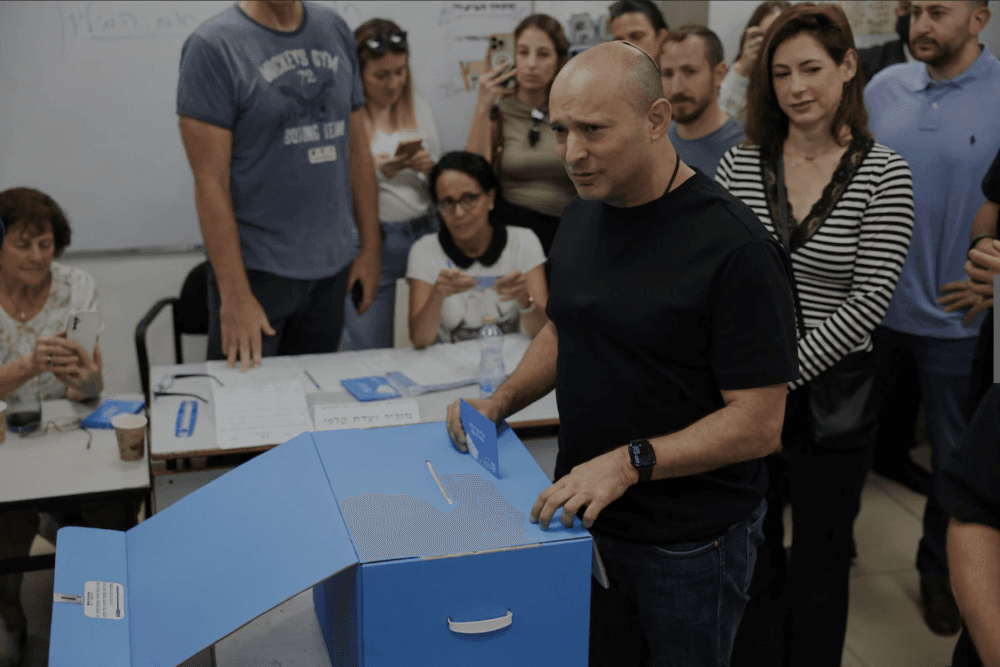
Record 77.7 Percent Turnout in Israeli Knesset Election Leaves Netanyahu and Eisenkot Blocs Short of Majority
Why it matters
The failure of either major bloc to secure a 61-seat parliamentary majority locks the region into extended political uncertainty, directly affecting Levant risk premiums, foreign direct investment allocations, and cross-border commercial corridors.
What happened (in 30 seconds)
* Turnout hit a 27-year peak: Final voter participation reached 77.7% on October 27, 2026, marking the highest civic engagement level documented by the Central Elections Committee since 1999. * Neither primary bloc cleared the threshold: Exit tallies projected Benjamin Netanyahu's right-wing bloc at 50 to 52 seats and Gadi Eisenkot's opposition bloc at 51 to 53 seats, leaving both short of the 61 seats needed to govern the 120-seat Knesset. * Arab parties emerged as pivotal kingmakers: Arab parliamentary lists secured an estimated 17 to 18 seats, creating a numerical roadblock for traditional coalition models and initiating protracted mandate negotiations overseen by President Isaac Herzog.
The context you actually need
* The first post-October 7 ballot: This election represented the initial nationwide electoral test since the regional escalations in Gaza and Lebanon, focusing voter scrutiny directly on systemic intelligence failures, military exemptions, and judicial architecture. * Structural fragmentation in the Knesset: Israel’s purely proportional electoral system requires disparate factions to aggregate power, meaning a shift of just two or three seats completely alters cabinet viability. * Netanyahu's transitional posture: Because formal coalition bargaining routinely spans multiple weeks, statutory rules permit Netanyahu to continue directing executive functions as a caretaker prime minister until a successor cabinet is sworn in.
What's really happening
The mechanics behind this electoral deadlock are structural rather than accidental. High participation rates—culminating in the 77.7% national turnout—did not deliver a decisive mandate; instead, they reinforced an exact split down the middle of the political spectrum.
Voter mobilization operated on divergent incentives. On one side, the opposition framed the election around systemic accountability for wartime failures, judicial independence, and ending broad military draft exemptions for ultra-Orthodox communities. On the other side, the incumbent Likud-led bloc prioritized continuity in regional security policy and judicial overhaul. The arithmetic of the 120-seat Knesset requires 61 seats to establish a government. With Netanyahu's bloc capturing roughly 50 to 52 seats and Eisenkot's opposition securing 51 to 53 seats, the conventional paths to power are blocked without cross-ideological compromises.
The decisive mathematical variable is the 17 to 18 seats projected for Arab parties. In prior decades, these factions largely operated outside mainstream executive coalition frameworks. However, signals indicating their conditional openness to support an Eisenkot-led arrangement fundamentally alter the leverage dynamics inside the chamber. Even so, reconciling the policy platforms of right-leaning members of the opposition with Arab party priorities creates substantial friction, making an immediate alternative coalition difficult to assemble.
Consequently, the underlying incentive for the incumbent leadership is to extend the negotiating clock. Under standard parliamentary rules, the caretaker mechanism preserves executive continuity. For global markets and regional observers, a caretaker administration represents institutional inertia: major long-term fiscal plans, institutional reforms, and diplomatic normalizations are routinely deferred while day-to-day security and administrative choices continue under interim leadership.
Rather than resolving the country's strategic direction, this record turnout crystallized institutional division. Until one bloc offers structural policy concessions that breach previous coalition boundaries, the system remains locked in a high-friction holding pattern.
Who feels it first (and how)
* Levant energy and infrastructure operators: Experience elevated project financing costs and delayed regulatory clearances while key ministerial portfolios remain subject to temporary caretaker stewardship. * Gulf and regional family offices: Face temporary capital allocation pauses as institutional investors reprice political risk indicators and cross-border commercial integration schedules. * Dubai-based corporate logistics hubs: Must navigate erratic regional freight movement patterns and monitor operational travel advisories for personnel moving through Eastern Mediterranean transit points.
What to watch next
* Presidential consultations under Isaac Herzog: Track which bloc leader gathers the initial threshold of formal recommendations, determining who receives the primary 28-day window to negotiate a cabinet. * Arab party coalition conditions: Watch whether Arab factions demand formal cabinet participation or limit engagement to external supply-and-confidence pacts, defining the stability of any proposed opposition executive. * Sovereign debt yield spreads: Monitor pricing on Israeli sovereign and corporate bonds for signals that international capital is pricing in either renewed snap elections or a durable governing compromise.
Total voter turnout finished at 77.7%, and neither Netanyahu's alliance nor Eisenkot's bloc reached the 61-seat threshold required for an independent governing majority.
Benjamin Netanyahu will retain administrative control as caretaker prime minister for months while multi-party consultations stall across parliamentary factions.
Whether the opposition can overcome its internal ideological divisions to formalize an operational coalition agreement alongside Arab party representatives, or if the electorate will be summoned to another snap election.
Frequently Asked Questions
- Why it matters?
- The failure of either major bloc to secure a 61-seat parliamentary majority locks the region into extended political uncertainty, directly affecting Levant risk premiums, foreign direct investment allocations, and cross-border commercial corridors.
- What happened (in 30 seconds)?
- Turnout hit a 27-year peak: Final voter participation reached 77.7% on October 27, 2026, marking the highest civic engagement level documented by the Central Elections Committee since 1999. Neither primary bloc cleared the threshold: Exit tallies projected Benjamin Netanyahu's right-wing bloc at 50 to 52 seats and Gadi Eisenkot's opposition bloc at 51 to 53 seats, leaving both short of the 61 seats needed to govern the 120-seat Knesset. Arab parties emerged as pivotal kingmakers: Arab parliament
- What's really happening?
- The mechanics behind this electoral deadlock are structural rather than accidental. High participation rates—culminating in the 77.7% national turnout—did not deliver a decisive mandate; instead, they reinforced an exact split down the middle of the political spectrum. Voter mobilization operated on divergent incentives. On one side, the opposition framed the election around systemic accountability for wartime failures, judicial independence, and ending broad military draft exemptions for ultr
- Who feels it first (and how)?
- Levant energy and infrastructure operators: Experience elevated project financing costs and delayed regulatory clearances while key ministerial portfolios remain subject to temporary caretaker stewardship. Gulf and regional family offices: Face temporary capital allocation pauses as institutional investors reprice political risk indicators and cross-border commercial integration schedules. Dubai-based corporate logistics hubs: Must navigate erratic regional freight movement patterns and monitor
- What to watch next?
- Presidential consultations under Isaac Herzog: Track which bloc leader gathers the initial threshold of formal recommendations, determining who receives the primary 28-day window to negotiate a cabinet. Arab party coalition conditions: Watch whether Arab factions demand formal cabinet participation or limit engagement to external supply-and-confidence pacts, defining the stability of any proposed opposition executive. Sovereign debt yield spreads: Monitor pricing on Israeli sovereign and corpora
Jordanian news and regional updates.
"Roya News is a Jordanian outlet focused on breaking news and local affairs."
— A47 Editor
القناة 12 العبرية: معسكر نتنياهو يتقدم إلى 52 مقعداً وآيزنكوت يتراجع إلى 49 والقوائم العربية تقفز إلى 19
Israel's Channel 12 published an updated poll sample showing Prime Minister Benjamin Netanyahu's bloc advancing to 52 seats, while Gadi Eisenkot's bloc slipped to 49 and the Arab lists jumped to 19, after a sudden update to the sample.
Arabic-language coverage of international news and geopolitics.
"RT Arabic is a Russian state-funded outlet often criticized for promoting Kremlin-aligned narratives."
— A47 Editor
عينة استطلاع القناة 12المحدثة: كتلة نتنياهو 53 مقعدا مقابل 49 لكتلة أيزنكوت.. وعينات القنوات تتباين
Israel's Channel 12 published an updated poll sample giving Prime Minister Benjamin Netanyahu's bloc 53 seats, against 49 for the Change bloc led by Gadi Eisenkot, and 19 for the Arab parties, with channel samples reportedly diverging.
Arabic-language coverage of political affairs and current events.
"Okaz political coverage typically follows mainstream Saudi framing on national and regional affairs."
— A47 Editor
من أصول مغربية وفقد ابنه في غزة.. من هو آيزنكوت منافس نتنياهو على حكم إسرائيل؟
Former Israeli Chief of Staff Gadi Eisenkot, born in Tiberias in 1960 to a Moroccan-born Jewish family and raised in Eilat, has emerged as a leading rival to Prime Minister Benjamin Netanyahu in the race for power, after losing his son and two nephew...
Arabic-language political and world news coverage for UAE readers.
"Emarat Al Youm world coverage usually presents international developments through a UAE and Arab audience lens."
— A47 Editor
عينة هيئة البث الإسرائيلية: غياب الحسم في الانتخابات.. وتكتل آيزنكوت يتصدر المشهد بـ 53 مقعداً عينة هيئة البث الإسرائيلية: غياب الحسم في الانتخابات.. وتكتل آيزنكوت يتصدر المشهد بـ 53 مقعداً
Israel's public broadcaster Kan released television poll results on Tuesday evening showing no decisive outcome in the upcoming elections, with Eisenkot's bloc leading the field with 53 seats. The survey, conducted among voters, highlights a lack of ...
Coverage of political affairs and regional developments from a Saudi perspective.
"Al Watan political coverage typically follows a mainstream Saudi framing of regional and national issues."
— A47 Editor
إقبال انتخابي كثيف يختبر بقاء نتنياهو
Israel's general election, the first national vote since the October 7, 2023 attack and the wars that followed, drew strong turnout of 44.9% within the first seven hours of voting on Tuesday, October 27, according to Central Elections Committee data,...
Pan-Arab political news and analysis.
"Al-Quds Al-Arabi is a London-based Arabic newspaper known for political coverage."
— A47 Editor
انتخابات إسرائيل… 13 حزبا وتحالفا مرشحة لدخول الكنيست
Israel is holding elections on Tuesday, with 37 parties and alliances contesting, and 13 of them expected to win seats in the Knesset (parliament). The Likud party led by Prime Minister Benjamin Netanyahu is among the leading contenders, alongside th...