
Arab Parties Win Record 19 Knesset Seats Positioning Them as Kingmakers in Israeli Coalition Deadlock
Why it matters
The arithmetic of coalition formation now hinges on non-governing minority factions, creating an institutional bottleneck that prevents either traditional bloc from reaching the required 61-seat threshold.
What happened (in 30 seconds)
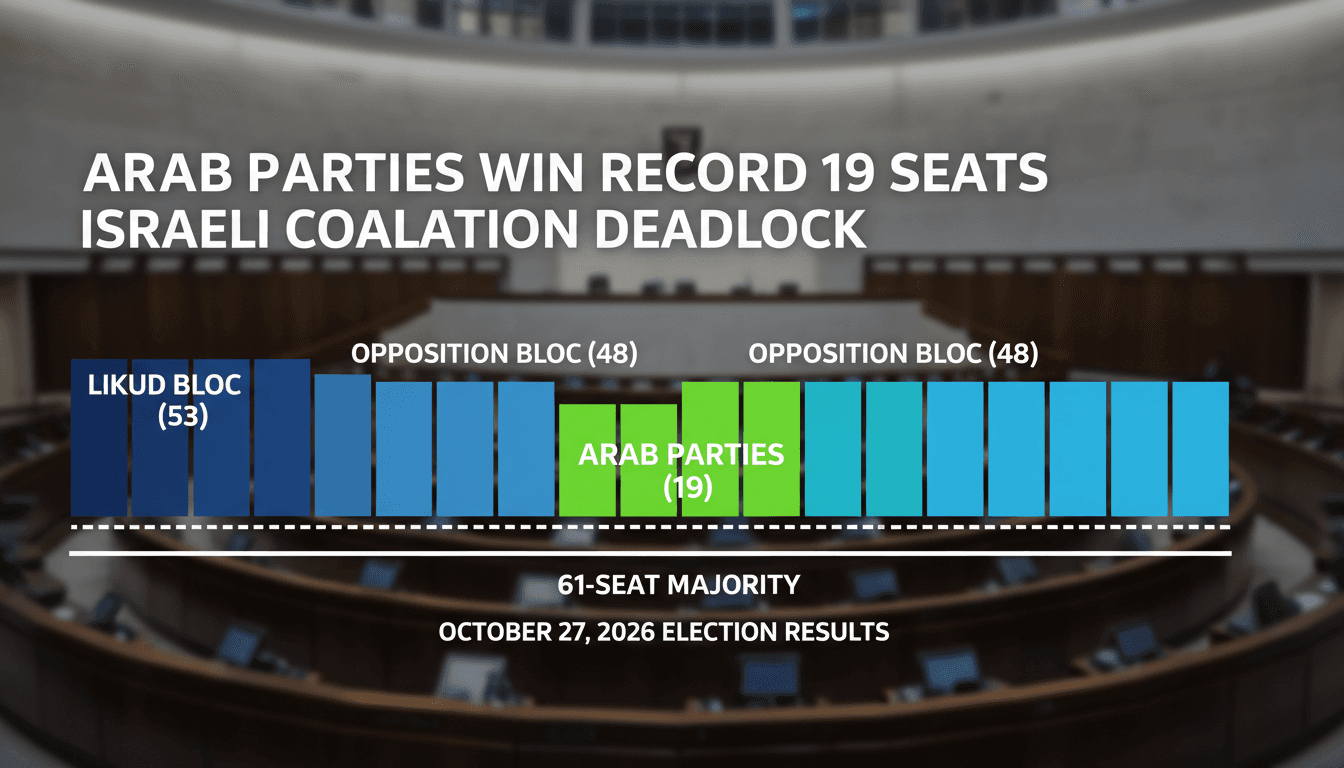
- A split result leaves no clear majority, with Benjamin Netanyahu's right-wing bloc securing 53 seats and Gadi Eisenkot's opposition bloc taking 48 seats following the October 27, 2026 vote.
- Arab factions captured 19 seats, surpassing their prior record of 15 seats in 2020, divided between the Joint List under Yousef Jabareen with 11 seats and Ra'am under Mansour Abbas with 8 seats.
- Coalition talks face an institutional impasse, as theoretical 67-seat anti-Netanyahu majorities depend on cross-bloc cooperation that key opposition figures resist under conditional security and civic terms.
The context you actually need
- Voter participation surged between 77.9% and 80% among Arab communities, translating localized grievances regarding municipal security, housing demolitions, and municipal funding into direct parliamentary leverage.
- A proportional representation system allocates all 120 Knesset seats based on national vote share, meaning marginal shifts in voter turnout heavily dictate leverage during post-election bargaining.
- Historical precedent exists for formal cooperation, following the short-lived 2021 Bennett-Lapid governing administration, which incorporated Ra'am as the first Arab faction inside an active governing cabinet.
What's really happening
The post-election arithmetic creates a structural paradox inside the 120-seat Knesset. Neither traditional governing alignment can cross the threshold of 61 seats independently. Benjamin Netanyahu's 53-seat coalition lacks eight seats to form an executive branch. Gadi Eisenkot's 48-seat bloc requires 13 seats. Mathematically, the 19 seats held jointly by the Joint List and Ra'am represent the sole numerical path to an operational majority for the opposition, yielding a potential 67-seat anti-Netanyahu coalition.
However, institutional incentives prevent automatic execution. The opposition operates under competing domestic imperatives. Aligning with Arab factions offers an immediate path to secure the Knesset speakership and direct state policy. Yet doing so exposes figures such as Naftali Bennett and Avigdor Lieberman to substantial political liabilities among right-leaning constituents. These leaders have demanded preconditions from prospective Arab partners, including formal recognition of state civic structures and specific commitments regarding military integration. Conversely, other opposition figures such as Yair Golan advocate pragmatic cooperation to bypass the bottleneck.
For Arab party leadership, the incentives balance national policy goals against domestic accountability. Mansour Abbas's Ra'am operates on a transactional civic model, pursuing pragmatic concessions on municipal safety funding, residential planning approvals, and civic infrastructure in exchange for votes. In contrast, Yousef Jabareen's Joint List focuses on fundamental legal reforms, equality mandates, and broader policy questions regarding territorial management. Both factions risk alienating an electorate mobilized by high turnout if their legislative leverage yields only cosmetic concessions.
Netanyahu's alignment faces an inverse tactical calculus. Having publicly dismissed coalition deals that depend on Arab factions, the incumbent leadership has raised allegations of administrative voting discrepancies to challenge the opposition's numerical path. With institutional consultations under President Isaac Herzog underway, the default trajectory points toward protracted negotiation cycles, high friction around parliamentary committee appointments, or eventual repeat elections, rather than rapid executive stabilization.
Who feels it first (and how)
- Sovereign debt and domestic capital allocators in Israel, who must price in continuous risk premiums as administrative decision-making and annual budget authorizations freeze.
- Arab municipal leadership, whose departmental funding, local housing permits, and municipal policing programs remain suspended in the absence of an operational cabinet.
- Regional diplomatic planners, who face delayed timelines on infrastructure treaties, bilateral regulatory standards, and broader economic corridors pending formal ministry appointments.
What to watch next
- The vote for Knesset Speaker, which will test whether the 48-seat opposition bloc and the 19-seat Arab factions can coordinate tactically to control the legislative agenda.
- President Isaac Herzog’s mandate designation, which signals which faction leader can realistically assemble the necessary 61 signatures during formal consultations.
- Sovereign bond yield spreads, which measure how global markets quantify the fiscal cost of prolonged electoral deadlock versus a compromise government.
Arab-led parties hold 19 seats in the 120-member legislature, leaving Netanyahu with 53 seats and Eisenkot with 48 seats.
The opposition will attempt targeted tactical alignment with Arab parties to capture parliamentary committees before committing to a full executive coalition.
Whether internal opposition divisions over defense commitments and national identity benchmarks will force a collapse into another election cycle.
Frequently Asked Questions
- Why it matters?
- The arithmetic of coalition formation now hinges on non-governing minority factions, creating an institutional bottleneck that prevents either traditional bloc from reaching the required 61-seat threshold.
- What happened (in 30 seconds)?
- A split result leaves no clear majority, with Benjamin Netanyahu's right-wing bloc securing 53 seats and Gadi Eisenkot's opposition bloc taking 48 seats following the October 27, 2026 vote. Arab factions captured 19 seats, surpassing their prior record of 15 seats in 2020, divided between the Joint List under Yousef Jabareen with 11 seats and Ra'am under Mansour Abbas with 8 seats. Coalition talks face an institutional impasse, as theoretical 67-seat anti-Netanyahu majorities depend on cross-blo
- What's really happening?
- The post-election arithmetic creates a structural paradox inside the 120-seat Knesset. Neither traditional governing alignment can cross the threshold of 61 seats independently. Benjamin Netanyahu's 53-seat coalition lacks eight seats to form an executive branch. Gadi Eisenkot's 48-seat bloc requires 13 seats. Mathematically, the 19 seats held jointly by the Joint List and Ra'am represent the sole numerical path to an operational majority for the opposition, yielding a potential 67-seat anti-Net
- Who feels it first (and how)?
- Sovereign debt and domestic capital allocators in Israel, who must price in continuous risk premiums as administrative decision-making and annual budget authorizations freeze. Arab municipal leadership, whose departmental funding, local housing permits, and municipal policing programs remain suspended in the absence of an operational cabinet. Regional diplomatic planners, who face delayed timelines on infrastructure treaties, bilateral regulatory standards, and broader economic corridors pending
- What to watch next?
- The vote for Knesset Speaker, which will test whether the 48-seat opposition bloc and the 19-seat Arab factions can coordinate tactically to control the legislative agenda. President Isaac Herzog’s mandate designation, which signals which faction leader can realistically assemble the necessary 61 signatures during formal consultations. Sovereign bond yield spreads, which measure how global markets quantify the fiscal cost of prolonged electoral deadlock versus a compromise government.
Arabic political reporting and analysis.
"Arabic Post is a digital outlet focused on politics and regional affairs."
— A47 Editor
كيف قلبت الأحزاب العربية حسابات تشكيل الحكومة الإسرائيلية؟
Israeli elections held on October 27, 2026 produced an unprecedented political equation, as Benjamin Netanyahu's camp lost its parliamentary majority without the opposition securing the seats needed to form an alternative government. Arab parties, wh...
Arabic-language coverage of political affairs and current events.
"Okaz political coverage typically follows mainstream Saudi framing on national and regional affairs."
— A47 Editor
19 مقعداً عربياً تربك حسابات تشكيل الحكومة الإسرائيلية
Israel's national election results have left the country in a new phase of political uncertainty, as neither Prime Minister Benjamin Netanyahu's bloc nor the opposition alliance led by Gadi Eisenkot secured the 61 seats needed for a parliamentary maj...
Arabic-language coverage of international news and geopolitics.
"RT Arabic is a Russian state-funded outlet often criticized for promoting Kremlin-aligned narratives."
— A47 Editor
انتخابات إسرائيل تفرز برلمانا معلقا
Israel's parliamentary election, held amid an ongoing war, has produced a hung Knesset in which neither Prime Minister Benjamin Netanyahu's bloc nor the Zionist opposition holds a majority capable of forming a government, according to RT Arabic repor...
Arabic-language coverage of political affairs and current events.
"Okaz political coverage typically follows mainstream Saudi framing on national and regional affairs."
— A47 Editor
بعد فرز 94% من الأصوات.. الكنيست الإسرائيلي بلا أغلبية لتشكيل الحكومة
Israel has entered a new phase of political uncertainty after Knesset elections failed to give either rival bloc a parliamentary majority. With 94% of votes counted and results unchanged, Netanyahu's bloc led with 53 seats in the 91% count, against 4...
Arabic-language coverage of political affairs and current events.
"Okaz political coverage typically follows mainstream Saudi framing on national and regional affairs."
— A47 Editor
19 مقعدًا للأحزاب العربية في انتخابات إسرائيل.. هل تتحد المعارضة لإسقاط نتنياهو؟
Israel has entered a new phase of political uncertainty after preliminary results of the parliamentary election, with about 91% of votes counted, showed Prime Minister Benjamin Netanyahu's bloc projected to win 53 seats against 48 for the opposition ...
Pan-Arab political news and analysis.
"Al-Quds Al-Arabi is a London-based Arabic newspaper known for political coverage."
— A47 Editor
ليبراسيون: فرص المعارضة الإسرائيلية في تشكيل الحكومة تتضاءل
Israeli media outlet Libération, as reported by Al-Quds Al-Arabi from Paris, noted that Prime Minister Benjamin Netanyahu and his allies made a slight gain in Israel's recent elections over the "Change Bloc" led by Gadi Eisenkot, the main coalition o...
Pan-Arab political news and analysis.
"Al-Quds Al-Arabi is a London-based Arabic newspaper known for political coverage."
— A47 Editor
انتخابات إسرائيل… نتنياهو 53 مقعدا والمعارضة 48 والعرب 19
Israel's election count, with 91 percent of votes sorted, shows Prime Minister Benjamin Netanyahu's bloc at 53 seats, the opposition Change bloc at 48, and the Arab parties at 19, leaving no side with a majority to form a government. Channel 12 repor...
Arabic-language coverage of political affairs and current events.
"Okaz political coverage typically follows mainstream Saudi framing on national and regional affairs."
— A47 Editor
الليكود يتهم الأحزاب العربية بـ«سرقة» الانتخابات والخلافات تتصعد.. من يشكل حكومة إسرائيل؟
Israel's parliamentary election has entered a decisive phase amid mutual accusations and a fierce struggle over forming the next government. Likud, led by Prime Minister Benjamin Netanyahu, accused Arab parties of "stealing" the election, alleging co...
Arabic-language coverage of political affairs and current events.
"Okaz political coverage typically follows mainstream Saudi framing on national and regional affairs."
— A47 Editor
تقارب النتائج يضع إسرائيل أمام مأزق سياسي
Israel's Knesset election produced no clear outcome, with preliminary counts after 84.5% of votes showing Netanyahu's bloc at 54 seats, the opposition led by Gadi Eisenkot at 49, and Arab-majority parties at 17 out of 120, leaving the 61-seat majorit...
Arabic-language reporting on global and regional news.
"BBC Arabic is part of the BBC, generally regarded for editorial standards and broad international coverage."
— A47 Editor
الانتخابات الإسرائيلية: ماذا لو لم يفز أي معسكر بأغلبية المقاعد؟
Israeli voters went to the polls in a tightly contested general election, with the bloc led by Prime Minister Benjamin Netanyahu facing off against an opposition bloc headed by former army chief Gadi Eisenkot. The base report, published by BBC Arabic...
Algerian and regional news coverage.
"Echorouk is a major Algerian outlet with broad national reporting."
— A47 Editor
نتائج أولية تربك حسابات نتنياهو.. لا أغلبية لأي معسكر
Preliminary partial results published by the Israeli Central Elections Committee on Wednesday morning showed Benjamin Netanyahu's coalition ahead of the opposition bloc after 50.1 percent of votes were counted, with no clear majority for either camp,...
Arabic-language reporting on global and regional news.
"BBC Arabic is part of the BBC, generally regarded for editorial standards and broad international coverage."
— A47 Editor
استطلاعات الرأي لا تحسم فائزاً واضحاً في الانتخابات العامة في إسرائيل والأحزاب العربية قد ترجّح الكفة
Polls ahead of Israel's general election show a very tight race between the camps led by Benjamin Netanyahu and Gadi Eisenkot, with neither side securing a parliamentary majority. Arab parties are recording significant gains amid record voter turnout...