
Democratic Congressional Majorities Face Structural Limits in Ending U.S.-Iran War
Heightened legislative friction in Washington introduces operational unpredictability for global supply chains and cross-border capital exposed to Gulf trade corridors.
Why it matters
Legislative power shifts can restrict discretionary funding and defense authorizations, but institutional veto thresholds make rapid exits from overseas military campaigns structurally complex.
What happened (in 30 seconds)
- Electoral realignment: Democratic candidates secured majorities in both the Senate and the House of Representatives during the November 2026 midterms, setting up institutional split-party rule on January 3, 2027.
- Legislative mandate: An estimated 71% of the U.S. public favors binding congressional action to halt active hostilities involving Iran, according to a November 2026 Reuters/Ipsos poll.
- Immediate budget requests: The White House has sought expanded defense appropriations, including a specific $67 billion allocation targeted at sustaining the military campaign initiated on February 28, 2026.
The context you actually need
- Operational background: The campaign, designated Operation Epic Fury, reached its eight-month mark in November 2026 after expanding into maritime enforcement corridors near the Strait of Hormuz.
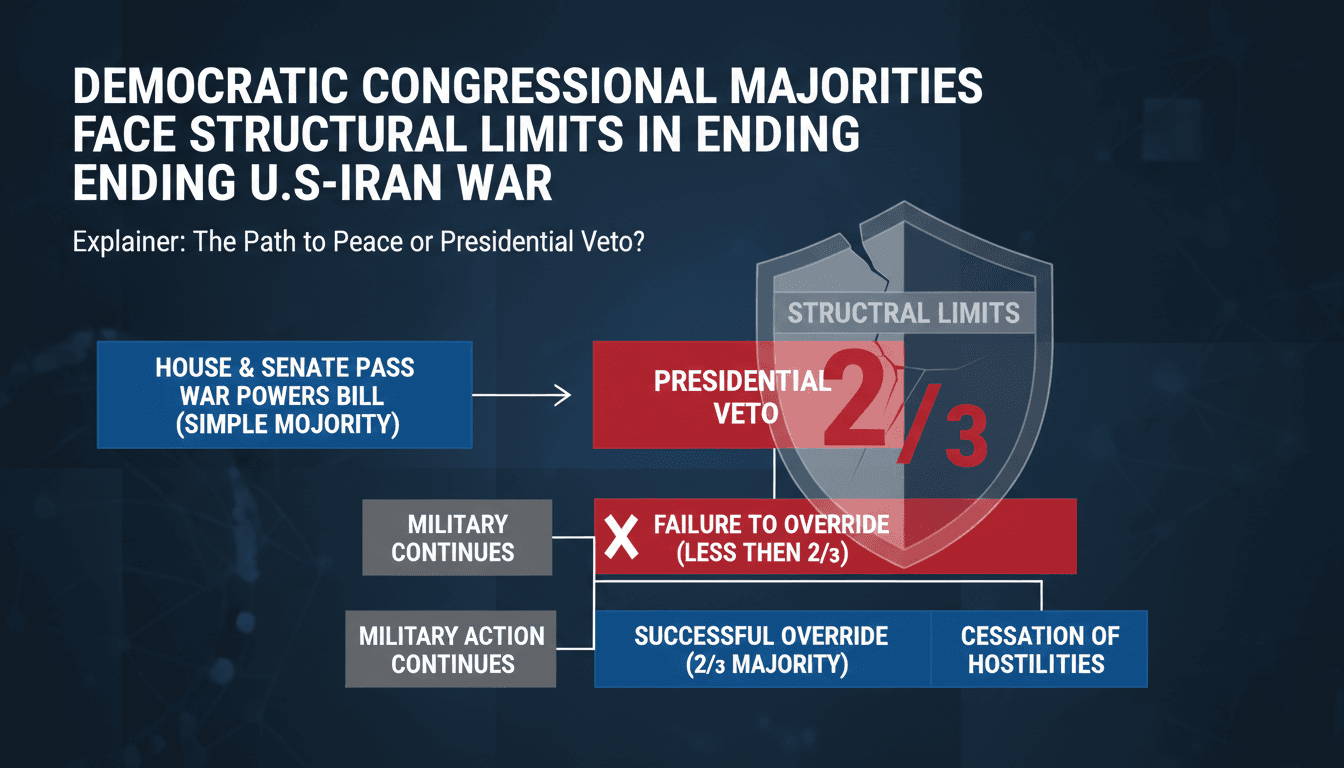
- Structural barriers: While Congress holds explicit constitutional power over federal spending and statutory war declarations, overriding a presidential veto requires a two-thirds majority in both chambers.
- Prior legislative limits: Earlier invocations of the War Powers Resolution failed to command the margins necessary to constrain executive deployment authorities or halt theater strikes.
What's really happening
The November 2026 midterms establish a structural confrontation between legislative fiscal controls and executive commander-in-chief powers. Under the U.S. constitutional framework, incoming congressional majorities possess the authority to deny discretionary defense requests, introduce restrictive language into future National Defense Authorization Acts, and subpoena executive branch leadership for oversight hearings. However, the legal mechanics of ending an ongoing armed deployment without executive concurrence remain constrained.
To turn policy intent into binding law, the 110th Congress must pass statutory prohibitions that can withstand executive review. If the executive issues a veto against a defense appropriations bill containing anti-hostility riders, lawmakers require a two-thirds supermajority in both chambers to override that veto. Although the Reuters/Ipsos survey registered broad anti-conflict sentiment—including 93% of Democrats and 51% of Republicans—legislative voting patterns routinely diverge from public polling when party discipline applies on national defense roll calls. Without substantial Republican support crossing party lines, standard majority rule cannot force an operational stand-down.
This dynamic creates an acute friction period between November 2026 and the formal seating of the new Congress on January 3, 2027. During this transition, executive authorities face an incentive to accelerate operational objectives before the legislative branch activates its oversight mechanisms. The administration's $67 billion supplemental spending request for the war will meet direct opposition once Democratic leadership assumes committee chairmanships.
Rather than achieving an immediate termination of theater operations, the likely operational mechanism will be fiscal attrition and regulatory scrutiny. By conditioning general defense procurement, freezing logistical tranches, and demanding accounting on operational outlays, the incoming majority can increase the political and institutional costs required to sustain high-tempo naval and aerial operations. For international operators, this institutional standoff guarantees ongoing policy uncertainty rather than an immediate resolution.
Who feels it first (and how)
- Commercial maritime operators: Shipping firms navigating the Strait of Hormuz face volatile hull insurance premiums and shifting maritime risk designations ahead of the January transition.
- Gulf trade and regional hubs: Dubai-based logistics and investment portfolios absorb indirect pricing shifts linked to regional tension and energy market variance.
- Defense procurement contractors: Corporate entities tied to Middle East theater allocations face potential disruptions as supplemental funding requests face legislative gridlock.
- Energy sector strategists: Commodity traders must price in both short-term escalation risks prior to January 3, 2027, and structural supply chain friction.
What to watch next
- The $67 billion defense supplemental: Tracking the specific line-item funding votes will signal whether the current Congress advances appropriations before the January 3, 2027, transition.
- Pre-transition theater actions: Monitoring operational tempo through December 2026 will indicate whether the administration seeks strategic leverage prior to split-party oversight.
- First 100 days committee calendars: Early hearing notices from House and Senate armed services panels will outline the exact scope of upcoming defense audit restrictions.
Democrats won majorities in both congressional chambers in November 2026, and the incoming legislature formally convenes on January 3, 2027.
The incoming majority will attach strict war-funding prohibitions to defense appropriations packages and initiate formal oversight inquiries.
Whether sufficient bipartisan support exists to assemble the two-thirds supermajority required to override expected presidential vetoes on war powers measures.
Frequently Asked Questions
- Why it matters?
- Legislative power shifts can restrict discretionary funding and defense authorizations, but institutional veto thresholds make rapid exits from overseas military campaigns structurally complex.
- What happened (in 30 seconds)?
- Electoral realignment: Democratic candidates secured majorities in both the Senate and the House of Representatives during the November 2026 midterms, setting up institutional split-party rule on January 3, 2027. Legislative mandate: An estimated 71% of the U.S. public favors binding congressional action to halt active hostilities involving Iran, according to a November 2026 Reuters/Ipsos poll. Immediate budget requests: The White House has sought expanded defense appropriations, including a spe
- What's really happening?
- The November 2026 midterms establish a structural confrontation between legislative fiscal controls and executive commander-in-chief powers. Under the U.S. constitutional framework, incoming congressional majorities possess the authority to deny discretionary defense requests, introduce restrictive language into future National Defense Authorization Acts, and subpoena executive branch leadership for oversight hearings. However, the legal mechanics of ending an ongoing armed deployment without ex
- Who feels it first (and how)?
- Commercial maritime operators: Shipping firms navigating the Strait of Hormuz face volatile hull insurance premiums and shifting maritime risk designations ahead of the January transition. Gulf trade and regional hubs: Dubai-based logistics and investment portfolios absorb indirect pricing shifts linked to regional tension and energy market variance. Defense procurement contractors: Corporate entities tied to Middle East theater allocations face potential disruptions as supplemental funding requ
- What to watch next?
- The $67 billion defense supplemental: Tracking the specific line-item funding votes will signal whether the current Congress advances appropriations before the January 3, 2027, transition. Pre-transition theater actions: Monitoring operational tempo through December 2026 will indicate whether the administration seeks strategic leverage prior to split-party oversight. First 100 days committee calendars: Early hearing notices from House and Senate armed services panels will outline the exact scope
Regional coverage and analysis focused on politics, diplomacy, and business across the Middle East.
"Al-Monitor is known for analytical reporting on Middle East politics and policy developments."
— A47 Editor
Explainer-Can a new US Congress mean an end to the Iran war?
Reuters reports that the American public has turned against the roughly eight-month-long war on Iran, with voters handing President Donald Trump's Republicans a resounding defeat in last week's congressional elections. Trump acknowledged that discont...
Global business headlines with AI angles.
"General business outlet that frequently covers AI."
— A47 Editor
Over 7 in 10 Americans Want Congress to End the Iran War. Half of Republicans Agree.
A new poll finds more than 7 in 10 Americans want Congress to end the Iran war, with half of Republicans in agreement, as President Donald Trump's approval stands at 32% and the incoming Congress faces demands for bipartisan cooperation rather than a...
Capitol Hill news, legislation, and policy insight.
"The Hill specializes in U.S. politics and policy, with a focus on Capitol Hill developments and a reputation for insider reporting."
— A47 Editor
The new Democratic Congress must work with Trump to win the Iran war
The Hill published an opinion piece arguing that the incoming Democratic-controlled Congress should work with President Donald Trump to end the Iran war, cautioning that Democrats should not replace Trump's hubris with their own and that how the host...