
Federal Judge Blocks Trump Second Birthright Citizenship Executive Order Expanding Prior Protections
Why it matters
The federal judiciary's continuous enforcement of the 14th Amendment prevents unilateral executive restructuring of domestic legal identity and immigration mechanisms.
What happened (in 30 seconds)
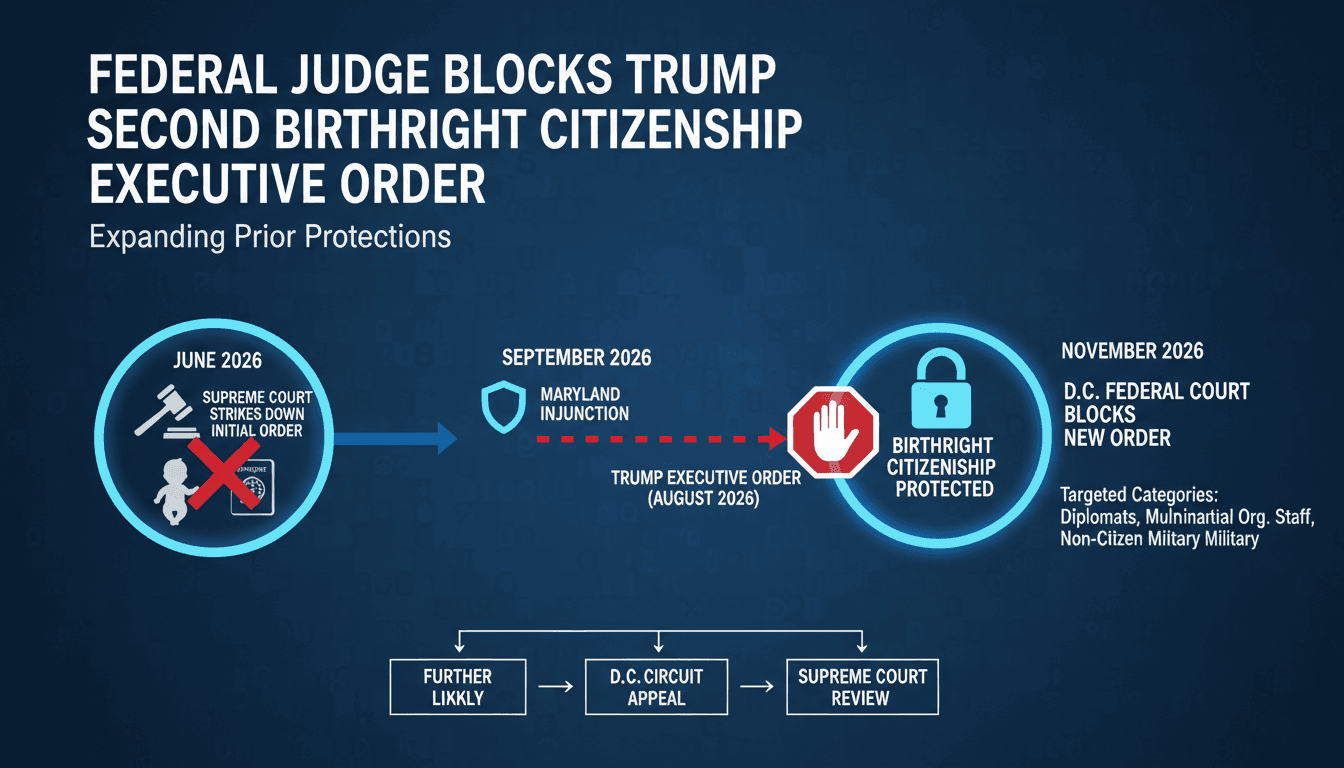
* A federal court issued a preliminary injunction on November 25, 2026, when U.S. District Judge Christopher Cooper halted President Donald Trump's August 2026 executive order restricting birthright citizenship. * The 67-page opinion expanded legal protections to include children born to foreign government staff, international organization personnel, suspected alien enemies, and children born via commercial surrogacy arrangements to foreign parents. * The ruling builds on clear judicial precedent, following a 6-3 Supreme Court decision in *Trump v. Barbara* on June 30, 2026, and a September 2026 injunction from a federal court in Maryland.
The context you actually need
* The administration attempted a phased executive strategy, starting with a January 2025 order directed at children of undocumented or temporarily present mothers, which was struck down by the Supreme Court in mid-2026. * A revised August 2026 order narrowed the targeted classifications, focusing on children of foreign diplomats beyond ambassadors, suspected gang members, alien enemies, and foreign parents utilizing commercial surrogacy. * District courts have systematically rejected these executive carve-outs, citing the foundational 1898 precedent *United States v. Wong Kim Ark* to affirm that territorial birth grants citizenship regardless of parental legal status.
What's really happening
The recurring cycle of executive orders and judicial injunctions illustrates a structural collision between executive immigration enforcement objectives and long-standing constitutional mechanics.
When the Supreme Court delivered its 6-3 decision in *Trump v. Barbara* on June 30, 2026, the bench reaffirmed a standard that has governed American law for more than a century: individuals born on U.S. soil fall under domestic jurisdiction by default. The historical exceptions to this rule remain narrow, strictly confined to the children of foreign heads of state, accredited diplomatic ministers, and hostile forces engaged in military occupation.
In response, the executive branch altered its regulatory model. Rather than attempting a broad restriction on all temporary visitors, the August 2026 order tested whether the executive could reinterpret the concept of being "subject to the jurisdiction" of the United States. By grouping commercial surrogacy arrangements, non-ambassador diplomatic staff, and suspected members of hostile entities into regulatory carve-outs, the administration sought to establish an administrative pathway to limit birthright status without requiring a constitutional amendment.
Judge Cooper's 67-page memorandum establishes that administrative reinterpretation cannot substitute for constitutional authority. In legal terms, the court rejected the notion that personal allegiance, political suspicion, or family origin invalidates sovereign territorial jurisdiction. A commercial surrogacy agreement arranged by international parents, for instance, operates fully within domestic contract and family law; participants remain subject to the regulatory and penal powers of the state. Consequently, their offspring meet the jurisdictional requirements established under the 14th Amendment.
This dynamic creates a defined institutional equilibrium. For executive policymakers, repeated administrative directives serve to assert policy priorities and construct legal records for appellate scrutiny. For the federal judiciary, issuing swift preliminary injunctions maintains institutional continuity and prevents fragmented legal statuses across jurisdictions. Until an appellate body or the Supreme Court explicitly modifies the parameters of *Wong Kim Ark*, the legal mechanism governing citizenship across all 50 states remains insulated from unilateral executive adjustments.
Who feels it first (and how)
* International organization and foreign diplomatic personnel: Mid-level envoys, consular employees, and multilateral representatives retain standardized legal protections for children born during their assignments in the United States. * The cross-border healthcare and fertility sector: Clinics, agencies, and legal practices handling commercial surrogacy arrangements avoid immediate regulatory disruptions to newborn legal identity. * Corporate legal and human resources departments: Global enterprises managing expatriate rotations retain regulatory certainty regarding the legal status of dependent family members born during domestic postings. * Executive agency administrators: U.S. immigration and vital statistics authorities remain bound to issue documentation under historic constitutional criteria rather than new executive classifications.
What to watch next
* Appellate review timing in the D.C. Circuit: The Department of Justice will file an appeal or request emergency relief, determining whether higher courts will maintain the preliminary injunction pending full merits litigation. * Supreme Court emergency docket activity: The administration's choice to seek temporary enforcement relief will show whether the high court intends to reconsider the 6-3 legal boundary established in *Trump v. Barbara*. * State vital statistics protocol consistency: State health departments and vital records offices will continue standard birth certificate processing under the baseline maintained by the federal injunction.
Judge Christopher Cooper's preliminary injunction prevents federal agencies from enforcing citizenship exclusions based on the August 2026 executive order.
The Department of Justice will challenge the ruling before the D.C. Circuit or petition the Supreme Court for emergency enforcement relief.
Whether future judicial proceedings will clarify specific jurisdictional boundaries regarding commercial surrogacy agreements involving entirely non-resident foreign nationals.
Frequently Asked Questions
- Why it matters?
- The federal judiciary's continuous enforcement of the 14th Amendment prevents unilateral executive restructuring of domestic legal identity and immigration mechanisms.
- What happened (in 30 seconds)?
- A federal court issued a preliminary injunction on November 25, 2026, when U.S. District Judge Christopher Cooper halted President Donald Trump's August 2026 executive order restricting birthright citizenship. The 67-page opinion expanded legal protections to include children born to foreign government staff, international organization personnel, suspected alien enemies, and children born via commercial surrogacy arrangements to foreign parents. The ruling builds on clear judicial precedent, fol
- What's really happening?
- The recurring cycle of executive orders and judicial injunctions illustrates a structural collision between executive immigration enforcement objectives and long-standing constitutional mechanics. When the Supreme Court delivered its 6-3 decision in *Trump v. Barbara* on June 30, 2026, the bench reaffirmed a standard that has governed American law for more than a century: individuals born on U.S. soil fall under domestic jurisdiction by default. The historical exceptions to this rule remain na
- Who feels it first (and how)?
- International organization and foreign diplomatic personnel: Mid-level envoys, consular employees, and multilateral representatives retain standardized legal protections for children born during their assignments in the United States. The cross-border healthcare and fertility sector: Clinics, agencies, and legal practices handling commercial surrogacy arrangements avoid immediate regulatory disruptions to newborn legal identity. Corporate legal and human resources departments: Global enterprises
- What to watch next?
- Appellate review timing in the D.C. Circuit: The Department of Justice will file an appeal or request emergency relief, determining whether higher courts will maintain the preliminary injunction pending full merits litigation. Supreme Court emergency docket activity: The administration's choice to seek temporary enforcement relief will show whether the high court intends to reconsider the 6-3 legal boundary established in *Trump v. Barbara*. State vital statistics protocol consistency: State hea
Conservative-leaning coverage of current events.
"Fox News is a highly influential conservative news outlet known for right-leaning political commentary and coverage."
— A47 Editor
Trump's birthright citizenship restrictions struck down again by DC federal judge he called 'hater'
A federal judge in the District of Columbia, Christopher Cooper, struck down President Donald Trump's second birthright citizenship order, ruling that it conflicts with the Fourteenth Amendment and rejecting its exclusions based on surrogacy arrangem...
Global business headlines with AI angles.
"General business outlet that frequently covers AI."
— A47 Editor
Trump Can't Decide Who Gets US Citizenship At Birth, Judge Rules. Second Attempt To Restrict Rights Blocked.
A federal judge has blocked the Trump administration's latest attempt to restrict who receives US citizenship at birth, marking a second injunction against such restrictions months after the US Supreme Court struck down the administration's original ...
Right-of-center views on political news.
"The Washington Times is a conservative-leaning newspaper known for its political coverage and advocacy of right-of-center viewpoints."
— A47 Editor
Another judge blocks Trump's second birthright citizenship order
A federal judge in Washington issued a preliminary injunction blocking the Trump administration from carrying out President Donald Trump's second attempt to limit birthright citizenship, according to The Washington Times.