
Iraq Federal Supreme Court Upholds Baghdad's Authority to Deploy Forces and Control Borders and Oil Assets in Kurdistan Region
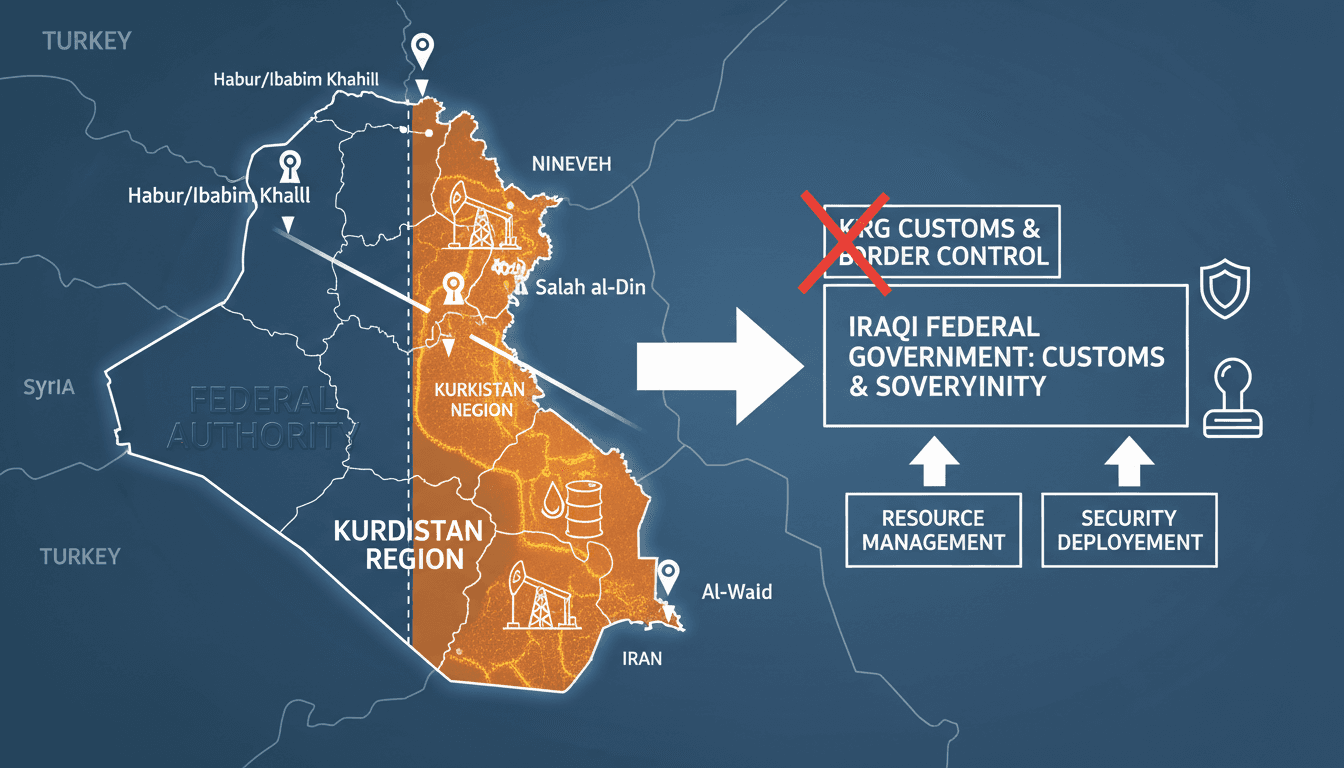
Why it matters
The judicial consolidation of border crossings and hydrocarbons reshapes the distribution of revenues in OPEC's second-largest producer, directly testing supply chain security in northern transit zones.
What happened (in 30 seconds)
- A binding judicial mandate: On November 25, 2026, Iraq’s Federal Supreme Court ruled that the central government possesses the legal power to deploy federal forces to secure all international borders, including those within the semi-autonomous Kurdistan region.
- Directives from the center: The decision reinforces executive instructions issued on November 24 by Prime Minister Ali al-Zaidi to take over Kurdish-run border crossings and assert authority over key oil operations in disputed territories.
- Regional resistance: The Kurdistan Regional Government (KRG) immediately rejected the decrees as unconstitutional, mobilizing political opposition and calling for dialogue while Baghdad stressed its intent to avoid military conflict.
The context you actually need
- A nine-year cycle of friction: Federal-regional relations have faced persistent friction over customs receipts, sovereignty, and independent oil sales following the 2017 independence referendum, which resulted in central territorial reclamation.
- The consolidation agenda: In office since approximately May 2026, Prime Minister Zaidi has systematically sought to establish centralized administration over strategic infrastructure, moving to curtail unauthorized smuggling and check regional security autonomy.
- The contested corridors: The executive orders focus on transit junctions abutting Turkey, Iran, and Syria, as well as extraction infrastructure in the historically disputed governorates of Kirkuk, Nineveh, Diyala, and Salahuddin.
What's really happening
The structural dispute between Baghdad and Erbil is an institutional reckoning over resource control and fiscal oversight. At its core, the issue centers on fiscal incentives: the central government seeks to halt non-transparent export flows and secure unified customs processing, while regional authorities depend on direct border and field administration to sustain their local budgets.
The enforcement push follows high-level investigations into systematic diversion schemes valued at hundreds of millions of dollars. For the central administration, securing external borders bordering Turkey, Iran, and Syria eliminates fragmented oversight that has allowed unmetered crude to bypass federal pipelines and standard clearinghouses. By asserting physical and regulatory jurisdiction over border points and upstream operations across Kirkuk, Nineveh, Diyala, and Salahuddin, the federal executive creates a mechanism to track hydrocarbon volumes from extraction to border clearance.
This intervention alters the functional governance of the Iraqi energy landscape. Rather than tolerating an arrangement where the regional authority handles localized sales and collections, the high court’s mandate legalizes federal deployments across previously autonomous territory. The legal finding grants the federal oil ministry and security organs primary responsibility for oil operations, while preserving an advisory or shared regulatory layer with regional counterparts.
For international operators, these structural adjustments introduce administrative friction. While Baghdad’s representatives have publicly signaled a preference for bureaucratic compliance rather than military confrontation, the dual-claim environment creates jurisdictional ambiguity. Contractual obligations and transport agreements arranged through regional ministries must now reconcile with federal compliance standards. If federal personnel physically manage the crossings and monitoring installations, third-party logistics firms and regional refiners must navigate uniform customs tariffs, federal clearances, and strict state auditing.
The economic model is straightforward: centralized control guarantees that sovereign export totals remain strictly aligned with federal quotas and treasury balance sheets. In contrast, it removes the fiscal flexibility that the regional government has relied upon for years. The challenge lies in enforcement: achieving institutional oversight without triggering operational interruptions requires both parties to negotiate the mechanics of daily customs clearances, pipeline metering, and revenue allocation.
Who feels it first (and how)
- Cross-border freight and logistics operators: Companies moving cargo through northern checkpoints with Turkey and Iran must prepare for revised customs procedures, dual-documentation demands, or operational delays as federal inspectors arrive.
- Regional energy exploration and drilling firms: Upstream producers operating in Kirkuk, Nineveh, Diyala, and Salahuddin will face federal administrative audits and contractual oversight from Baghdad's federal oil ministry.
- Commodity compliance and trade finance teams: Legal and financial professionals underwriting contracts linked to northern Iraqi crude flows must recalibrate risk assessments regarding legal title, customs compliance, and clearing channels.
- Local border-adjacent commercial sectors: Commercial transport businesses and wholesale markets in Erbil, Sulaymaniyah, and Duhok will see shifting supply dynamics if tariff collections and customs regulations align strictly with federal rates.
What to watch next
- The deployment mechanism at frontier crossings: Watch whether federal presence is established via physical units or mixed joint-civilian customs teams, which will signal whether administrative integration occurs cooperatively or through contested standoffs.
- KRG compliance frameworks and revenue dialogue: Monitor formal communiqués from Erbil detailing whether regional authorities initiate structured technical negotiations with Baghdad over shared customs duties and regional budget allocations.
- Federal oil ministry integration directives: Observe formal notices issued to international and local producers in disputed zones regarding pipeline metering, offload tracking, and legal export authorizations.
The Federal Supreme Court issued a binding ruling on November 25, 2026, granting Baghdad authority over all national borders; Prime Minister Zaidi ordered the takeover of regional border crossings and oil fields; the KRG rejected the directives.
Implementation will lean heavily on fiscal pressure, administrative audits, and anti-smuggling task forces rather than sudden, direct armed confrontations across primary Kurdish cities.
The exact operational timeline for federal personnel to assume physical control of border points, and whether joint revenue-sharing formulas will be established before transport disruptions occur.
Frequently Asked Questions
- Why it matters?
- The judicial consolidation of border crossings and hydrocarbons reshapes the distribution of revenues in OPEC's second-largest producer, directly testing supply chain security in northern transit zones.
- What happened (in 30 seconds)?
- A binding judicial mandate: On November 25, 2026, Iraq’s Federal Supreme Court ruled that the central government possesses the legal power to deploy federal forces to secure all international borders, including those within the semi-autonomous Kurdistan region. Directives from the center: The decision reinforces executive instructions issued on November 24 by Prime Minister Ali al-Zaidi to take over Kurdish-run border crossings and assert authority over key oil operations in disputed territories
- What's really happening?
- The structural dispute between Baghdad and Erbil is an institutional reckoning over resource control and fiscal oversight. At its core, the issue centers on fiscal incentives: the central government seeks to halt non-transparent export flows and secure unified customs processing, while regional authorities depend on direct border and field administration to sustain their local budgets. The enforcement push follows high-level investigations into systematic diversion schemes valued at hundreds of
- Who feels it first (and how)?
- Cross-border freight and logistics operators: Companies moving cargo through northern checkpoints with Turkey and Iran must prepare for revised customs procedures, dual-documentation demands, or operational delays as federal inspectors arrive. Regional energy exploration and drilling firms: Upstream producers operating in Kirkuk, Nineveh, Diyala, and Salahuddin will face federal administrative audits and contractual oversight from Baghdad's federal oil ministry. Commodity compliance and trade fi
- What to watch next?
- The deployment mechanism at frontier crossings: Watch whether federal presence is established via physical units or mixed joint-civilian customs teams, which will signal whether administrative integration occurs cooperatively or through contested standoffs. KRG compliance frameworks and revenue dialogue: Monitor formal communiqués from Erbil detailing whether regional authorities initiate structured technical negotiations with Baghdad over shared customs duties and regional budget allocations. F
Oil, metals, and agriculture: supply/demand headlines, OPEC chatter, inventories, and price action.
"Solid tape for energy and metals traders tracking macro and micro catalysts."
— A47 Editor
Iraq’s top court says Baghdad can deploy troops to secure borders in Kurdistan region
Iraq's top court has ruled that Baghdad is permitted to deploy troops to secure the country's borders within the Kurdistan region, according to a report published by Investing.com. The base article's summary is not provided, and the reporting centers...
Global news coverage with extensive reporting on Middle Eastern conflicts and geopolitics.
"Al Jazeera is a Qatar-based broadcaster known for wide regional coverage and alternative perspectives."
— A47 Editor
Iraq’s top court rules government can take over Kurdish borders, oil fields
Iraq's Federal Supreme Court has ruled that the federal government can take over Kurdish borders and oil fields, a decision that came a day after Kurdish authorities accused Baghdad of an 'assault' on the region's constitutional rights.
Comprehensive coverage of Middle Eastern and global issues.
"Al Jazeera is a prominent voice from the Global South, especially the Middle East, with an emphasis on underreported stories."
— A47 Editor
Iraq’s top court rules government can take over Kurdish borders, oil fields
Iraq's Federal Supreme Court has ruled that the federal government can take over Kurdish borders and oil fields, a decision that came a day after Kurdish authorities accused Baghdad of an 'assault' on the region's constitutional rights.
Arabic-language coverage of international news and geopolitics.
"RT Arabic is a Russian state-funded outlet often criticized for promoting Kremlin-aligned narratives."
— A47 Editor
المحكمة العليا بالعراق تجيز نشر قوات لتأمين الحدود في كردستان
Iraq's Supreme Court has ruled that Baghdad may deploy forces to secure the country's international borders, including those located in territory administered by the Kurdistan Region, according to Iraqi state television as reported by RT Arabic.
Regional coverage and analysis focused on politics, diplomacy, and business across the Middle East.
"Al-Monitor is known for analytical reporting on Middle East politics and policy developments."
— A47 Editor
Iraq's top court says Baghdad can deploy troops to secure borders in Kurdistan region
Iraq's highest court ruled on Wednesday that Baghdad can deploy federal forces along all international borders, including in the semi-autonomous Kurdistan region, backing Prime Minister Ali al-Zaidi's push to assert more central control.