
Federal Judge Blocks FCC Early Review of ABC Licenses Citing Unconstitutional Retaliation for Protected Speech
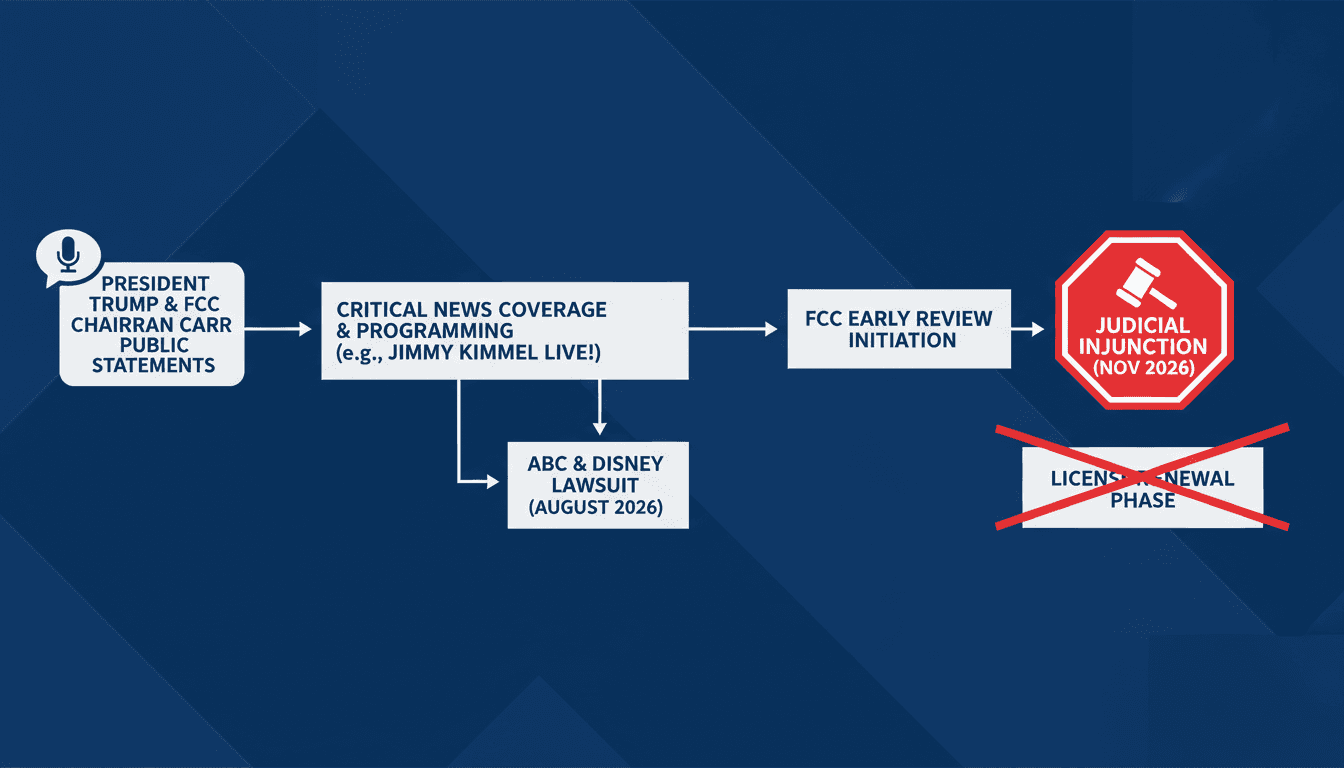
Regulatory friction against media assets introduces legal overhead and editorial compliance costs for enterprise communications, regardless of where your firm operates.
Why it matters
The judicial boundary drawn between agency administrative reviews and protected commercial speech resets the operational risk profile for state-regulated communications infrastructure.
What happened (in 30 seconds)
- A federal injunction halted an administrative license review: U.S. District Judge Loren L. AliKhan blocked the Federal Communications Commission from proceeding with an early renewal review targeting eight ABC-owned television stations, including KABC-TV in Los Angeles.
- The court identified retaliatory timing: In a 45-page ruling on November 25, 2026, the court determined that ABC, owned by Walt Disney Co., demonstrated a strong likelihood of success on its First Amendment retaliation claim following repeated public demands from the executive branch to revoke network licenses.
- Collateral inquiries remain active: While the order bars the regulatory agency from using license reviews as an enforcement mechanism against editorial output, a parallel investigation into corporate workplace anti-discrimination policies was permitted to continue.
The context you actually need
- A pattern of specific public demands: Documented court evidence recorded 11 instances where public calls were made for the regulatory commission to pull ABC's transmission permits over political commentary, news reporting, and programs such as *Jimmy Kimmel Live!* and *The View*.
- An accelerated review timeline: Following leadership transitions at the agency, the regulator initiated an off-cycle examination into eight ABC-owned stations in April 2026, citing workplace and diversity frameworks rather than standard technical operating criteria.
- Documented behavioral shifts within the broadcaster: ABC's August 2026 court filings showed that regulatory scrutiny prompted immediate operational adjustments, including altered guest bookings and rescheduling political programming segments to manage licensing exposure.
What's really happening
The mechanics of broadcast regulation rely on the public interest standard, a statutory framework that grants federal regulators discretion over electromagnetic spectrum allocations. Because broadcast television stations must renew their operating licenses on cyclical terms, the threat of an irregular, off-cycle administrative review creates balance-sheet uncertainty. For a media conglomerate like Walt Disney Co., station groups such as KABC-TV represent core distribution nodes. Disrupting these permits does not merely interrupt daily broadcasts; it creates operational friction across syndication deals, advertiser guarantees, and legal compliance reserves.
In this proceeding, the regulatory agency attempted to separate its mandate by opening an inquiry framed around corporate workplace equity metrics. However, Judge AliKhan’s 45-page determination anchored its analysis to operational causality. The ruling found that the administrative commission’s decision to launch the license audit directly tracked executive criticisms directed at ABC's entertainment and opinion programming. When administrative steps mirror political grievances, regulatory bodies face heightened judicial scrutiny under First Amendment protections.
The structural takeaway centers on regulatory deterrence. The court highlighted that the prospect of license revocation carries a disproportionate penalty relative to standard administrative fines. Even without a formal license cancellation, initiating early reviews generated verifiable operational adaptations. Broadcasters altered guest rosters and repositioned content to avert regulatory friction. By stepping in with a preliminary injunction, the district court checked the agency's ability to use licensing delays as leverage against editorial decisions, with sitting Commissioner Anna M. Gomez characterizing the enforcement posture as fundamentally constrained by constitutional thresholds.
At the same time, the legal mechanism remains narrow. The court declined to halt the parallel administrative inquiry into internal workplace policies, creating a dual-track precedent. Regulators retain administrative authority over standard employment compliance audits, but they are barred from tying those inquiries to station authorization renewals when clear timelines link the agency action to protected commercial speech.
Who feels it first (and how)
- Broadcast compliance and legal officers: Must document editorial decision-making processes to build clear evidentiary lines between programming changes and standard commercial guidelines.
- Enterprise advertisers and media buyers: Face temporary stabilization in linear broadcast inventory pricing now that the immediate threat of operational suspension for major network stations has paused.
- Agency regulatory leadership: Experiences immediate judicial limits on utilizing spectrum management oversight as a lever for non-technical, corporate policy investigations.
What to watch next
- Appellate filings on agency jurisdiction: Whether the federal government seeks an expedited appeal before the D.C. Circuit to contest the scope of the preliminary injunction, which will signal the administration's long-term regulatory posture.
- Progress of the secondary policy investigation: How the agency structures its separate inquiry into corporate workplace metrics, showing whether administrative audits can proceed without leveraging broadcast authorizations.
- Network programming adjustments: Whether ABC and other major networks revert defensive programming changes, demonstrating how quickly content distribution normalizes once judicial relief is secured.
The U.S. District Court for the District of Columbia issued a preliminary injunction halting the regulatory review of ABC's eight station licenses, citing First Amendment violations while leaving a separate administrative inquiry operational.
Broadcast networks with pending license renewals will cite this 45-page ruling as a defensive shield against administrative inquiries that depart from standard regulatory calendars.
Whether the judicial standard established in this injunction will withstand full-merits litigation or alter how regulatory agencies frame non-spectrum compliance investigations in the future.
Frequently Asked Questions
- Why it matters?
- The judicial boundary drawn between agency administrative reviews and protected commercial speech resets the operational risk profile for state-regulated communications infrastructure.
- What happened (in 30 seconds)?
- A federal injunction halted an administrative license review: U.S. District Judge Loren L. AliKhan blocked the Federal Communications Commission from proceeding with an early renewal review targeting eight ABC-owned television stations, including KABC-TV in Los Angeles. The court identified retaliatory timing: In a 45-page ruling on November 25, 2026, the court determined that ABC, owned by Walt Disney Co., demonstrated a strong likelihood of success on its First Amendment retaliation claim foll
- What's really happening?
- The mechanics of broadcast regulation rely on the public interest standard, a statutory framework that grants federal regulators discretion over electromagnetic spectrum allocations. Because broadcast television stations must renew their operating licenses on cyclical terms, the threat of an irregular, off-cycle administrative review creates balance-sheet uncertainty. For a media conglomerate like Walt Disney Co., station groups such as KABC-TV represent core distribution nodes. Disrupting these
- Who feels it first (and how)?
- Broadcast compliance and legal officers: Must document editorial decision-making processes to build clear evidentiary lines between programming changes and standard commercial guidelines. Enterprise advertisers and media buyers: Face temporary stabilization in linear broadcast inventory pricing now that the immediate threat of operational suspension for major network stations has paused. Agency regulatory leadership: Experiences immediate judicial limits on utilizing spectrum management oversigh
- What to watch next?
- Appellate filings on agency jurisdiction: Whether the federal government seeks an expedited appeal before the D.C. Circuit to contest the scope of the preliminary injunction, which will signal the administration's long-term regulatory posture. Progress of the secondary policy investigation: How the agency structures its separate inquiry into corporate workplace metrics, showing whether administrative audits can proceed without leveraging broadcast authorizations. Network programming adjustments:
Hollywood business, film/TV deals, awards, and industry analysis.
"Variety is a leading entertainment trade publication covering Hollywood, film, TV, and media business."
— A47 Editor
Judge Blocks FCC’s Move Against ABC’s Station Licenses: ‘This Is Not a Close Case’
A federal judge on Wednesday blocked the Federal Communications Commission from seeking early license renewals from ABC-owned stations, finding that the network has faced a "campaign of retaliation" for its protected speech. The FCC had ordered Disne...
Hollywood, film, television, and awards coverage.
"The Los Angeles Times is a major West Coast newspaper offering in-depth reporting with a liberal editorial tone and strong regional focus."
— A47 Editor
Trump, FCC illegally sought to punish ABC in free speech case, judge rules
A U.S. District Judge, Loren L. AliKhan, granted ABC's request for a preliminary injunction, blocking any further action by the Federal Communications Commission (FCC) amid its high-stakes review of ABC's broadcast licenses. The ruling found the Trum...
Breaking entertainment industry news, casting, and box office.
"Deadline delivers fast, authoritative entertainment industry coverage."
— A47 Editor
Judge Sides With ABC In First Amendment Lawsuit Against FCC, Puts Halt On Early License Renewal Proceeding
A federal judge, Loren AliKhan, largely sided with ABC in its First Amendment lawsuit against the Federal Communications Commission, issuing a preliminary injunction that halts the FCC's early license renewal proceeding for ABC's broadcast licenses. ...